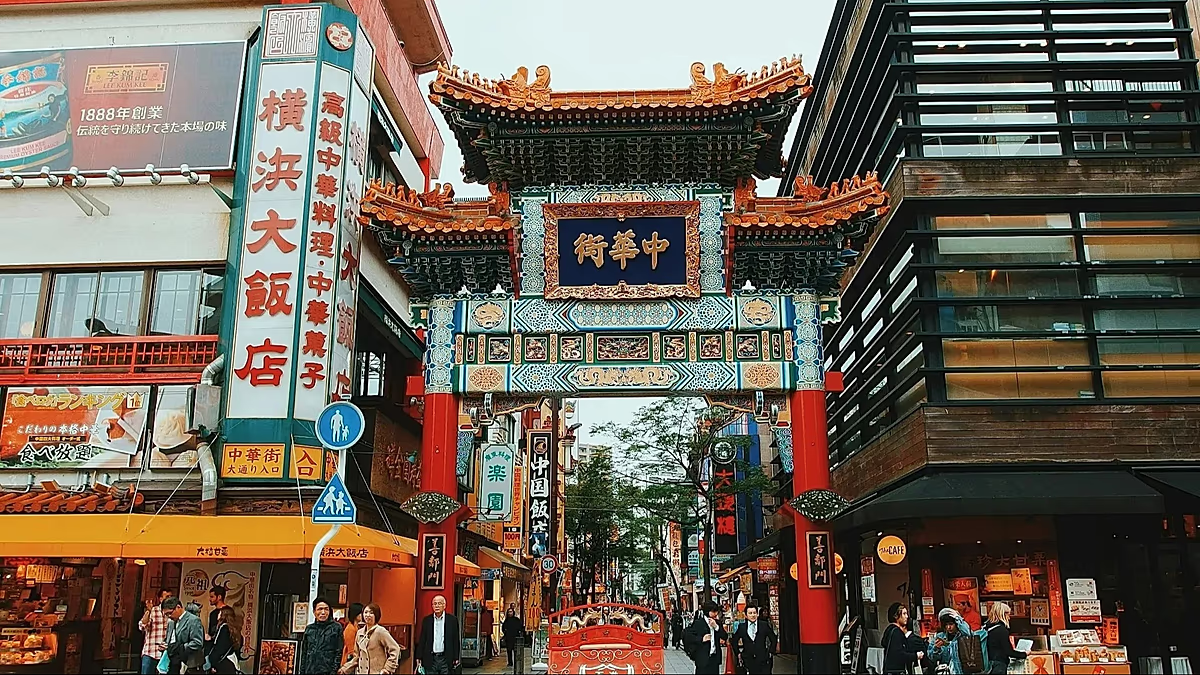







Europe’s enduring magnetism as the world’s most visited continent is both a triumph and a challenge, a double-edged sword that demands careful handling. As millions of travellers flock to its historic cities, sun-drenched coasts, and cultural landmarks, the question of how to manage these flows sustainably has never been more urgent. Speaking at the Euronews Travel & Tourism Summit in Brussels, Eduardo Santander, CEO and Executive Director of the European Travel Commission (ETC), offered a strikingly candid metaphor: Europe, he said, is in danger of becoming “a museum or attraction park” for the globe’s wanderers. Yet rather than lamenting this fate, he embraced it with pragmatism. There is “nothing wrong” with being an attraction park, he argued, so long as it is “well organised” and “well managed.” His words cut to the heart of a tension many destinations feel: the very qualities that make Europe irresistible to tourists—its density of history, culture, and natural beauty—are also what make it vulnerable to being loved to death. The challenge, then, is not to reject tourism but to harness it intelligently, ensuring that the crowds who come to marvel do not inadvertently trample the very things they came to see, nor strain the communities that call these places home. The summit’s focus on local communities and climate change signals a broader reckoning: tourism can no longer be an industry that simply happens to people; it must be designed with them, for them, and with an eye to a warming world that is already altering the patterns of travel itself.
The economic weight of tourism in Europe is staggering, and Santander was quick to underscore its centrality. According to the latest World Economic Forum’s Travel & Tourism Development Index, European countries claimed seven of the top ten spots globally, with Spain ranking third—a testament to the continent’s competitive edge. But these numbers translate into real livelihoods and fiscal heft. Tourism accounts for roughly 10% of Europe’s economy, a figure that rises to 15% or even 20% in some individual markets. Santander, speaking from his native Spain, noted that tourism there represents 10% of GDP, making it “instrumental” to national prosperity. Yet this dependence comes with a caveat: despite its economic significance, tourism infrastructure—accommodation, transport, and the connective tissue that moves people seamlessly from airport to attraction—often lags behind other industrial sectors in investment. Santander argued that this is a critical oversight. As Europe looks to bolster productivity in industries like chemicals and automotive, it must also treat tourism as deserving of equally serious capital and strategic thought. After all, a thriving tourism sector is not a luxury; it is a pillar of European competitiveness. But investment alone is not enough. It must be channelled into solutions that address the sector’s vulnerabilities, from overcrowded airports to overtaxed ground transport and bottlenecked attractions, ensuring that the infrastructure can withstand not just peak-season surges but also the shocks of a changing climate. In this sense, tourism is not merely an economic engine but a test of Europe’s ability to plan for the long term, balancing growth with resilience and the well-being of its residents.
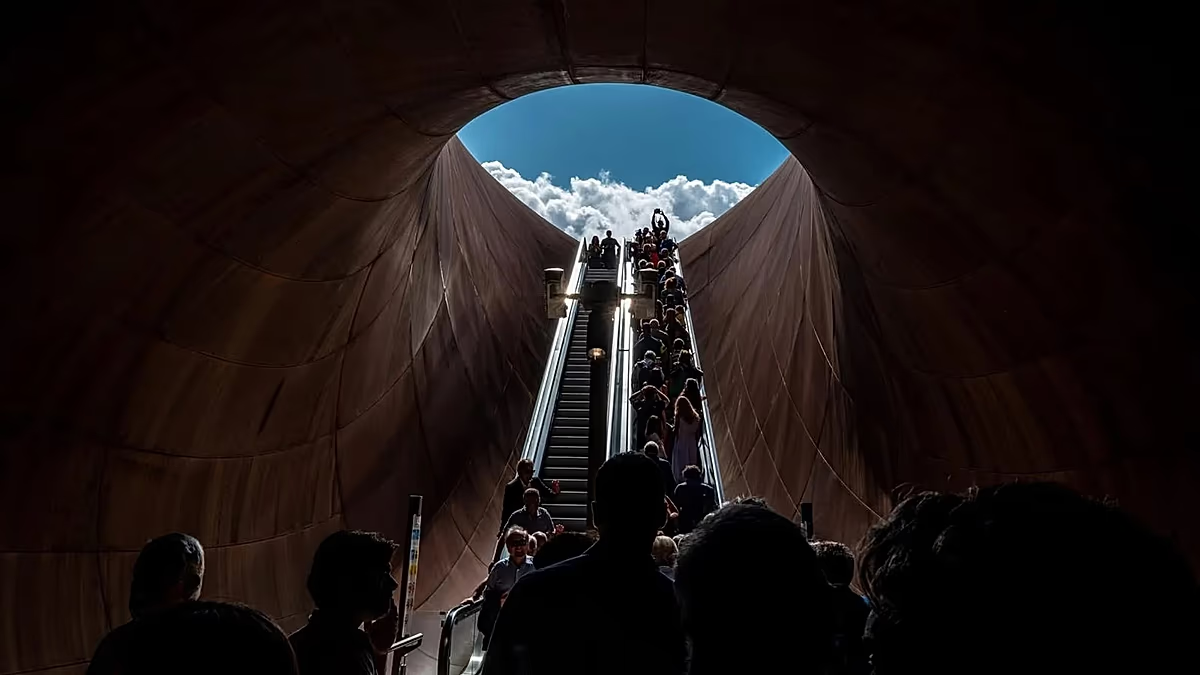
Santander’s most nuanced insight, however, was his reframing of overtourism itself. In popular discourse, the term conjures images of swarming plazas, selfie-stick-wielding hordes, and resentful locals. But Santander suggested that the real problem is not tourism per se, but congestion—a distinction that matters for how solutions are designed. Congestion, he noted, manifests in myriad ways: queues at airport security, gridlocked ground transportation, and overcrowding at Europe’s most iconic sites. These bottlenecks are not merely inconveniences; they degrade the visitor experience, strain local infrastructure, and can erode the goodwill of host communities. The issue, then, is one of flow and distribution. Some destinations are oversubscribed while others, equally worthy, remain undiscovered. Some seasons are overrun while others are tranquil. Santander’s framing implies that with better management, the very same visitor numbers could be absorbed more gracefully. This is not about closing doors but about opening them more thoughtfully—directing travellers to lesser-known gems, encouraging off-peak travel, and investing in smart mobility solutions that move people efficiently without overwhelming neighbourhoods. It is a vision of tourism that is less about saying “no” and more about saying “here is a better way.” By shifting the focus from the abstract threat of overtourism to the concrete, fixable problem of congestion, Santander offers a more hopeful and actionable path forward—one where the goal is not to reduce the number of visitors but to improve how they move, where they go, and how they interact with the places they visit.
Yet even as Europe grapples with the logistics of crowds, a more existential threat looms: climate change. Santander was unequivocal in his assessment, calling it “the biggest threat to tourism right now, by far.” His warnings are grounded in observable, often unsettling realities. Heat waves have expanded railway tracks, halting trains that millions rely on for summer travel. Droughts have lowered European rivers so dramatically that cruise lines—a cornerstone of river tourism—have been forced to cancel sailings. These are not abstract projections; they are happening now, and they are reshaping the very operations of the industry. For Santander, this means that resilience must become “one of the engines of European tourism.” The sector can no longer assume that the conditions of the past will hold. Infrastructure must be designed to endure extreme heat, water scarcity, and more volatile weather patterns. It means diversifying tourism products so that destinations are not solely reliant on a single season or a single mode of transport. And it means recognising that the industry’s long-term survival depends on its ability to adapt to a changing environment rather than merely reacting to it. This is a profound shift in mindset: from a tourism industry that exploits natural and cultural resources to one that stewards them, understanding that its own prosperity is inextricably linked to the health of the planet. The call for resilience is not just about surviving climate shocks but about building a system that can thrive despite them—one that is flexible, innovative, and prepared for whatever comes next.
The early signs of climate-driven change are already visible in travel behaviour, as Santander highlighted with the emergence of the “coolcations” trend. The summer of 2026 saw travellers increasingly shunning the traditional Mediterranean hotspots, where scorching heat waves have made afternoons on the beach less idyllic and more oppressive. Instead, they sought refuge in cooler climes—northern Europe, mountainous regions, and other destinations that offer a reprieve from the heat. This shift is not a blip; it is a harbinger of a broader transformation in global tourism. As the planet warms, the map of desirable destinations is being redrawn. Places that were once considered too cold or too rainy are becoming appealing, while those that were once synonymous with summer sun are being visited in spring or autumn, or abandoned altogether for more temperate alternatives. For destinations, this is both an opportunity and a challenge. Emerging coolcation spots must prepare for an influx of visitors, building the infrastructure and management strategies to handle demand without repeating the mistakes of their southern counterparts. Traditional Mediterranean destinations, meanwhile, must reinvent themselves, offering experiences that are not dependent on extreme heat—cultural attractions, indoor activities, night-time tourism—and investing in climate-proofing their facilities. Santander’s call for a “much more coordinated and comprehensive” approach underscores the need for cross-border planning. Climate change does not respect national boundaries, and neither should tourism strategy. A heatwave in Spain affects tourism in Scotland; a drought in France affects cruises in Germany. Only by working together—sharing data, best practices, and resources—can European tourism adapt to this new reality.
Ultimately, Santander’s vision is one of optimism tempered by realism. Europe’s role as the world’s favourite travel destination is not a problem to be solved but a responsibility to be managed. The continent can continue to be a “perfect place to be” for millions of visitors, but only if its tourism systems are rebuilt around resilience, investment, and a deep respect for local communities. This requires a fundamental shift in how we think about travel: not as a one-way extraction of experiences, but as a mutually beneficial exchange between visitor and host. It means investing in infrastructure that works for everyone, not just tourists. It means embracing technology and innovation to ease congestion and distribute visitors more evenly. And it means confronting climate change head-on, not only as a threat to tourism but as a threat to the very places and cultures that make travel meaningful. The road ahead is not easy. There will be trade-offs, difficult choices, and the need for political will. But the alternative—allowing tourism to wither under the weight of its own success and the pressures of a changing planet—is unthinkable for a region so deeply intertwined with travel. As Santander suggests, with careful management, Europe can remain a vibrant, welcoming, and sustainable destination for generations to come. The museum can stay open, the attraction park can flourish, but only if we learn to be not just visitors but custodians of the places we love. And that is a journey worth taking.