




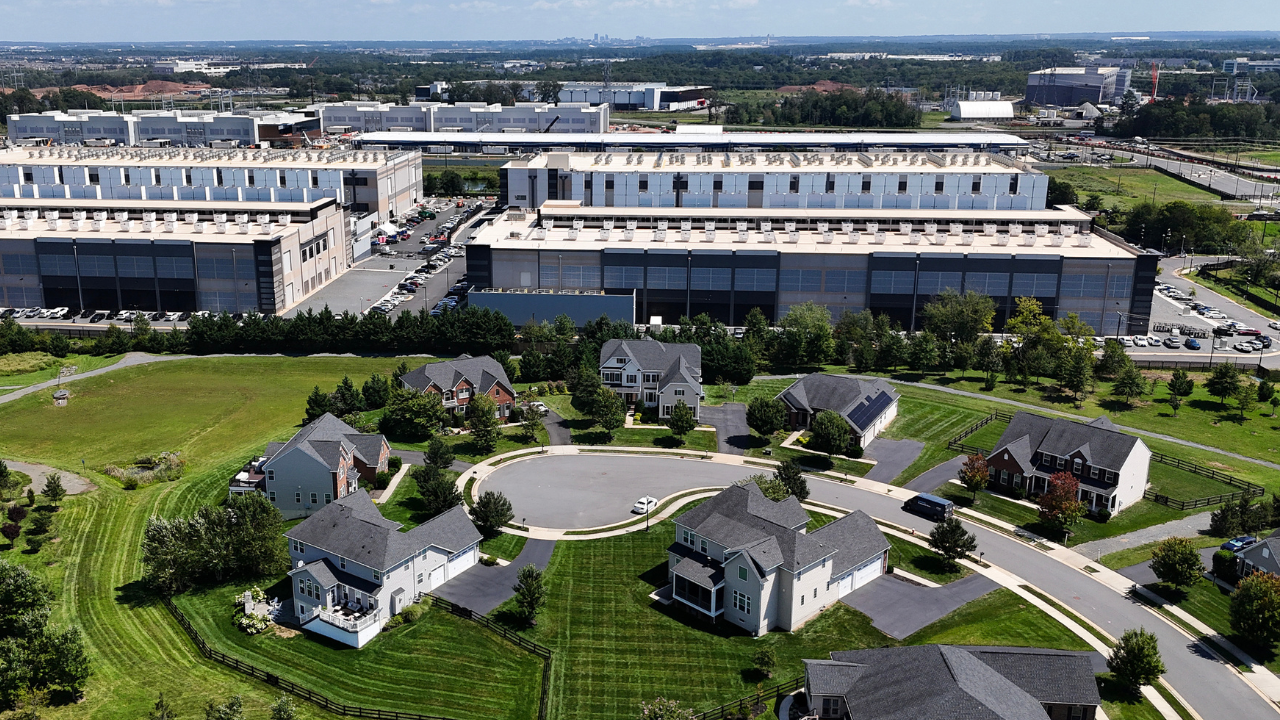
They came to Statesboro Place for what so many people look for in the Washington, D.C. suburbs: a quiet street, a spacious backyard, and a sense that the world’s chaos would stay at a comfortable distance. The cul-de-sac in Ashburn, Virginia, tucked inside Loudoun County, once felt like a small sanctuary. Then came the explosions, the heavy machinery, and the red dust that settled over everything like a stubborn reminder that the ground beneath them was being reshaped. Soon after, towering, windowless buildings rose beyond a thin line of trees, their blank facades blocking the horizon and stealing the open views that once defined the neighborhood. The construction noise eventually faded, but silence did not return. Instead, a steady mechanical hum settled over the homes, day and night, turning the soundtrack of suburban life into something industrial. For the families living on this quiet dead-end street, the future of American innovation has arrived with a very physical presence: data centers owned by Amazon Web Services and Microsoft, two of the largest cloud-computing companies in the world. The buildings sit roughly 150 feet from some backyards. “It’s like 150 feet away and just constant noise,” one resident said on a rainy September afternoon, looking out at the gray sky and the industrial structures beyond. “So far, they’ve planted some trees, thinking that would solve the issue.” The trees did not solve it. The resident spoke on condition of anonymity, as did others in the neighborhood, because they are still in negotiations with their homeowners’ association and county officials. They do not want to burn bridges, but they also cannot pretend the intrusion has been easy to accept.
The hum follows them everywhere. It does not stay politely behind the fence line; it drifts down walking trails, curls into backyards, and slips through the edges of conversations. One homeowner, who arrived nearly a decade ago, described watching the transformation unfold in stages: open fields, then dirt, then concrete, then buildings, and finally the relentless noise that now feels permanent. What bothers residents most is not just the sound itself, but the sense that their quality of life has been traded for a technological boom they did not ask for. “When I moved in, it was an open field. I had a nice backyard and there was not an ugly building to look at,” another resident recalled. That version of home is gone. In its place are featureless structures that hold servers, cooling systems, and the invisible machinery of artificial intelligence. Currently, two data centers are active behind the neighborhood, and two more are scheduled to come online next spring. The prospect of doubling the source of the noise has made people anxious. They worry that the hum will become a roar, that the trees will never get tall enough to block what is coming, and that their small street will become an afterthought in the larger race to build out America’s AI infrastructure. They are not anti-technology, they insist. They use cloud services, they shop online, they understand why data centers matter. But living next to the infrastructure of the future is different from celebrating it from afar. “Are we the guinea pigs?” one resident asked. “It feels that way.” The answers offered by the companies involved have done little to quiet the unease. A Microsoft spokesperson said the company is “actively meeting with nearby HOAs to address community priorities, including landscaping, lighting and noise, working to ensure that our development lives up to residents’ expectations.” Amazon, for its part, said it has “been part of Loudoun for 20 years” and that its local team has been working directly with residents and the HOA to address concerns. “We’re committed to building responsibly and being good neighbors,” the Amazon spokesperson said. But for the people who actually live on Statesboro Place, those assurances are hard to hear over the hum.
Loudoun County has become the epicenter of the data center boom, and the industry has reshaped the region’s economy as profoundly as it has reshaped its landscape. County officials report that more than 230 data centers have already been built or are under construction across the county, with another 116 projects in the pipeline. These facilities generated $1.2 billion in tax revenue in fiscal year 2026, a figure that accounts for 39 percent of the county’s budget. Officials project that number will rise to $1.3 billion in fiscal year 2027. On paper, this is a stunning success story. The tax dollars fund schools, roads, emergency services, and other public amenities. The promise is that data centers allow the county to keep tax rates low while still delivering robust services. But residents living closest to the infrastructure say the financial benefits are not showing up in their own bills. One homeowner shared six years of property tax records with Fox News Digital, and the numbers tell a different story from the one county boosters like to tell. The annual real estate tax bill rose from $17,391 in 2021 to about $22,250 in 2026—an increase of nearly $5,000 in just five years. “In our experience, our taxes have not gone down,” the homeowner said. “We also own multiple properties and vehicles in Loudoun County and we have not experienced a reduction in our real estate or personal property tax burden.” The math is familiar to anyone who has watched property values climb: even when tax rates stay flat or fall, assessed values can rise fast enough to push bills higher. For residents on Statesboro Place, the data centers have not only ruined the view and the quiet; they have helped inflate their property values while also making their homes less livable. That contradiction is hard to swallow. County officials may tout the billions in revenue, but the people shouldering the burden of the boom are seeing their costs go up, not down, and they are left wondering whether the trade-off is actually worth it.
The local political landscape has begun to shift in response to this tension. Little River District Supervisor Laura TeKrony has emerged as a vocal skeptic of the data center industry’s expansion into residential and rural areas. She told Fox News Digital that she has not voted for a single data center application since her term began in 2024. “There are some things that matter more than additional tax revenue: our land, our water, our quality of life, and our community character,” she said. Her stance reflects a broader backlash in some corners of the county against the relentless pace of development. For years, Loudoun welcomed data centers with open arms, viewing them as clean, quiet, and lucrative. But as more facilities have pushed up against neighborhoods, residents have begun to ask whether the county has been too generous with its land use decisions. TeKrony’s district includes areas where data centers have expanded into formerly residential and rural communities, and she says the county should focus future growth in industrial zones where the impact on homes is minimized. Some residents agree but doubt that will happen in time to help them. They recognize that the data centers already behind their homes are not going to be torn down. They are not demanding the impossible. Instead, they are asking for practical changes that might make the coexistence more bearable. They want sound barriers, not just bushes. They want ongoing noise monitoring, not occasional gestures. And they want tax relief for the homeowners who have absorbed the negative consequences of a countywide economic windfall. “Trees are not a solution,” one resident argued, pointing out that a thick wall like the ones built along major highways would do far more to block the constant drone than a few rows of young saplings. Another homeowner suggested that if the county keeps approving data centers next to homes, it should offer some compensation to those most affected. “If you ask me what the county can help us with, it’s reduce our property tax by at least 50%,” the resident said. It is a simple plea, but behind it lies a deeper question about fairness: Why should a handful of neighborhoods absorb the disruption that powers the entire country’s digital economy?
The companies and the county point to their outreach efforts and their commitments to being good neighbors, but residents say the process feels one-sided. The meetings, the HOA discussions, the promises about landscaping and lighting—these are small comforts in the face of a fundamental imbalance. The data centers provide jobs and tax revenue, advantages that spread across the county. The costs, by contrast, are intensely concentrated on the people who happen to live closest. For every resident on Statesboro Place, every new server rack installed in those windowless buildings means another bit of noise, another worry about the future, another reminder that their home has become a boundary zone between ordinary life and industrial ambition. They watch as county leaders tout the success of the data center economy, and they hear the national conversation about artificial intelligence as something exciting and inevitable. But from their backyards, the AI boom looks different. It looks like red dust on the windowsills. It sounds like a low-voltage hum that never quite goes away, even at midnight, even on Sundays. It feels like being a small footnote in a very large story that was written without their consent. The residents of Statesboro Place do not expect the march of progress to halt. They know the world needs data centers, just as it needs power lines and highways and airports. But they also believe that progress should not have to flatten everything in its path. They are asking for a simple thing: to be seen and heard, not just as obstacles or beneficiaries on a spreadsheet, but as people who have a right to quiet nights and open skies.
So while the rest of the country races to embrace the promise of artificial intelligence, the people on this tucked-away cul-de-sac are left to live with its heavily physical footprint. The data centers behind their homes are a monument to a global shift, a transformation that is reshaping economies, jobs, and everyday life. But monuments are easier to admire from a distance. Up close, they are just blocks of concrete and steel, humming with the anonymous work of storing the world’s information. The residents know, deep down, that this is only the beginning. More data centers are planned, not just in their neighborhood but throughout Loudoun County. The boom is not slowing down. And while politicians and executives celebrate the expansion, the families on Statesboro Place will continue to wake up to the hum, water their trees, and wonder when their concerns will be taken seriously. Their story is not an anti-tech story. It is a story about place and belonging, about the middle of a revolution that has no plan for the people who live at its edge. They are not asking to turn back time. They are asking for sound walls, for honest engagement, for tax policies that recognize their sacrifice. They are asking to be treated as citizens, not as collateral. And until that happens, the hum will keep playing, the trees will keep growing slowly, and the neighborhood will keep wondering if the price of the future is too high. The country may be busy dreaming of what artificial intelligence can do, but on Statesboro Place, the future is just a noise in the backyard.