






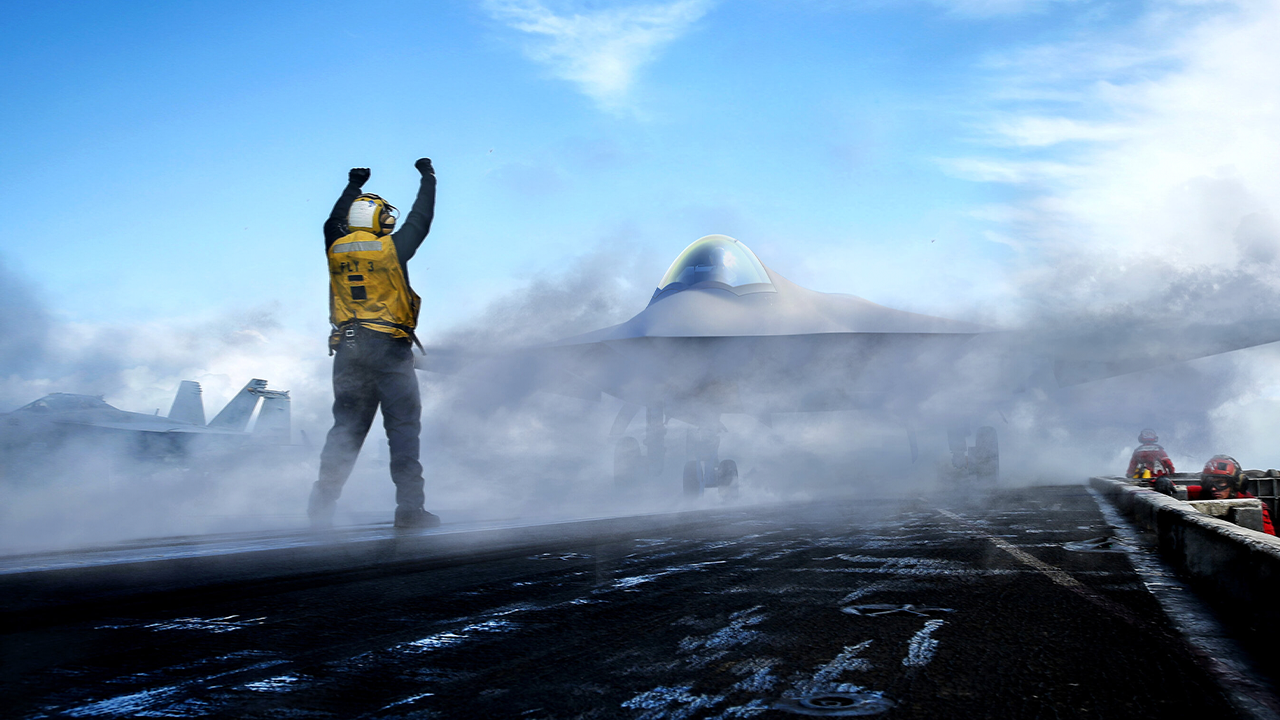
Late Tuesday, the Pentagon made a decision that will shape the future of naval aviation for generations: Boeing will build the U.S. Navy’s next sixth-generation fighter. The contract, valued at more than $20 billion, covers full-scale development of the F/A-XX, a carrier-based strike fighter designed to push America’s naval power further into contested waters and keep enemy forces guessing. In the plainest terms, this plane exists to ensure American pilots can take to the skies, face the most dangerous threats, and fly back to their ships alive. The announcement was framed as an urgent national priority, not just another defense procurement. Warfighters today operate in an era where air superiority cannot be assumed, and the F/A-XX is meant to restore that dominance. Officials described it as a “critical pillar” in maintaining peace through strength, and the language in the announcement was deliberately forceful. This is a fighter that is supposed to extend the reach of aircraft carriers, work side by side with drones, and outmatch anything an adversary can put in the air for the next several decades. The Navy expects it to eventually take over the missions currently flown by aging combat aircraft, including the F/A-18E/F Super Hornets and EA-18G Growlers, which have served with distinction but are approaching the limits of what their airframes and systems can offer against rapidly modernizing enemies. The F/A-XX, by contrast, is not just another upgrade; it is a generational leap.
For Boeing, this victory feels both well-earned and historically significant. It is the company’s second sixth-generation fighter program, coming after the Air Force selected Boeing for its own next-generation F-47 in 2025. That rare double win puts the defense giant at the center of America’s future combat air strategy. Steve Parker, president and CEO of Boeing Defense, Space & Security, made it clear that the company had planned for this moment. “Delivering two advanced fighters in parallel was always our plan, and we invested accordingly. We are ready and able to build multiple concurrent future combat aircraft franchise programs,” he said. In practical terms, that means Boeing has already been thinking about how to engineer, test, and manufacture two extremely complex aircraft at the same time—without treating either one as an afterthought. The Navy’s contract will fund more than just a concept. It includes multiple test aircraft for ground testing, airworthiness evaluations, and the delicate work of integrating advanced systems and weapons into a single, lethal package. There are still many details that remain classified, and the public will not see the full picture of the jet’s sensor suites, stealth capabilities, or combat logic. But the scale of the investment signals a long-term commitment. This is not a paper airplane or a mock-up; it is a serious effort to field a weapon that will dominate skies for decades, and Boeing is now responsible for delivering it.
The F/A-XX sits under the broader Next Generation Air Dominance program, which is much more than a single aircraft. It is a constellation of manned and unmanned systems that share data, communicate in real time, and fight as one interconnected force. The new fighter will be the centerpiece of that system-of-systems around carriers, but it will also enhance the drones that fly alongside it. In other words, the F/A-XX will be the quarterback, directing a team of uninhabited aircraft—sometimes called Collaborative Combat Aircraft—to scout ahead, jam enemy radar, launch strikes, or absorb threats that would be too dangerous for human pilots. This networked approach is a major shift from older fighters, which were essentially independent weapons platforms. The F/A-XX will turn a carrier air wing into a single, fused combat organism. Michael P. Duffey, under secretary of war for acquisition and sustainment, used strong language when he announced the decision. “The F/A-XX is a critical pillar in our commitment to maintaining peace through strength. F/A-XX will dominate contested airspace, extend operational reach, and deliver a decisive combat advantage for the warfighter,” he said. He went on to call it a “crucial, non-negotiable investment” in America’s national security and long-term air combat capabilities. The message was unmistakable: the Pentagon believes this fighter is essential to deterring aggression, projecting power across the world’s oceans, and guaranteeing that American forces never enter a fight at a disadvantage.
For Navy aviators, the F/A-XX means something more personal than budget figures and program acronyms. It means newer cockpits, better displays, longer range, and a better chance of returning to the boat after a difficult mission. Acting Navy Secretary Hung Cao called the contract the beginning of “a new era” for the service. “The Sixth-Generation fighter is a generational leap in air superiority and will provide the world’s best aviators with unparalleled capabilities to fight, win, and come home safe,” he said. That phrase—”come home safe”—is not a slogan. It is the core promise behind every engineering choice, every test flight, and every maintenance hour. The Navy plans for the F/A-XX to begin augmenting and eventually replacing the Super Hornets and Growlers in the 2030s, while also flying alongside the F-35C, the fifth-generation strike fighter already stationed on modern carriers. That overlap will give the Navy time to refine tactics, train pilots, and build a seamless transition between today’s aircraft and tomorrow’s. The anticipation is already building in the fleet. For years, pilots have been flying aircraft that were originally designed in the twentieth century and deeply upgraded ever since. The F/A-XX offers a blank canvas, built from the ground up to confront threats that did not exist even a decade ago. It is a vote of confidence in the men and women who will one day strap into this machine and push it to its limits.
Back on the ground, the announcement is also a major win for manufacturing and industrial policy. Boeing continues construction on a secure manufacturing facility in St. Louis, a city with a long and proud history of building fighter aircraft. Missouri Governor Mike Kehoe did not hide his excitement. “St. Louis is Fighterland, USA!” he wrote on X. “Proud of this incredible win that further cements Missouri as a critical leader in the future of America’s air dominance, innovation, and national defense.” The political and economic ripple effects are significant. Thousands of highly skilled workers, engineers, software developers, and suppliers will be tied to the program for decades. Parker emphasized that the investment goes beyond buildings. “Investment in facilities is just one part of the story; we’re also investing in technology and people so that we can deliver for our customers,” he said. In an era when many Americans worry about the erosion of the country’s manufacturing base, the F/A-XX is a tangible reminder that the United States can still design and build something extraordinary. The airplane itself may be secret, but the labor behind it is not. It will be assembled by American workers, tested by American pilots, and maintained by American sailors. The project is a statement that the industrial ingenuity that won past wars is still alive, and that the next generation of airpower will be born in American factories, not overseas.
Ultimately, the F/A-XX is more than an expensive machine with exotic materials and software code. It is a promise carried across oceans and into the unknown. The Navy wants pilots to dominate the skies, defeat enemies, and come home safely—the last part being just as important as the first two. But the promise only works if the entire chain holds together: the designers in St. Louis, the sailors on the flight deck, the maintainers who work overnight in cramped hangars, and the families waiting on shore. The jet is a symbol of national resolve, a way of saying that America will not allow any adversary to control the high seas or the air above them. It is also a reminder that peace, in the Pentagon’s view, is bought with strength. The F/A-XX is designed to be so capable that potential enemies think twice before testing it. If deterrence fails, it is meant to be overwhelming. The next few years will be full of tests, setbacks, breakthroughs, and milestones, and no one expects it to be easy. But the decision has been made, the money is committed, and the work is already underway. For the Navy, for Boeing, and for the men and women who will one day strap into this new fighter, the future has just become a little more certain. It is not simply a new airplane. It is the beginning of a new generation of naval aviation, built on the same old hopes that have always driven military pilots: to do their duty, to protect their country, and to come home safe.