





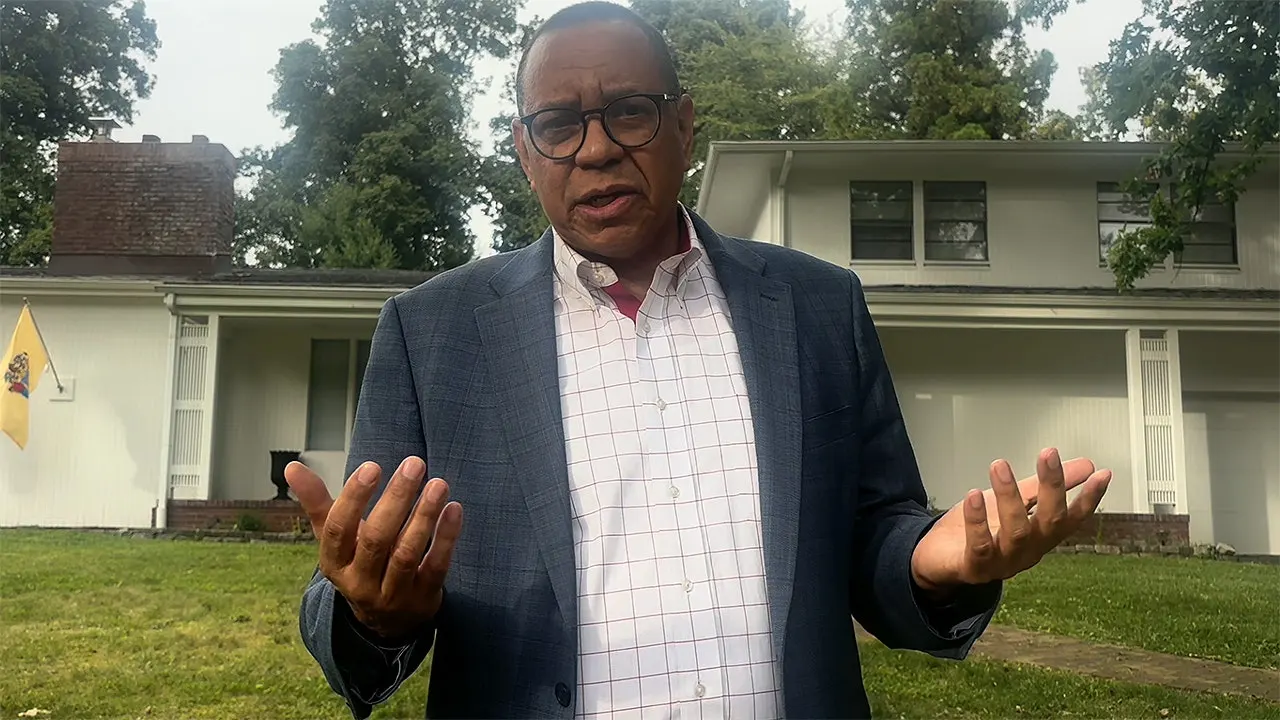
On a quiet Friday morning, with cameras waiting and the political world still absorbing the news of his abrupt departure, former New Jersey Lt. Gov. Dale Caldwell stepped outside his home and did something he had not done since the storm broke: he spoke. His resignation had been announced just one day earlier, after Democratic Gov. Mikie Sherrill publicly called for him to step down following a months-long independent ethics investigation. The report against him was 61 pages long and included a “substantiated” finding of sexual harassment. But Caldwell did not sound like a man accepting that verdict. He sounded like a man drawing a line. “I’m not resigning because of that ridiculous report,” he told a reporter. “I’m resigning because I don’t want to be a distraction to the Mikie Sherrill administration.” He insisted, in his first on-camera remarks since leaving office, that his decision was driven by a desire to make a difference, not to impede the governor or escape accountability. “If I’m going to impede anybody else’s ability to be successful, then I can move on to something else,” he explained, citing his past as a university president and his years at the Deloitte consulting firm. There was something almost philosophical about the way he framed it: public life involves sacrifice, and he was willing to step aside so the work of the people could continue. But the words hung in the air like a challenge, because they stood in direct tension with the findings that had cost him his job. For Caldwell, this was a moment to reclaim the story. For his critics, it was more proof of a pattern of deflecting accountability. And so the scene outside his home became a microcosm of a larger battle—the facts in a 61-page report, the politics of an administration, and one man’s insistence that the worst things said about him simply aren’t true.
The report at the center of the controversy is not a slim document. It is a detailed, 61-page investigation conducted by an independent law firm hired by the state, and its findings are hard to ignore. Investigators concluded that Caldwell had violated ethics rules multiple times, and they specifically substantiated a claim of sexual harassment. The allegation that drew the most attention involved a moment when Caldwell told a female staffer, “you young women are looking for young sperm.” The comment reportedly came after the staffer told him that a younger friend of hers was not interested in a romantic relationship with him. The words, as described in the report, were both sexual and demeaning, and investigators found that Caldwell’s denial that he ever said them was not credible. That credibility finding matters, because it suggests the investigators did not simply take the accuser’s word over his; rather, they weighed his denial and found it lacking. But the sexual harassment finding was not the only violation detailed in the report. Investigators also found that Caldwell had repeatedly violated ethics rules around official events, bringing guests to ticketed events without reimbursing the state, and that he had improperly sought a promotion for a state employee with whom he was romantically involved. Taken together, the findings paint a picture of a public official who treated the boundaries of workplace conduct as flexible, who mixed personal relationships with professional decisions, and who continued to do so despite ethics trainings and warnings. For anyone who has ever worked in a professional environment, these are not abstract legal concepts. They are the kinds of behaviors that create a toxic workplace, undermine morale, and breed resentment. The woman who reported the “young sperm” comment was not relying on a single offhand remark; she was speaking within a pattern that investigators found over months and across settings. And while Caldwell’s lawyer has strongly disputed the report, saying its conclusions go further than the evidence supports, the report itself is now public record. It will follow Caldwell into whatever chapter comes next, and it will also serve as a cautionary tale for other public officials—a reminder that the office carries responsibilities that extend beyond policy and budgets.
Caldwell’s response to the report was sharp and unsparing. Standing outside his home, he described the investigation as “specious,” “ridiculous,” and “poorly done.” He did not get into specifics on camera, instead encouraging people to read the report for themselves and saying that his attorney would provide detailed responses. But he made his disappointment clear, especially with the legal work that produced the findings. “I just think it was poorly done. It was poorly done. I mean, I just think that there are ways that they could have done better. And I was just disappointed in the legal, the legal work in that,” he said. The repetition of the phrase “poorly done” gave the impression of someone who had sat with the report, read it closely, and come away convinced that it was more about narrative than truth. He also revealed that he had exchanged text messages with Gov. Sherrill that morning, calling her “a wonderful person” and saying “she really means well.” It was a striking message to send alongside his criticism of the process. He seemed to be drawing a distinction between the governor, whom he likes and respects, and the investigation that the governor’s office commissioned. For Caldwell, the report may have been flawed, but the governor herself was still someone worth supporting. “This is one of those things that happens. And as I said, I’m going to continue to work as a private citizen,” he said. “I’m freed up to do a lot more things. So, I’m looking forward to supporting the administration and really supporting folks.” The image he was trying to project was one of graceful resignation, a man who had been dealt an unfair blow but was choosing to move forward with dignity and even enthusiasm. Whether that portrait holds up will depend on what his lawyer ultimately says and how the public reacts to the details in the report. But at least for that moment, Caldwell was offering a narrative that was much different from the one in the report: not a serial violator of ethics rules, but a dedicated public servant who was bowing out for the good of the team.
Gov. Mikie Sherrill, however, was in no mood to accept that narrative. Asked about Caldwell’s criticism of the investigation, Sherrill defended both the process and the findings. She said she thought the investigation was “very thorough,” and that it “lays out exactly what the investigation looked into, who they contacted and spoke to, and I think lays out a pattern and practice of long-term concerning behavior.” Her language was measured but firm. She did not attack Caldwell personally; she simply pointed to the document. The implication was unavoidable: the report speaks for itself. Sherrill also emphasized that the sexual harassment finding was “substantiated,” and she noted that Caldwell had continued to violate standards despite “multiple” violations and ethics trainings. That last detail is particularly important. It suggests that this was not a one-time lapse in judgment or a misunderstanding that spiraled out of control. According to Sherrill, Caldwell received trainings, was found to have violated rules, and yet kept doing so. That turns the report from a story about a single bad comment into a story about institutional breakdown and personal conduct over time. Caldwell’s lawyer, Thomas Calcagni, had pushed back on the findings Thursday, saying they “strongly disputed the three findings in the investigation” because the conclusions “go further than the evidence supports.” But Sherrill, in her response, seemed to anticipate exactly that kind of criticism. Of course a lawyer would defend his client, she might have been saying, but anyone who reads the report closely would see the depth of the evidence. The conflict between the governor and the former lieutenant governor is now as much about interpretation as it is about facts. One side sees a reasonable investigation that uncovered a pattern of abuse. The other side sees a rushed and sloppy process that overreached. What makes this difficult is that both sides cannot be right, yet both sides are speaking with confidence. In the court of public opinion, the report itself will likely carry the most weight. But the dispute is a reminder that ethics investigations are not always black and white. They involve credibility assessments, subjective judgments, and sometimes inconsistent recollections. And when the person accused is a high-ranking official, the political consequences ripple far beyond the individual.
The immediate political consequences are already underway in New Jersey. Caldwell was not just lieutenant governor; he was also serving as secretary of state, an office that oversees elections. That meant his resignation came at a particularly sensitive time, just weeks before the midterm elections. Sherrill announced Friday that the state’s acting comptroller, Shirley Emehelu, would become acting secretary of state. It was a practical move designed to keep the elections machinery running smoothly. But the vacancy at the top created a constitutional question that goes beyond the secretary of state’s office. Under the New Jersey State Constitution, a vacancy in the office of the lieutenant governor must be permanently filled by the governor within 45 days. Sherrill confirmed she intends to appoint a permanent successor within that window, but she also said she does not plan to name an acting lieutenant governor in the meantime. That means, for the next several weeks, the line of succession will be unusual. In the event of an emergency, or if Sherrill leaves the state before a permanent appointment is made, Senate President Nicholas Scutari would become the acting governor. It is the kind of detail that usually only political insiders care about, but it matters enormously in a moment when the government is already being tested by scandal. The resignation of a lieutenant governor is not routine. It creates uncertainty, complicates the administration’s agenda, and forces the governor to make another high-stakes appointment. For Sherrill, who has been in office only since January, this is an early test of her leadership. How she handles the search for a replacement, how she manages the relationship with Caldwell’s allies, and how she ensures the public trusts the process will all shape her political future. For Caldwell, the next 45 days will be a period of watching from the sidelines. He says he is looking forward to supporting the administration, but it is hard to support an administration that pushed you out. The coming months will reveal whether he can truly move on, or whether the report will continue to follow him in the form of diminished reputation, legal challenges, and personal reflection.
At its heart, this story is about more than one official’s resignation. It is about the ethics of power, the difficulty of accountability, and the human beings behind the headlines. The report against Caldwell describes behavior that, if true, was deeply inappropriate for anyone, especially for someone tasked with overseeing elections and serving as second-in-command of a state. The “young sperm” comment, in particular, is the kind of remark that reduces someone from a colleague to an object, and it is no wonder that investigators found it so troubling. But Caldwell is not an anonymous bureaucrat. He is a man with a career, a family, and a public record. His insistence that the report was poorly done and that he resigned to help the administration rather than to escape punishment is a human response to a humiliating situation. It is natural to want to protect one’s reputation, to frame events in the best possible light, and to believe that fairness is on your side. At the same time, the report is a reminder that institutions exist to hold people accountable even when they do not want to be held accountable. Ethics rules are not just paperwork; they are the standards that keep power from becoming abuse. When leaders say they are leaving “to avoid being a distraction,” it can be a graceful exit or a way of dodging responsibility. The truth often lies somewhere in between. In this case, the public has the advantage of being able to read the 61-page report itself. They can weigh the findings, the denials, and the governor’s defense of the investigation. They can decide whether Caldwell was the victim of an overzealous process or a public official who finally faced consequences. Whatever they conclude, the story has already changed the political landscape in New Jersey. It has forced a transition at two offices, tested the governor’s leadership, and sparked a conversation about what we expect from our leaders. And for Caldwell, it has begun a new chapter that will be defined less by his titles and more by how he handles the aftermath. Whether he truly believes he did nothing wrong, or whether he is simply doing what people do when they have been publicly shamed, his words Friday were a plea for understanding. That plea will have to compete with the written record. In the end, that is how accountability is supposed to work: not through passion, not through politics, but through facts, a fair process, and a public that refuses to look away.