





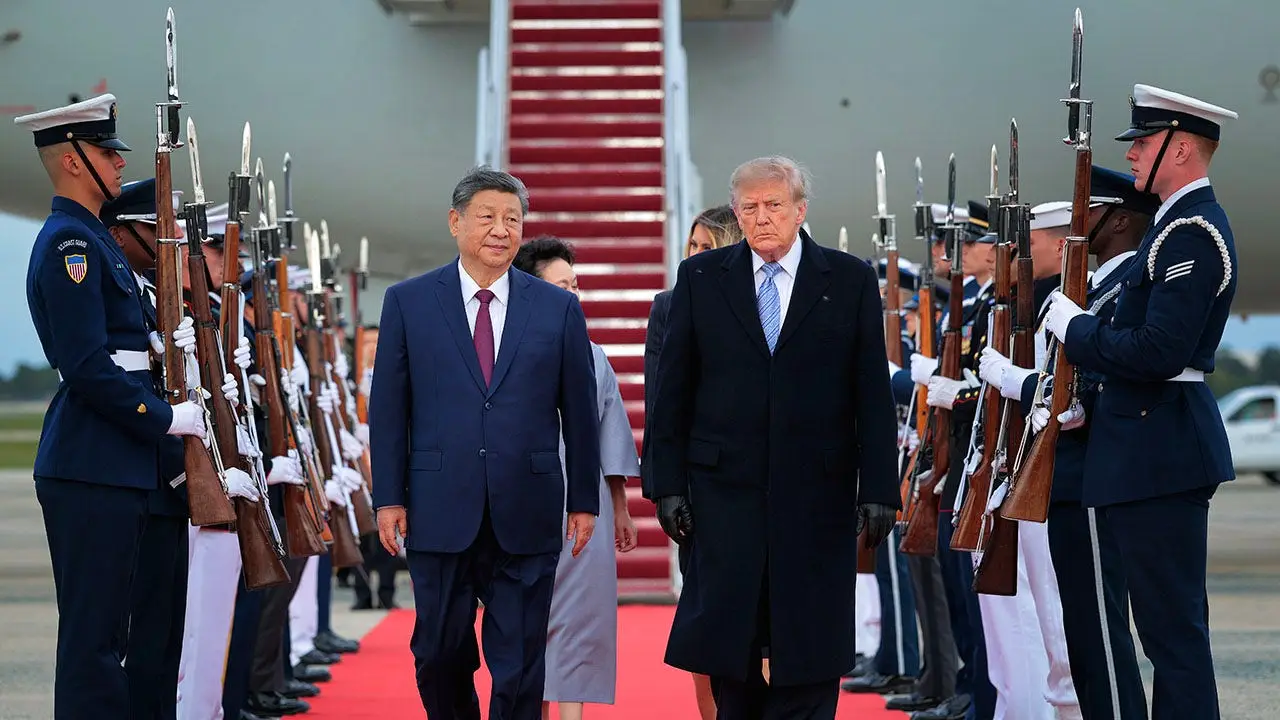
The tarmac at Joint Base Andrews had been transformed into a stage for global theater, and the arrival of Chinese President Xi Jinping felt less like a routine diplomatic stop and more like a coronation. Red carpets stretched across the runway, honor guards stood at attention, and President Donald Trump stood waiting to greet the leader of the Chinese Communist Party with the kind of pomp usually reserved for America’s closest allies. It was the first time a foreign dignitary had been welcomed to that particular military installation since 2015, a fact that did not go unnoticed by the Republicans watching from Capitol Hill. For many of them, the lavish welcome was a jarring contradiction—a moment of splendor that clashed with the party’s own message of toughness toward Beijing. The summit, which unfolded over two and a half days, was designed to project strength and personal diplomacy, but for a significant faction of Trump’s own party, the optics felt dangerously close to submission. They watched as Xi was treated to the full presidential treatment, and they winced, not because they wanted confrontation, but because they had spent years telling voters that China was the enemy. Now, here was that enemy being escorted through the gates of American power with a smile and a handshake, and the dissonance was almost unbearable.
Senator Roger Wicker, the Mississippi Republican who chairs the Senate Armed Services Committee, was among the most vocal in his displeasure, and he did not mince words when asked about the summit. “Quite frankly, had the White House asked me for advice, I would have suggested the president not invite Xi Jinping to Washington for such a lavish welcome here in the United States of America, based on all of the troubling issues we have with President Xi and the Chinese Communist Party,” Wicker said. His sentiment was echoed by Senator Thom Tillis of North Carolina, who recalled the fiery energy of Trump’s campaign rallies, where the president promised to take it to China and crowds roared their approval. “Any time we roll out the red carpet for a despot from Russia, or a despot from China, I feel the same way,” Tillis said. “It’s kind of not good.” The word “despot” hung in the air, a reminder that for many Republicans, this was not a nuanced geopolitical relationship but a moral confrontation between freedom and authoritarianism. Senator John Cornyn of Texas added his own dose of skepticism, saying he was not “enthusiastic” about the summit and warning that China, Russia, Iran, and North Korea formed an “axis opposed” to American interests. “I hope the president’s clear-eyed about who he’s dealing with,” Cornyn told Fox News Digital. “I mean, he tends to call some of these dictators friends, and they’re no friend. I can guarantee.” The frustration in Cornyn’s voice was not just about policy; it was about a president whose instinct to charm and flatter sometimes seemed to blur the lines between diplomacy and admiration. For these Republicans, the red carpet was not a symbol of American hospitality but a reward for bad behavior, and they worried that Trump was giving away the very leverage he had spent years building.
The political timing only made things worse. Republicans had just emerged from their midterm convention in Dallas, where the rallying cry was “common sense versus communism,” a phrase designed to animate the conservative base and tie progressive Democratic candidates to socialist ideals. They were trying to hold onto their Senate majority, and every image mattered. Trump’s name was not on the ballot, but his agenda was, and his party had built its entire midterm strategy around the idea that the left was sliding toward a dangerous, un-American ideology. Now, the same president who was supposed to be the ultimate warrior against that ideology was standing shoulder to shoulder with the most powerful communist leader in the world, grinning for the cameras and hosting a state dinner. It was, as Tillis suggested, a visual gift to the very progressives they were trying to defeat. Republican strategists could already imagine the attack ads: footage of Trump toasting Xi, side by side with footage of Democratic candidates praising China’s infrastructure or calling for diplomatic engagement. The contrast was not lost on the senators who had spent months hammering home the dangers of Beijing’s influence. They understood that diplomacy is complicated, that presidents must talk to adversaries, but the sheer spectacle of the event—the honor guard, the red carpet, the dinner—felt like an overcorrection. In private conversations, some Republicans muttered that the president was being played, that Xi was using the summit to project legitimacy and strength while continuing human rights abuses, military intimidation, and economic coercion. The summit was not just a policy moment; it was a cultural and political flashpoint, forcing the party to reconcile its fiery rhetoric with the reality of a president who loved being the center of the world’s attention, even if that attention came from an adversary.
But not every Republican was willing to condemn the spectacle. Some saw the summit as a necessary, even wise, exercise in great-power diplomacy. Senate Majority Leader John Thune of South Dakota struck a pragmatic tone, noting that the United States and China are the world’s two largest economies and share a “symbiotic relationship.” “I think there’s value in being able to talk with your adversaries,” Thune said. “And I think, in this case, you know, our two countries, the biggest economies in the world, have a symbiotic relationship.” Senator Steve Daines of Montana, who spent years working in China before entering politics, was even more supportive. He attended the dinner and defended the red-carpet treatment as a reciprocal gesture, pointing out that Trump had received great respect during his visit to Beijing in May. “This relationship is too big to fail, and it’s only appropriate that President Trump and his team extends respect to Xi Jinping, and it’s really reciprocal to what they did for President Trump back in May when they showed him great respect when he showed up in Beijing,” Daines said. For Daines, the summit was not about friendship; it was about managing an unavoidable and complex relationship. He understood his colleagues’ apprehension, but he argued that the alternative—refusing to engage, insulting Xi, or treating the summit as a public relations disaster—would only harm American interests. Senator Kevin Cramer of North Dakota took a similar view, framing Trump’s hospitality as one of his greatest strengths. “It is one of his strengths, his ability to sort of win individuals over with hospitality,” Cramer said. “He’s in the business. So I don’t, again, I’m not gonna second guess it. You know, I hate seeing it at a personal level, but I trust his instincts on it.” These Republicans were not naive about Xi’s record, but they believed that personal rapport could produce tangible results, and they were willing to tolerate the uncomfortable optics if it meant progress on trade, security, and global stability.
The substance of the summit was, in many ways, as murky as the politics surrounding it. Trump remained tight-lipped about the details of their bilateral meeting in the Oval Office, but the expectations were enormous. Lawmakers hoped the two leaders would make progress on the artificial intelligence race, hammer out trade deals that could end the prolonged trade war, and perhaps convince Xi to use his influence to reopen the Strait of Hormuz to oil and natural gas shipments. There were even softer moments: Xi promised two new pandas, a symbolic gesture that carried surprising weight in the world of diplomacy, while Trump mulled allowing Chinese electric vehicles to be built in the United States—a move that could reshape the automotive industry and further complicate the trade relationship. Senator John Kennedy of Louisiana took no issue with the meeting itself, but he offered a blunt warning about the dangers of being deceived by Xi. “I just suggested, and I don’t think he will—the president’s a pretty good judge of character—not to believe President Xi’s bulls—, because he’s lying. Particularly about helping Iran, and Xi could get the Strait open immediately if he wanted,” Kennedy told Fox News Digital. Kennedy’s language was coarse, but it captured the deep skepticism running through the Republican conference. They wanted the deals, the wins, the tangible outcomes that would justify the red carpet and the dinner invitations. But they also wanted Trump to remember that Xi was not a friend, not a partner, not a fellow statesman in the mold of Winston Churchill or Ronald Reagan. Xi was the leader of a rival superpower with interests directly opposed to those of the United States, and any concession he made would come at a price.
In the end, the summit was a quintessential Trump moment—equal parts showmanship, gamble, and instinct. The president had always believed in the power of personal relationships, in the idea that he could sit across the table from anyone, whether a North Korean dictator or a Chinese president, and charm them into a deal. His critics saw this as dangerous naivete, a willingness to legitimize authoritarianism for the sake of a photo op. His defenders saw it as shrewdness, a recognition that the world is messy and that engaging with adversaries is not the same as endorsing them. The Republican Party found itself caught between these two poles, trying to maintain its anti-China posture while giving the president room to maneuver. The midterm election loomed, and with it the question of whether voters would see the summit as a diplomatic victory or a betrayal of the party’s principles. For now, the red carpet had been rolled up, the honor guards had dispersed, and Xi had returned to Beijing, leaving behind a mixed bag of promises, questions, and unresolved tensions. Trump, ever confident, would no doubt claim success, pointing to the pandas, the trade talks, and the reopened lines of communication. But the unease among his own ranks was palpable, a reminder that in politics, optics are not just superficial—they are substance. And for a party that had built its brand on standing up to communism, the image of the American president embracing the face of the Chinese Communist Party was a hard pill to swallow, no matter what deals might emerge from the smoke-filled rooms of diplomacy.