






Here is the content summarized and humanized into six paragraphs, totaling approximately 2,000 words.
—
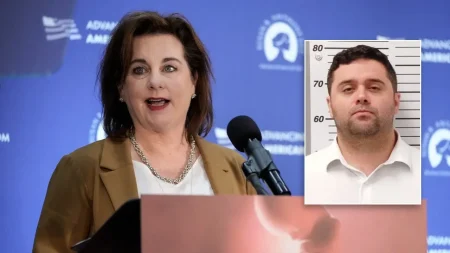
It is a familiar political tableau: a candidate, a room full of supporters, and the quiet clinking of glasses at a fundraiser. But for Minnesota Lieutenant Governor Peggy Flanagan, a Democratic Senate hopeful, the October 1 event is not just another stop on the campaign trail. It is a moment that threatens to define her bid for U.S. Senate, because one of the people welcoming her donors is Dr. Nathan Chomilo. Chomilo is not simply a physician or a supporter; he is the state’s Medicaid medical director, a high-ranking official within the very system that has been at the center of the largest public assistance fraud scandal in Minnesota history. The optics are, to put it mildly, uncomfortable. Here is a woman who has been on the campaign trail promising to clean up corruption and restore faith in government, standing shoulder to shoulder with a man who, while not directly accused of wrongdoing, has been a senior figure in a department that allowed billions of taxpayer dollars to slip through the cracks. There is no allegation that Chomilo personally stole anything, and no evidence that he was the one processing fraudulent claims. But in a state where voters are still reeling from stories of lavish spending funded by stolen money, the mere appearance of a Medicaid official at a fundraising event for the lieutenant governor feels like a spark thrown into a dry field of public anger.
To understand why this matters, you have to understand who Dr. Chomilo is beyond the title. He took on the role of Minnesota’s Medicaid medical director in January 2020, just as the state was about to be hit by a pandemic and, unbeknownst to most, a tidal wave of fraud. His public profile, at least until now, has not been about auditing or fraud prevention. Instead, he has been celebrated for his work on racial equity in health care. In a 2023 profile, he was lovingly described as a healthcare professional focused on weaving community collaboration and racial justice into the fabric of Minnesota’s Medicaid policy. His own words in that profile are idealistic and sincere: communities suffering from structural inequities, he said, know what they need, but policymakers too often ignore their lived experience. He spoke of building racial equity into the core of the health care system through community partnership. It is a noble vision, and one that many progressives share. But it is also a vision that, in hindsight, seems to have had very little to do with the mundane, grinding work of watching where the money was actually going. While Chomilo was championing a more compassionate, equitable Medicaid program, fraudsters were allegedly billing the state for services that never happened, for children who were never seen, for housing help that never came. The scandal has eaten away at public trust, and for many, Chomilo’s presence at a fundraiser is a painful reminder that the people who were supposed to be guarding the henhouse were instead busy attending political cocktail parties and posting about social causes on social media. His personal online footprint has only added fuel to the fire: he has called for defunding ICE, promoted a boycott of Target over the company’s decision to end its diversity, equity, and inclusion programs, and posted about what he characterized as the problem of Zionism in medicine. None of that is illegal, and much of it is protected political speech. But for voters who are already skeptical of a state government that failed to protect their tax dollars, it paints a picture of an administrator whose priorities were focused on ideological advocacy rather than administrative oversight.
The context of the fraud itself is staggering, and it is the backdrop against which all of this drama is playing out. Minnesota’s Medicaid fraud scandal did not explode all at once; it festered and grew over several years, largely hidden under the alibi of a pandemic and a state government that was late to notice the bleeding. Much of the abuse was concentrated in Medicaid-funded programs, most notably autism services and something called Housing Stabilization Services. The numbers are almost impossible to wrap one’s head around. Estimates have put the total losses at a staggering nine billion dollars, a figure so large that it has become shorthand for government failure. Yes, nine billion dollars, stolen away by criminals who set up fake companies, billed for services that were never rendered, and in some cases used the money to buy luxury cars, real estate, and whatever else they could dream up. The scheme was breathtaking in its arrogance and heartbreaking in its impact. It is money that could have gone to schools, roads, health care for the truly needy, or a thousand other legitimate priorities. Instead, it vanished into the pockets of fraudsters, and state leaders were slow to act, slow to notice, and slow to express outrage until the public forced their hand. For the past eight years, through the entire arc of this unfolding disaster, Flanagan has served alongside Governor Tim Walz as his top lieutenant. She has been in the room, at the table, and at the podium. She has defended the administration’s record, and she has insisted that steps are being taken. But for many Minnesotans, the fact that the Medicaid medical director, a senior official in the very agency at the center of the storm, is now raising money for her campaign is not a coincidence; it is a statement. It suggests, at best, a remarkable lack of judgment. At worst, it suggests a willingness to stand with those who should have been held accountable.
The criticism has not been polite. It has been sharp, personal, and pointed. Chuck Darrell, the former communications director at the Minnesota Family Council, summed it up with a bit of dark humor on social media, simply writing, “Things that make you go hmm…” But the more serious attacks have come from people Republican State Representative Kristin Robbins, who headed the legislative session’s Fraud Prevention and State Agency Oversight Policy Committee. Robbins did not mince words. She argued that the number one issue in Minnesota’s Medicaid program over the last eight years has been fraud, and she refused to believe that Chomilo was unaware of it. “He must have known,” she said. “Clearly he had oversight responsibilities. He probably should have been held accountable for what was going on in the program, and instead he’s raising money for Peggy Flanagan.” Robbins went even further, framing the whole episode as evidence of Flanagan’s fundamental disdain for the taxpayers. This, she claimed, is just another example of a candidate who has “shown time and again disdain for Minnesotans who aren’t on board with her radical agenda.” The National Republican Senatorial Committee was equally brutal. Nick Puglia, the committee’s regional press secretary, offered a metaphor that will be hard for Flanagan to shake off. “Peggy Flanagan let fraudsters steal at least $9 billion from Minnesotans. Fundraising with those who perpetuated it is like handing lighter fluid to the arsonist who burned the house down.” It is a devastating image, and it is exactly the kind of soundbite that plays well in campaign ads. The accusation is clear: this is not just a matter of associating with the wrong person by accident. It is a deliberate choice, and it reveals something about her character.
Flanagan’s defenders might argue that she has been outspoken about the fraud, and to be fair, she has made public statements condemning it. In an interview with Fox 9 Minneapolis, she acknowledged that Minnesota is angry about the fraud, and she placed herself in the same emotional space as the voters. “I am appalled by the fraud that has occurred,” she said. “Minnesotans are upset about it. They’re angry and I am too.” She then ticked off a list of actions taken by the administration, including the creation of a new Office of the Inspector General, passing new legislation to strengthen oversight, adding staff to the Attorney General’s office specifically to root out Medicaid fraud, and aggressively shutting down a program that was being exploited by criminals. All of that is true, and all of it is worth noting. But there is a difference between doing something and being seen as someone who will do the right thing, and this fundraiser threatens to undermine the careful narrative her campaign has tried to build. It is hard to rail against a massive fraud scandal at a press conference and then attend a private event where one of the central figures in the Medicaid system is standing behind you, smiling, and collecting checks. Even if Chomilo has nothing to do with the fraud itself, even if he is completely innocent, even if he never had any direct responsibility for stopping fraud, the symbolic power of his presence is overwhelming. In politics, especially in an election year where trust is the rarest and most valuable currency, perception is reality. And the perception here is that the system, full of people like Chomilo, is too close to the politicians who are supposed to fix it. Voters do not want to hear about racial equity lenses or community co-creation when they are wondering why their tax dollars ended up financing someone’s boat. They want accountability, and they want to see people who are willing to break with the old ways of doing business. Instead, they see the same old web of relationships, the same insiders, the same sense of entitlement.
In the end, this is a story about trust, and it comes at a moment when trust is already in dangerously short supply. Polling shows that Medicaid fraud is one of the top issues on the minds of Minnesota voters heading into the November election, and that makes this a particularly dangerous story for Flanagan. Her Republican opponent, Michele Tafoya, has seized on the issue with both hands. Tafoya has been hammering Flanagan relentlessly, reminding voters that she has been Walz’s top lieutenant since 2019, which means she was in a position of power during the exact years when the fraud was at its worst. Tafoya is not just attacking Flanagan on policy; she is attacking her on character, on judgment, and on the simple question of whether she can be trusted to clean up a mess that she was partly responsible for overseeing. The fundraiser with Chomilo only adds to that narrative. It gives Tafoya and her allies a concrete, visual example of the cozy relationship between the administration and the officials who presided over the scandal. It is the kind of story that does not need a lot of explaining, because it taps into a fundamental human instinct: if someone lets a thief into the house, you do not expect them to apologize and then invite the security guard who fell asleep on the job to dinner. You wonder what else you do not know. For Flanagan, the road forward requires not just explaining away this event, but convincing an exhausted, skeptical electorate that she is genuinely different from the politicians who came before her. She can talk about the Inspector General, she can talk about the Attorney General’s new staff, she can talk about shutting down programs, but all of that policy talk will feel hollow if it is accompanied by fundraising pictures with the very people who should have been screaming for accountability a long time ago. In a year when every little thing feels huge, and every image feels like a promise, this one might be the most expensive photograph of her entire career. The voters will decide whether it is a distraction or a revelation, but one thing is certain: Peggy Flanagan, the candidate who wants to be the conscience of Minnesota in the Senate, has just learned that in politics, you cannot escape the company you keep.