





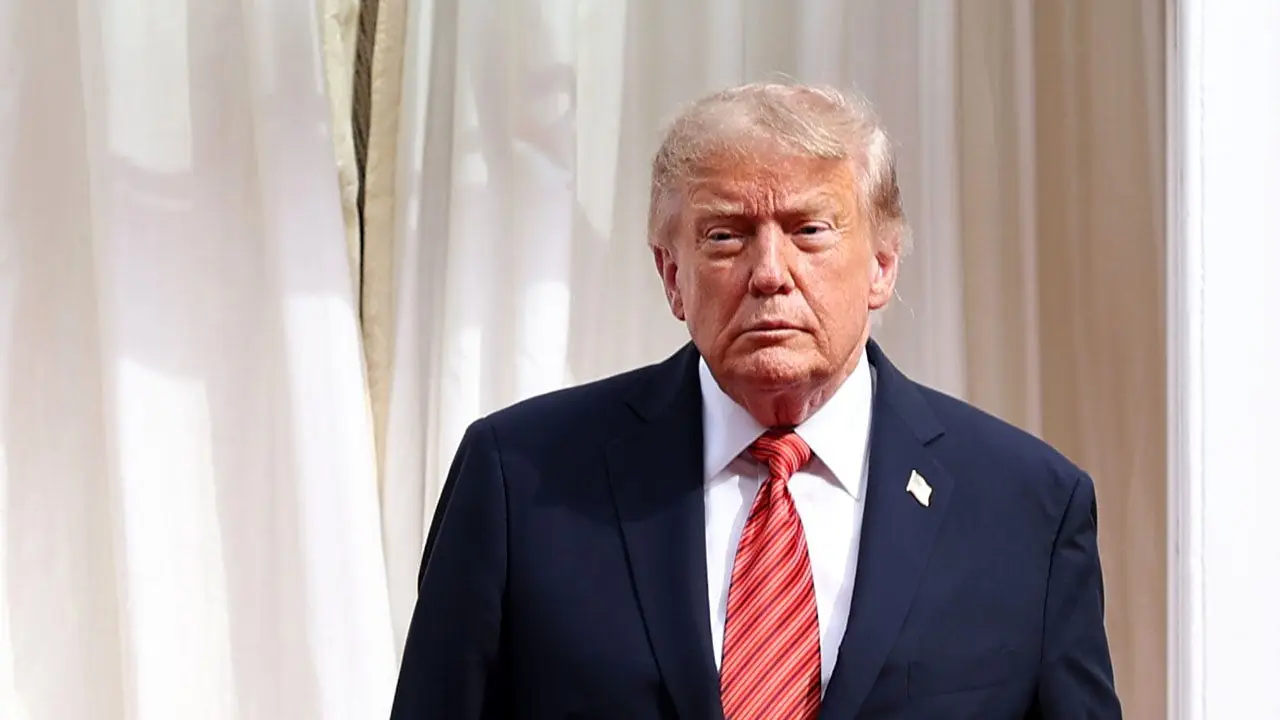
President Donald Trump is trying a different kind of persuasion game with his own party. For weeks, he has been demanding that Senate Republicans blow up the filibuster, the decades-old rule that requires 60 votes to pass most major legislation. It’s the rule that has stood in the way of his agenda, especially the SAVE America Act, which has stalled on the Senate floor as a handful of Republicans joined Democrats in refusing to break through that threshold. Trump’s old pitch to skeptical Republicans was simple: if you don’t end the filibuster now, Democrats will do it the moment they’re back in charge, and then they’ll push through everything they’ve ever dreamed of with zero restraint. But now he’s trying something more personal, more existential, and much darker. He’s warning his own side that if they don’t act, he might be the last Republican president they ever see. In a fiery Truth Social post, he insisted that Senate Republicans must “TERMINATE THE FILIBUSTER,” or Democrats will, and then, despite all the party’s momentum, he will be “the last Republican President.” It’s a stark and almost doomsday-style framing, designed not to appeal to their sense of procedural caution, but to their fear of losing power forever. He’s not just asking them to change a rule anymore; he’s asking them to choose between survival and extinction.
The core of Trump’s warning is a nightmare scenario about maps and demographics. He points to Washington, D.C., and Puerto Rico, two places that Democrats have long wanted to make into states. Trump argues that if either or both of those become states, the political math would be permanently tilted against Republicans. He claims the “Dumocrats” would pick up four senators, eight congressmen and women, plus a huge number of popular votes and Electoral College votes, not to mention control of voting systems across the country. Right now, D.C. residents can vote for president in the general election and carry three electoral votes, but they have no voting members of Congress. They send non-voting delegates to the House, and the district has a shadow senator, but those people don’t have real power. Puerto Rico’s voters can participate in presidential primaries, but not the general election for president, and they also lack full representation in Congress. So when Trump talks about both places being admitted to the Union, he’s talking about a huge shift in who gets to sit in the Senate and the House, and he’s convinced those new seats would all go to Democrats. He’s not just predicting a bad midterm or a lost election; he’s predicting an avalanche that would bury the Republican Party so deeply that no Republican could ever win the presidency again. It’s a scary thought for many in his party, and he knows it. But the problem is that the very same Senate rule he wants to destroy is the only thing standing between Democrats and their own dreams of statehood for those two places. If Republicans kill the filibuster, they make it easier for Democrats to add new states later. If they don’t, they let Trump’s agenda die slowly in legislative gridlock.
To understand why this is such a complicated moment, it helps to remember what the filibuster actually is and why it has survived so long. The filibuster isn’t written into the Constitution; it’s a Senate tradition, a set of rules that allows a minority of senators to block a bill unless 60 votes can be found to end debate. In recent years, with the Senate divided so narrowly, that means almost anything meaningful has to be bipartisan or it’s dead. That has frustrated presidents from both parties, but it has also protected whichever party is in the minority from the worst fears of the moment. The last time the filibuster was seriously challenged was in 2022, when Democrats controlled the Senate and then-Majority Leader Chuck Schumer tried to change the rules to create a “talking filibuster,” requiring senators to actually stand on the floor and speak until they ran out of gas. He did that in an attempt to pass voting rights legislation, but it failed because his own party didn’t have unanimity. Democrats have also pushed legislation to make D.C. and Puerto Rico states, and they’ve talked openly about adding seats to the Supreme Court. So both parties understand the filibuster as a kind of armored car: the side in power wants to break into it to get their treasure, and the side out of power wants to keep it locked tight so their rivals can’t do permanent damage. Trump is now telling Republicans that the armored car is worthless if the other side is about to steal the entire bank. But many Republicans are not convinced that blowing it up is the right move, even if they understand his frustration.
Senate Majority Leader John Thune is the main voice pushing back, and he’s doing it with calm, plain-spoken stubbornness. Thune has repeatedly told Trump that there simply aren’t enough Republican votes to eliminate the filibuster. It’s not that Thune doesn’t want to pass Trump’s agenda; it’s that he knows the political reality. Earlier this month, he said on the Ruthless Podcast that at least half of the Senate Republican conference wants to keep the filibuster in place. He used a memorable metaphor, saying that Democrats might try to steal the car, but Republicans are not going to hand them the keys. In his view, the first thing Democrats would do if the filibuster disappeared is start passing every radical idea they’ve been holding back, including adding Puerto Rico and D.C. as states, federalizing elections, and packing the Supreme Court. Thune is essentially telling Trump: I know you’re frustrated, but if we break this rule, we’re opening the door to things that would make your “last Republican president” prophecy come true much faster. It’s a strange moment because Trump and Thune are both pointing at the same horrifying future, but drawing opposite conclusions. Trump says the filibuster is the reason Republicans will lose forever; Thune says the filibuster is the reason they might survive at all. Both men are afraid of the same thing, but one sees the rule as a trap and the other sees it as a shield. The conversation between them and their party is no longer about policy; it’s about which risk is bigger: the risk of doing nothing or the risk of changing everything.
There’s a deep irony in Trump’s warning, and it’s not lost on anyone watching closely. He’s arguing that if Republicans don’t act aggressively and rile up the rules, future Republicans will never win the White House again. But the actions he’s demanding could also trigger the exact outcome he fears most. If the filibuster is eliminated, there’s no going back. A future Democratic majority, with a simple majority in the Senate, could pass a bill to admit Washington, D.C., and Puerto Rico as states without needing a single Republican vote. They could also pass sweeping voting rights legislation that Republicans believe would give them an unfair advantage forever. They could expand the Supreme Court and fill it with judges who would serve for decades. Thune and his allies understand this chain of consequences, which is why they won’t move even for a popular president of their own party. Trump, on the other hand, believes the Democrats are going to do those things anyway, filibuster or no filibuster, because they are already trying and because pressure will eventually break the rule from the other side. In his mind, the only sensible move is to strike first and get what Republicans want before Democrats get the chance to get what they want. He’s treating the filibuster like an old, brittle relic that can’t protect anyone forever. The Republicans who oppose him are treating it like a sacred firewall that must not be moved unless there is no other choice. And so the party is stuck in a heated standoff, with Trump yelling from outside the gates and Thune trying to hold the fort on the inside, while the SAVE America Act waits on the floor, gathering dust.
What does this all mean for ordinary Americans who just want the government to work? It means the Senate is likely to stay gridlocked for a while, and the frustration will only grow. Trump’s message is emotionally powerful because it taps into a deep fear of losing not just an election, but the entire country as we know it. When he says, “It will be THE END OF AMERICA!” he’s not mincing words. He’s speaking in the language of survival, not legislation. But the more he pushes, the clearer it becomes that the filibuster is no longer just an obscure procedural rule. It has become a symbol of everything wrong with Washington: the inability to act, the constant fear of the other side, the sense that the rules are only respected when they work in your favor. Both parties have contributed to this mess. Democrats want statehood for D.C. and Puerto Rico, which they frame as a matter of basic fairness and civil rights, because people in those places pay taxes and deserve representation. Republicans see it as a naked power grab, a way to stack the deck forever. Both sides are convinced they are the protectors of democracy, and both sides are sure the other is the threat. The filibuster sits in the middle like an old warden who refuses to unlock the cell door, and neither side can agree whether he’s protecting them from the prisoners or trapping them with a madman. Eventually, someone is going to have to decide what kind of Senate America wants: one where a majority can govern but a minority has no voice, or one where a minority can block almost everything and majority rule becomes meaningless. Trump is making his choice clear, but he doesn’t have the votes to force it, and Thune is making his choice clear, but he doesn’t have a solution to get Trump’s agenda passed. The clock is ticking, the stakes are enormous, and the only thing both sides can agree on is that something has to give. But maybe not today. Maybe not until the fire gets so hot that the doors finally break open. Until then, Americans are left watching two wings of the same party argue about whether to jump out of a plane that’s on fire, while the ground rushes up to meet them.