


The Weight We Carry: Why Overpacking Ruins Our Travels and the Simple Hacks to Fix It
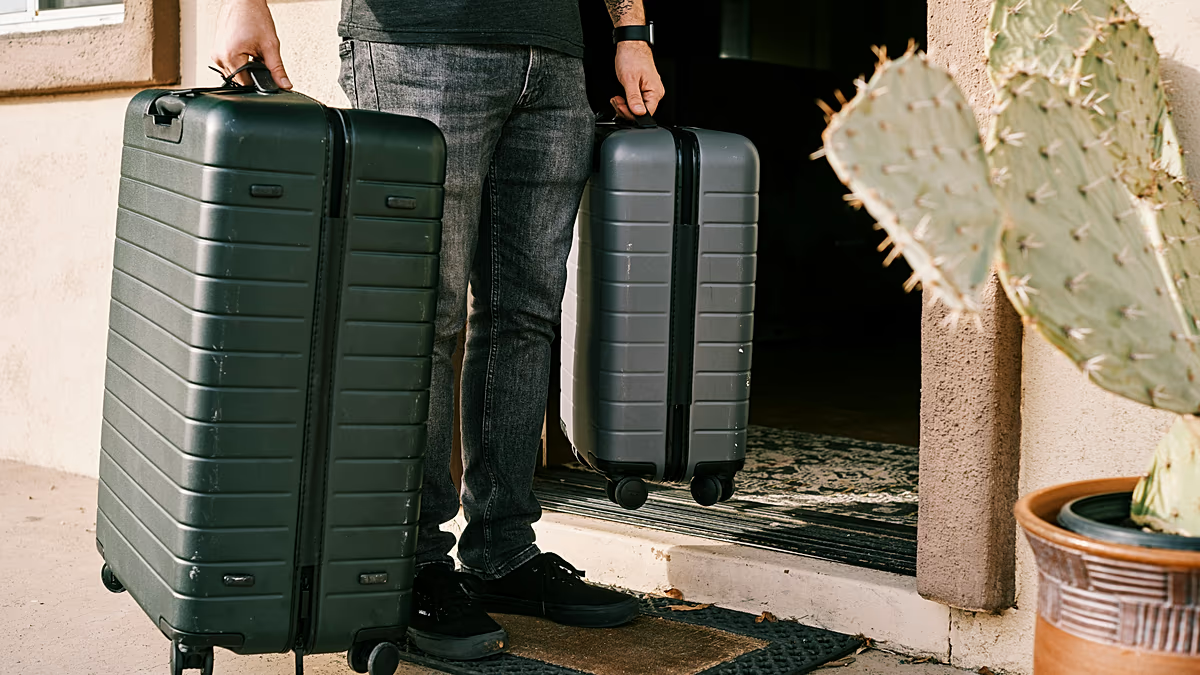
There is a moment that defines every traveler, a benchmark of anxiety that occurs long before the passport is stamped or the first foreign language washes over you. It is that precarious instant in the airport terminal when you attempt to hoist your suitcase onto the security conveyer belt. Your shoulder screams, the zipper strains against the fabric like a ship’s hull in a storm, and the patient person behind you sighs audibly, wondering if you have packed a full set of kitchen appliances. In that single, straining act, the romanticized dream of a far-flung adventure collides head-on with the grinding logistics of moving your physical life from point A to point B. Travel, in its purest sense, is meant to be an escape—a glorious shedding of the mundane, a chance to step outside the confines of our daily routines. Yet, according to a fascinating new survey from Global Rescue, a leading provider of travel risk, security, and crisis management services, we are sabotaging this escape from the moment we unroll the suitcase on our bed. We are dragging our old baggage—both literally and psychologically—onto our new horizons, making the journey harder, more stressful, and even more dangerous than it ever needs to be.
Global Rescue’s latest Traveller Sentiment and Safety survey has crunched the numbers, and the results are clear: the number one mistake we make, year after year, is overpacking. Among experienced, seasoned international travelers—people who should know better—fully 38% admit that lugging around too much stuff is their single worst travel error. This isn’t just a minor faux pas or a quirky habit; it’s a systemic issue that actively tarnishes the experience. What is even more telling is that this figure isn’t improving; it’s actually creeping upward. This year, 38% confessed to this burden, a jump from 32% just last year and 35% in the two years prior. Despite the proliferation of minimalist packing guides, YouTube tutorials on rolling techniques, and dire warnings about airline baggage fees, our hands remain firmly clamped around the handles of our oversized, max-capacity suitcases. Why do we do it? It’s a psychological quirk known as “just-in-case” syndrome. We aren’t packing for the trip we are actually taking; we are packing for a hypothetical life where we might need that third pair of formal shoes for an impromptu gala, that heavy fleece for a freak blizzard, or that extra hair straightener because the hotel one might be faulty. We pack out of fear, not out of logic.
The data shows a slight silver lining compared to the pre-pandemic era—in February 2020, a staggering 74% of travelers identified overpacking as their primary travel blunder. The lockdowns and the restart of travel seem to have taught us a lesson in efficiency, at least for a while, but that lesson is fading as we slide back into our comfortable, overloaded habits. This regression is precisely why Dan Richards, the CEO of Global Rescue, calls it the most preventable and consistent mistake he sees in his industry. “Overpacking is the single most consistent preventable mistake we see, year after year,” Richards states emphatically. “It’s a habit that adds stress, weight, and unnecessary complexity to every stage of a trip, when the real goal of travel should be freedom, flexibility, and discovery.” Richards is articulating a profound truth about the human condition. When we obsess over the contents of our bag, we rob ourselves of spontaneity. We spend more time at baggage carousels, more money on excess baggage fees, and more energy heaving our belongings into cabs and up hotel staircases. The suitcase becomes an anchor, dragging us down as we try to swim in the sea of new experiences.
But the burden of overpacking goes far beyond mere inconvenience or a strained back. It crosses the line into a genuine health and safety hazard. Imagine navigating the slick, moving walkway of a busy airport like Heathrow or JFK with a 50-pound bag slung over one shoulder. The asymmetric weight puts incredible torque on your spine. You become off-balance and clumsy. Richards explains the physical toll in stark terms: “Heavy luggage increases fatigue, reduces balance and raises the risk of falls, back strains, and other orthopedic injuries while navigating airports, cruise terminals, cobblestone streets, or rugged trails.” The cobblestones of Europe, so charming in photographs, become a dangerous obstacle course when you are unsupported by a rolling bag with a broken wheel. The fatigue itself is a risk; a tired traveler makes poor decisions, gets easily lost, and loses the situational awareness required to navigate unfamiliar environments safely. However, there is a darker, more urgent side to this issue. When disaster strikes—whether it’s a raging hurricane, a creeping wildfire, or sudden civil unrest—that heavy bag you insisted on bringing becomes a life-threatening liability. In an emergency, seconds matter. You cannot outrun a wildfire carrying eighty pounds of clothing and electronics. Richards paints a vivid picture of this terrifying reality: “Travelers burdened with oversized or multiple bags move more slowly, tire more quickly, and may have to abandon their luggage altogether. In a crisis, the ability to move quickly can be just as important as what you packed.”
Picture a hotel evacuation in a coastal city under a tsunami warning. The alarm blares, and you are told to make your way to higher ground immediately. Are you going to spend precious minutes struggling to carry three suitcases down five flights of stairs? Absolutely not. You will grab your passport, your phone, a jacket, and you will run. In that terrifying moment, you realize that every item you meticulously packed—your hair dryer, your extra sneakers, your heavy denim jacket on a warm day—has become a deadly anchor. The security you felt in having your home with you transforms into a trap. You might lose the bag anyway, or worse, you might put yourself directly in harm’s way by trying to save it. This devastating realization—that our stuff can actually prevent us from saving our own lives—should be the ultimate motivation to pack lighter.
Of course, the survey reveals that overpacking is far from the only travel mistake we sabotage ourselves with. When travelers were asked about their greatest frustrations and regrets, a revealing list emerged, highlighting the many ways we overcomplicate our journeys. 19% of respondents admitted that their biggest mistake was booking impossibly tight layover connections. We have all fallen victim to this false economy. You book a 35-minute connection in a massive, sprawling airport like Chicago O’Hare or Dallas–Fort Worth because the ticket was $50 cheaper. You ignore the tiny font in the ticket confirmation that warns “connection time may be insufficient.” Then, your first flight is delayed for 20 minutes, and your jetlagged body is suddenly sprinting through overcrowded terminals, dodging golf carts, sliding past security checkpoints, and praying that the gate agent is merciful enough to wait. You arrive breathless, sweaty, and frazzled, only to realize your mind is no longer on the adventure ahead, but on surviving the logistical gauntlet you created for yourself.
Following closely behind this, 10% of respondents confessed to over-scheduling their entire itineraries. They packed their days with back-to-back museum tours, guided culinary experiences, and complex day trips, leaving absolutely no room for idleness or discovery. The “vacation” becomes a rigorous checklist, an endurance test where you are constantly rushing to the next stamp on your imaginary passport. You might see all the famous sights, but you never actually taste the local street food in a quiet plaza. You never stumble upon a hidden bookstore. You never just sit and people-watch. This frantic pace drains all the joy out of travel, leaving you exhausted and ironically feeling like you need another vacation just to recover from the first one.
The digital age has introduced brand new pitfalls as well. 8% of respondents regretted not downloading offline maps or digital documents before they departed. We have an illusion of total connectivity, yet the moment you step off a plane, you are met with roaming charges, spotty Wi-Fi, or a dead zone. Getting lost in a narrow medieval alley in Rome with no signal and no paper map is a recipe for panic. Similarly, another 8% admitted to falling victim to sky-high currency exchange rates at airport kiosks. Desperate for local cash before jumping into a taxi, they hand over their credit card and realize too late that they are paying a 15% premium for the convenience. They could have simply withdrawn local currency from an ATM at their destination or used a credit card with no foreign transaction fees. These are mistakes born of haste, lack of preparation, and a failure to think the logistics through.
Thankfully, the Global Rescue survey offers a broad beacon of hope. In response to these common mistakes, the world’s savvy, experienced travelers have developed a toolkit of brilliant solutions that can rescue us from ourselves. The number one travel hack, used by an impressive 31% of respondents, is the simple act of placing smart tags—like Apple AirTags or Tile trackers—inside checked luggage. This cheap, tiny piece of technology delivers an enormous amount of peace of mind. Gone is the anxiety of staring at the baggage carousel as the same suitcases go round and round, wondering if yours got left behind. Instead, you can watch your bag load onto the plane from your smartphone seat, see it land at your destination, and track it instantly if the airline loses it. It transforms the chaotic baggage claim into a calm, data-driven certainty, saving you hours of stress and potentially hundreds of dollars in replacement gear.
In the digital realm, 16% of travelers have adopted the simple habit of emailing themselves digital copies of their passport, visa, and identification documents. This acts as an ironclad backup if the physical documents are stolen or lost. If you lose your wallet in a foreign country, trying to prove your identity to the local consulate without any paperwork is a bureaucratic nightmare. Having that email in your inbox—something you can access from a borrowed phone or an internet café—can be the difference between a day-long headache and a proper rescue. When it comes to conquering the actual suitcase, 10% of respondents swear by packing cubes to compress and organize their clothing, while another 10% utilize the classic rolled-clothing technique to maximize space and minimize wrinkles. These methods work in beautiful harmony: packing cubes create order within the chaos, and rolling clothing creates capacity. Together, they allow you to fit a week’s worth of clothes into a weekender bag, breaking the cycle of overpacking entirely.
Small gadget innovations are also making a difference. 9% of savvy travelers bring a multi-port wall charger instead of a tangled web of adapters and cables, saving a significant amount of space and eliminating the morning ritual of untangling a knot of wires. A further 7% bring an empty reusable water bottle through security, filling it up at a drinking fountain once they are on the other side. This saves them money on overpriced airport beverages, reduces plastic waste, and keeps them effortlessly hydrated during a long flight—where dehydration is a primary cause of jet lag fatigue. Finally, 6% make sure to download entertainment—movies, music, podcasts, or audiobooks—onto their devices before they head out the door. This ensures they have flawless in-flight entertainment even if the airline’s in-seat system crashes, or they are flying a no-frills budget airline that charges $15 for a pair of headphones.
Analyzing this wealth of data, a clear narrative emerges. Travel is a glorious paradox. We crave freedom, yet we act like pack mules. We seek adventure, yet we over-plan our days to the minute. We want to disconnect, yet we refuse to leave behind our chargers and cables. The good news, however, is that these mistakes are entirely preventable. The Global Rescue survey isn’t just a list of failures; it’s a roadmap to a significantly better travel experience. It underscores that the best travel gear isn’t the latest high-tech gadget or the most expensive suitcase—it’s strategic minimalism paired with thoughtful preparation. By embracing the habits of the 38% who are learning from their mistakes, we can finally align our actions with Dan Richards’ vision. Let his words be our new packing mantra: travel should be about freedom, flexibility, and discovery. So, as you prepare for your next great escape, edit your packing list down by one-third. Leave the “just-in-case” items behind. Download the maps. Email yourself the documents. Remember that the world is waiting, and the best way to experience it isn’t with a fifty-pound albatross around your neck, but with an open mind, an open itinerary, and a light, manageable bag. Your back, your wallet, and your sense of wonder will thank you for it.