



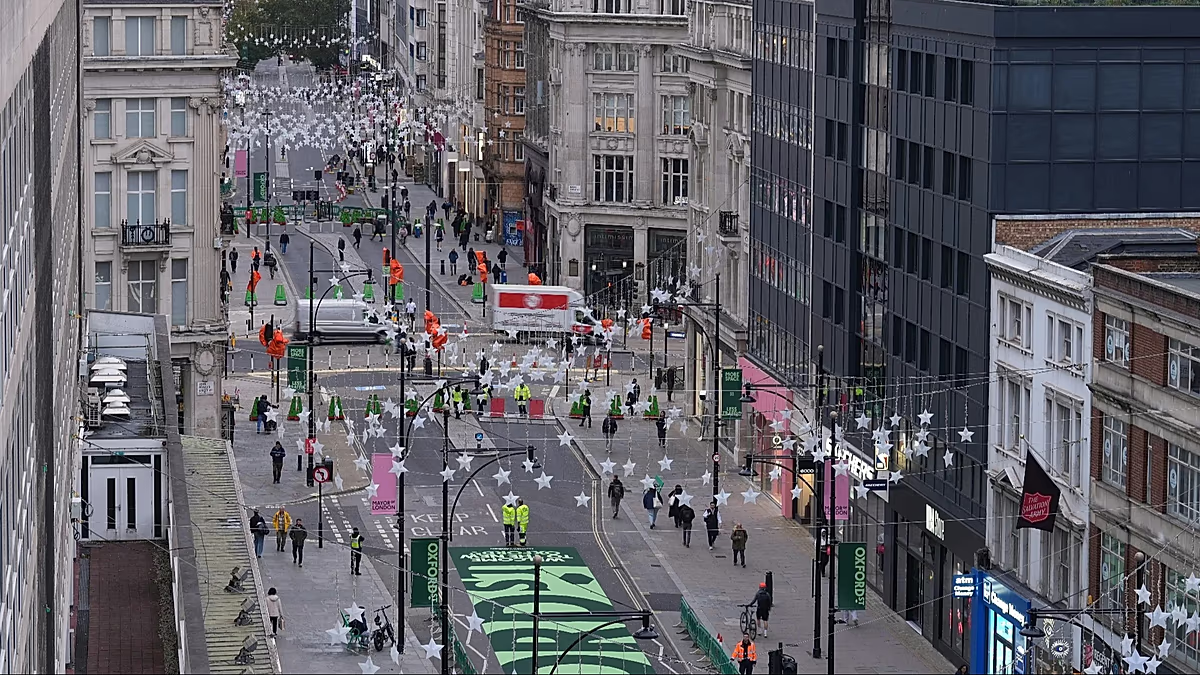
Every first-time visitor to London carries a mental checklist of addresses that must be ticked off before the trip feels complete. Leicester Square, with its neon glare and cinema queues. Brick Lane, where the smell of curry drifts from Bengali kitchens and every available wall is covered in street art. Abbey Road, where the Beatles immortalised a zebra crossing on the album cover of the same name, turning an ordinary footpath into a place of pilgrimage. Groups still gather there, waiting for a gap in the traffic so they can recreate the iconic photograph, one eye on the camera and one eye on the oncoming cars. But as of 26 October 2026, marked crosswalks are no longer needed on another of London’s most famous streets. Oxford Street, the great shopping artery, has been closed to cars, buses and bicycles along a stretch of nearly a kilometre between Orchard Street and Great Portland Street. Vehicles have been diverted onto surrounding roads, and for the first time in decades, people can stand in the middle of the road without worrying about taxis or delivery vans. Mayor Sadiq Khan called it “a momentous day for London, a momentous day for Oxford Street” and promised “a new era.” It is a big claim, but not an empty one. The street still draws around half a million visitors a day, bustling between Selfridges, Zara and John Lewis. To give that much public space back to pedestrians is not just a transport decision; it is a statement about what kind of city London wants to be. For years, Oxford Street was a strange contradiction: a place where you could buy almost anything but where you rarely wanted to linger. The pavements were jammed with shopping bags and pushchairs, while the road itself was clogged with red buses and black taxis. Now the ground has shifted. Visitors can pause in the middle of the asphalt, look up at the old department store facades, and begin to imagine a calmer, more human street beneath the Christmas lights.
The change is only the beginning of a much larger transformation. City officials have made clear that the removal of traffic is the first step in an ambitious makeover of the storied shopping district, with plans to plant trees, install seating and create two new public squares. The idea is to turn what has often felt like a utilitarian corridor of fast fashion into a public realm worthy of a global capital. On a typical day before the closure, Oxford Street was a paradox: enormous crowds, yet almost no space to stand still. The pavements were so narrow for the volume of people that moving from one shop to another was an act of endurance. The road, meanwhile, carried a constant convoy of buses, taxis and delivery vans, many of them barely inching forward. Now that the vehicles are gone, the space opens up in ways that go beyond convenience. The first phase, between Orchard Street and Great Portland Street, covers the section closest to Selfridges, which means the experience of arriving at one of London’s most iconic department stores has already changed. Shoppers can step outside and find not a wall of traffic but an open, almost ceremonial approach to the store’s grand entrance. The absence of engines also changes the soundscape. You can hear footsteps, conversation, a street musician’s guitar, the rumble of a suitcase across the tarmac. That sensory shift is exactly what the planners hope to build on. The new public squares are intended to be places where people can sit with a coffee, watch a performer, or simply rest after hours of walking. The trees will provide shade and softness in a part of London that has long been dominated by concrete and glass. It is a deliberately slow, deliberate reinvention of a street that has spent decades moving too fast.
The road to this moment was not smooth. Local officials first began discussing the idea of pedestrianising Oxford Street more than a decade ago, but the project repeatedly stalled under the weight of opposition and bureaucracy. Residents in neighbouring areas such as Marylebone and Fitzrovia were vocal in their fears: they argued that diverting vehicles from Oxford Street would simply push traffic into their narrow, residential streets, creating new congestion and pollution while doing little to solve the underlying problem. Shop owners worried about deliveries, loading and access for disabled customers. For years, every proposal seemed to die under the competing pressures of business, residents and transport planners. The turning point came when the mayor’s office created the Oxford Street Development Corporation, a dedicated body with the power to shepherd the project through planning and consultation. That institutional focus changed the conversation. Instead of asking whether pedestrianisation was desirable, the debate shifted to how it should be done. A public consultation later produced the answer that supporters had been waiting for: removing traffic would attract new shops and new visitors to Oxford Street, making it, in the official phrase, “an iconic destination.” The consultation also gave politicians political cover to act. There was another quiet ally in the project: the Elizabeth Line, the new railway that runs through the heart of the city with a station just steps from the pedestrianised zone. For the first time, the street was genuinely accessible by high-quality public transport, which meant that the argument that people needed to drive there was weaker than ever. With construction and further work scheduled to begin in the new year, officials say they will refine their plans based on feedback from visitors, but the direction is clear. As Khan put it, “In advance of Christmas, I want people to come here and shop and enjoy the experience.”
City leaders are unashamed in their global ambition. They want Oxford Street to compete again with the great shopping boulevards of the world: Times Square, the Champs-Élysées, La Rambla. For much of the twentieth century, Oxford Street was itself one of those names, a place where Londoners and tourists alike came for the annual lights, the department stores and the sheer spectacle of urban life. But in recent decades, the street lost some of its lustre. Online shopping, the rise of out-of-town retail parks and changing consumer habits hit many of its flagship stores hard. A wave of empty units, souvenir shops and questionable American candy stores gave the street a slightly faded, sometimes seedy feel. Pedestrianisation is, in many ways, an attempt to rebrand the street as a destination rather than a transit corridor. The hope is that people will come not simply to buy something, but to stroll, sit, watch, eat and be entertained. That economic bet is not without risk. Detractors still worry that removing traffic will complicate deliveries and that the street could lose some of its chaotic energy. Others argue that a truly great shopping street needs more than trees and benches; it needs affordable rents, diverse independent shops and a reason to visit beyond commerce. But the early signs are optimistic. Retailers like Selfridges, Zara and John Lewis are being given the chance to present themselves in a calmer, more elegant setting, and the pedestrianised street is expected to attract a better mix of brands than the quick-turnover chain stores that dominated in recent years. The comparison with Times Square is instructive: when New York closed parts of its most famous intersection to cars, critics predicted disaster, yet the city gained a popular public space and tens of millions of dollars in new retail activity. London is hoping for the same alchemy.
If there is a season that will test and celebrate the new Oxford Street, it is Christmas. The street’s festive lights are a tradition that dates back to 1959, and for generations they have been one of London’s most beloved winter rituals. Parents bring children to see them being switched on; office workers glance up from their commutes; couples pause beneath the glow. The illuminations have taken many forms over the years—sparkling snowflakes, giant baubles, showers of stars—but this year they carry an especially magical theme. According to the official website, the 2026 display will be Harry Potter themed, timed to mark the opening of the UK’s largest official Harry Potter store and the launch of the controversial new HBO series. For fans, the street will feel like something out of the wizarding world, with floating candles, golden snitches and the unmistakable glitter of enchantment woven into an ordinary shopping street. The technical scale is staggering. In previous years, the display has featured five thousand stars powered by more than three hundred thousand LED bulbs, a sea of light stretching across the entire street. With cars gone, those lights can be appreciated without a haze of exhaust fumes, and the pedestrianised road becomes a stage for one of the most photographed Christmas scenes in the country. The timing of the closure—just weeks before the holiday shopping season—was no accident. As Khan said, he wants people to come and enjoy the experience. There are few experiences more London than standing in the middle of Oxford Street in December, looking up at the lights, surrounded by strangers who are all smiling at the same sky. For the first time, you can do it without dodging a taxi.
The makeover, however, is still in its early days. The next phase of construction will begin in the new year, and city officials have said they will listen carefully to feedback from visitors before finalising plans for the trees, the seating and the two public squares. There will no doubt be teething problems: delivery access will need to be renegotiated, emergency services will need new routes, and residents on surrounding streets will be watching closely to see whether the promised reductions in traffic actually materialise or simply move elsewhere. But the decision to pedestrianise Oxford Street represents something larger than a road closure. It is a statement about the future of cities—about how we choose to move, spend time and share public space. For decades, urban planning assumed that the car was king, and that shopping streets existed to serve drivers as well as pedestrians. Oxford Street, one of the busiest streets in the world, has now chosen the other path. It has bet that people, not vehicles, are the real source of a city’s vitality. Whether the bet pays off will depend on a thousand small decisions: whether the new squares become true gathering places, whether the trees survive the fumes of the surrounding roads, whether the shops fill and rents stay reasonable, whether the festive spectacle draws crowds without overwhelming the space. But on a crisp autumn day in 2026, the first thing you notice is the silence. The absence of engines on Oxford Street is almost disorienting. You can stand in the middle of the road and take a photograph without a bus in sight. You can hear the clip of heels, the chatter of tourists, the distant rumble of traffic on nearby streets. It may not be perfect, and it has not won over every sceptic, but it feels like the beginning of something. As the Harry Potter lights go up and the new year’s work begins, London is reminding itself that a great city is not measured by how fast traffic can pass through it, but by how gladly people stay.