


In a world increasingly dominated by the relentless hum of urbanization, digital notifications, and the exhausting pace of modern life, the human spirit naturally yearns for places where time operates on a completely different scale. Germany’s lesser-known islands, scattered across its northern coastlines and southern alpine lakes, offer exactly this antidote—a quiet sanctuary where the natural world still takes precedence over human industry. Among these hidden treasures is the Baltic Sea island of Hiddensee, a slender, car-free crescent of land stretching off the coast of Mecklenburg-Western Pomerania. Famously beloved by artists, poets, and dreamers for generations, Hiddensee remains a place of profound stillness, where the only sounds are the rhythmic clip-clop of horse-drawn carriages, the whisper of bicycle tires on paved paths, and the cry of gulls riding the coastal breeze. Visitors here are greeted by sweeping dune landscapes, endless sandy beaches, and the iconic, windswept cliffs of the northern Dornbusch, topped by its historic lighthouse that stands as a lonely sentinel over the Baltic waves. Just a short distance away, connected to the larger island of Rügen by a single bridge, lies the serene island of Ummanz. Far removed from the bustling resort culture of its larger neighbors, Ummanz is a flat, ethereal landscape of salt marshes, quiet pastures, and tiny, sleepy fishing villages that feel suspended in a bygone era. It is a photographer’s dream and a haven for birdwatchers, particularly during the autumn months when the island becomes a vital resting station for thousands of migrating grey cranes, whose haunting calls fill the crisp Baltic air as they sweep across the golden fields in a breathtaking natural spectacle.
Further west along the Baltic coastline, cradled between the historic Hanseatic city of Wismar and the sweeping shoreline of Mecklenburg, lies the often-overlooked island of Poel. Poel possesses an authentic, rustic charm that has managed to resist the tides of mass tourism, offering travelers a peaceful retreat characterized by wide, uncrowded beaches, dramatic cliffs, and a countryside dotted with traditional thatched-roof cottages. Visitors can spend their days cycling along scenic coastal paths, exploring the rugged cliffs of Timmendorf, or watching the fishing boats come and go from the quiet harbors, all while breathing in the clean, salty Baltic air that seems to wash away the stresses of everyday life. This gentle accessibility stands in stark contrast to the nearby island of Vilm, which lies off the southern coast of Rügen and represents one of Germany’s most exclusive and strictly protected ecological sanctuaries. For decades, Vilm was closed to the general public, serving as a private retreat for high-ranking political figures, which inadvertently preserved its ancient, primeval ecosystems from any form of development. Today, only a highly restricted number of visitors are permitted to step ashore each day, and then only under the strict guidance of authorized naturalists. To walk through Vilm’s ancient, undisturbed beech and oak forests—some of the oldest in the country—is to step into a living fairy tale, where towering, moss-covered giants of trees grow, decay, and regenerate completely untouched by human hands, surrounded by a pristine shoreline that feels as old as time itself.
Transitioning from the calm, brackish waters of the Baltic to the wild, dynamic environment of the North Sea, one encounters the extraordinary landscape of the Wadden Sea, a UNESCO World Heritage site shaped by the dramatic, twice-daily rise and fall of the tides. Nestled in the heart of this shifting maritime wilderness is the tiny island of Neuwerk, a geographical anomaly that politically belongs to the city-state of Hamburg despite lying over a hundred kilometers away, off the coast of Lower Saxony. The journey to Neuwerk is an adventure in itself, as the receding tide reveals a vast, wet expanse of mudflats that can be traversed either on foot with an experienced guide or aboard traditional, high-wheeled horse-drawn carriages known as Wattwagen. Rising from the flat horizon of the island is its legendary landmark: a massive, square brick lighthouse dating back to the 14th century, which originally served as a defensive tower against pirates and remains the oldest functional building along the entire German coast. For those who choose to stay overnight after the tide rushes back in, cutting the island off from the mainland and transforming it into a true fortress of solitude, Neuwerk offers an experience of deep, almost spiritual isolation. As night falls, the absolute absence of urban light pollution reveals a breathtaking, velvety canopy of stars, accompanied only by the distant, rhythmic sigh of the North Sea and the gentle rustle of the coastal wind across the salt marshes.
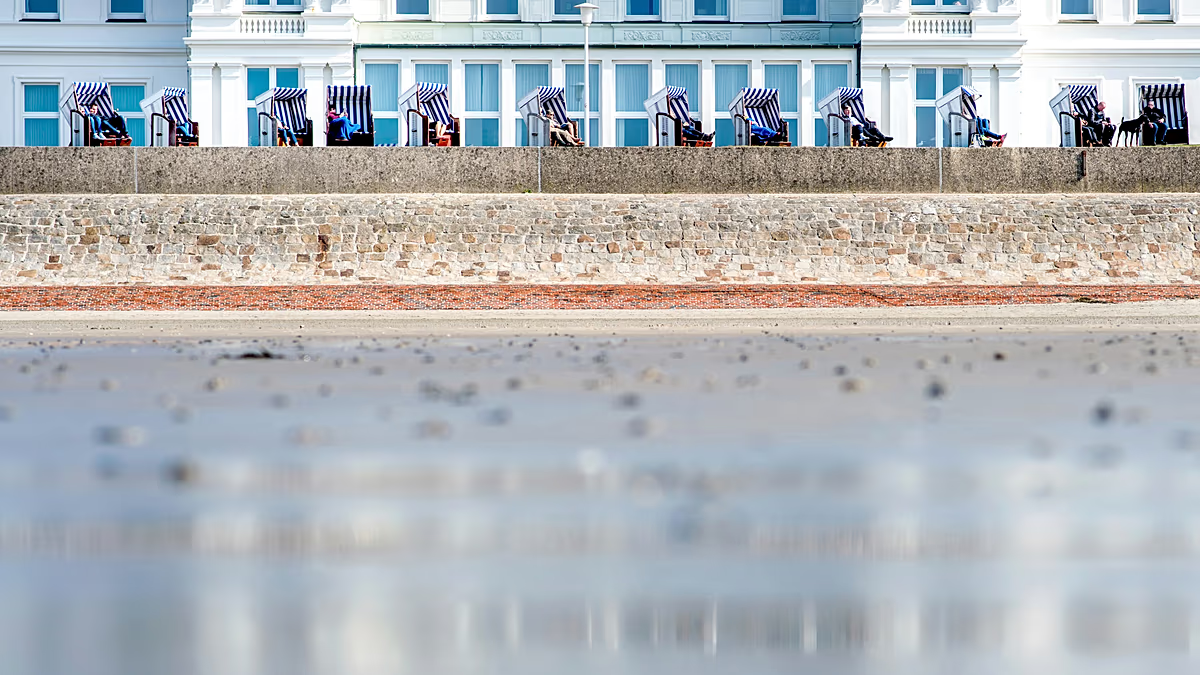
Strung along the coast of Lower Saxony like a protective barrier of sand and sea grass lie the East Frisian Islands, a chain of unique maritime worlds where car-free streets, sweeping dunes, and a distinct cultural heritage create an unparalleled atmosphere of relaxation. Among these, the tiny island of Baltrum, affectionately known as the “Sleeping Beauty of the North Sea,” offers a compact sanctuary of less than seven square kilometers where visitors can easily explore every corner on foot, guided only by the sound of the surf and the sea wind. Nearby Langeoog presents a slightly larger but equally tranquil escape, characterized by its towering, grass-covered dunes, endless sandy beaches, and a vibrant avian population that thrives in the island’s protected salt meadows. Further along the archipelago, Spiekeroog stands out as a living monument to maritime history, preserved through its narrow, lime-tree-lined avenues, historic captain’s houses, and a deliberate refusal to allow large-scale modern resort developments, choosing instead to focus on wellness, nature, and the preservation of its pristine coastal ecosystems. On Wangerooge, the easternmost inhabited island of the chain, the slow-paced lifestyle begins the moment visitors board the nostalgic, narrow-gauge island railway that chugs slowly from the harbor through salt marshes to the main village, offering glimpses of resting seals and diving seabirds along the way. Meanwhile, the long, slender island of Juist, stretching seventeen kilometers but measuring only a few hundred meters wide, epitomizes the ultimate car-free retreat, where heavy goods and passengers alike are transported solely by beautiful, horse-drawn carriages, allowing the natural symphony of the Wadden Sea and the endless horizons of the North Sea to take center stage. For those seeking an even deeper connection to this watery wilderness, the uninhabited former island of Arngast in the nearby Jade Bay offers a hauntingly beautiful destination; though no longer populated, its solitary, red-and-white striped lighthouse rises dramatically from the mudflats, reachable only by guided walks across the seabed at low tide, serving as a poignant monument to the shifting forces of nature.
While the cold, salty winds of the north command much of Germany’s island lore, the southern regions of the country offer their own spectacular, albeit vastly different, island experiences nestled within the dramatic, alpine-framed waters of Lake Chiemsee. Known as the “Bavarian Sea,” this expansive lake is home to three main islands that prove an island escape does not require a trip to the ocean. The most culturally vibrant of these is the Fraueninsel, or Women’s Island, a tiny, car-free paradise of just fifteen hectares that feels like a living watercolor painting. At its heart lies the historic Benedictine convent of Frauenwörth, founded in the late 8th century by Duke Tassilo III, where a community of nuns still lives and works today, keeping centuries of spiritual and artisanal traditions alive. Walking along the island’s narrow, winding paths, visitors are enchanted by beautifully manicured cottage gardens, historic fishermen’s homes, and small artisan workshops selling everything from handmade pottery to traditional marzipan and herbal liqueurs crafted by the nuns. Just a short distance across the sparkling blue water lies the Krautinsel, or Herb Island, the smallest and most primitive of the trio. Uninhabited and completely untamed, this flat, green jewel got its name from the Middle Ages when the nuns of Fraueninsel and the monks of neighboring Herreninsel cultivated cabbage and vegetables in its fertile soils. Today, the Krautinsel has reverted to a pure nature reserve, closed to visitors and serving as a quiet sanctuary for rare marsh plants, nesting waterfowl, and grazing livestock, offering a peaceful glimpse of the lake’s prehistoric landscape to those who pass by on local passenger boats.
Completing the Chiemsee trio is the majestic Herreninsel, or Men’s Island, which, at 230 hectares, is the largest of the lake’s islands and home to one of Germany’s most opulent historical landmarks: Herrenchiemsee Palace. Commissioned in 1878 by the eccentric “Fairytale King” Ludwig II of Bavaria, this grand estate was designed as a direct, glittering homage to Versailles and the French “Sun King” Louis XIV, complete with a breathtaking Hall of Mirrors and magnificent, symmetrical gardens adorned with elaborate fountains. Yet, despite the grandeur of this unfinished royal monument, the true magic of Herreninsel often lies beyond the palace walls, where the manicured gardens abruptly give way to deep, ancient beech and fir forests crisscrossed by miles of silent, pine-needle-strewn walking trails. Hikers who venture away from the main tourist paths are rewarded with quiet, sun-dappled clearings and hidden shoreline lookouts that offer panoramic views of the crystal-clear lake, framed by the snow-capped peaks of the Bavarian Alps in the distance. Ultimately, whether it is the wind-scoured mudflats of the North Sea, the quiet beech forests of the Baltic, or the mountain-ringed shores of Lake Chiemsee, Germany’s lesser-known islands reveal a common truth: that true luxury in the modern world is not found in grand resorts or bustling attractions, but in the rare and quiet spaces where we can reconnect with the earth, slow our breathing, and listen to the natural rhythms of the world.