

Close your eyes and recall the sights, sounds, and distinct tactile sensations of your middle school math classroom. There is the steady, rhythmic drone of the teacher’s lecture, the sharp scraping of metal desk legs against the hard linoleum floor, the faint scent of pencil shavings, and the inevitable, frustrating battle with school-issued stationery. For generations of students, geometry class has been defined by a cheap, transparent piece of plastic: the standard classroom protractor. It is a fragile, easily warped tool that has remained virtually unchanged for decades, notorious for sliding out of alignment at the exact moment you try to draw a precise line, with its tiny, faded black numbers quickly becoming illegible under daily wear and tear. For most of us, this was simply an accepted, minor annoyance of adolescence—a small friction point to be tolerated until the final bell rang. But for fourteen-year-old Wenxin Fang, an eighth grader sitting in his geometry class at Evergreen Middle School in Redmond, Washington, this flimsy piece of plastic represented an unnecessary design failure that disrupted his academic focus. He grew increasingly exasperated by the repetitive, clumsy process of marking an angle’s vertex, lifting the plastic, realigning the edge, and trying to draw a clean ray without the tool slipping out of place. Why, he wondered, should a student have to fight so hard with a cheap piece of plastic just to perform a fundamental mathematical task? Rather than resigning himself to the status quo, Fang decided to take matters into his own hands. Pulling out his school notebook, he began to sketch alternative concepts in the margins of his paper, transforming his classroom frustration into a creative blueprint for change. This spontaneous act of teenage defiance marked the birth of a project that would consume his high school years, driving him to redesign a basic learning tool from the ground up and challenge the decades-old standards of educational hardware.
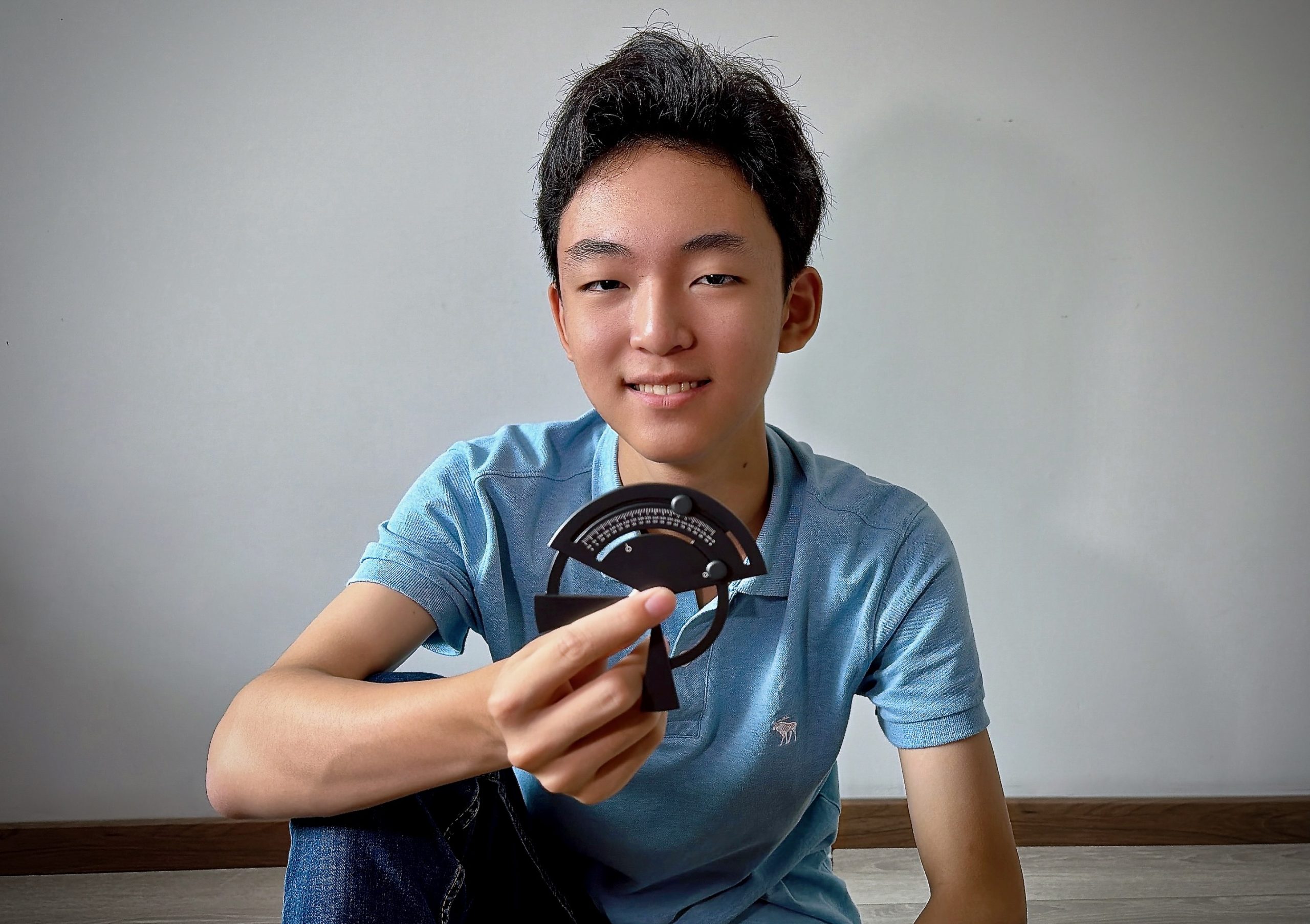
The journey from those initial, frustrated notebook sketches to a market-ready, professional-grade physical product would require more than two and a half years of relentless dedication, intellectual curiosity, and self-taught engineering. As Fang transitioned from middle school to the academically rigorous environment of Tesla STEM High School, his conceptual designs matured alongside his growing understanding of physics, mathematics, and industrial manufacturing. He went through seven complete design iterations, constructing prototype after prototype, testing various materials, and refining the tool’s mechanics through trial and error to achieve the perfect balance of friction and smooth movement. Fang quickly realized that to make a meaningful improvement, he had to entirely abandon the traditional semi-circular plastic layout that had constrained students for generations. Instead, he envisioned a dynamic, linear system built around a guide-rail sliding mechanism that moved with the user. Rather than requiring a user to execute multiple, disconnected steps to plot an angle, Fang’s innovative design allowed for the plotting, measuring, and drawing of precise angles in a single, fluid, sweeping motion. To bring this vision to life, he bypassed cheap plastics in favor of anodized aluminum—a premium, highly durable material that gave the instrument a satisfying weight, smooth tactile response, and exceptional longevity. This choice of aluminum was a point of pride for Fang, who stubbornly insisted on the material despite the significantly higher production costs, believing that students, artists, and creators deserved an educational tool that felt like a high-precision professional instrument rather than a disposable piece of trash.
No ambitious invention is born in a complete vacuum, and Fang’s creative evolution was heavily nurtured by a remarkable and supportive ecosystem of mentorship at Tesla STEM High School. Recognizing that his high-end protractor sketches had the potential to become a real-world consumer product, Fang sought out the expertise of his teachers, who enthusiastically transformed his personal hobby into a structured, educational launchpad. Together, they helped him establish his own corporate entity, Bonae Artis LLC, and guided him through the complex realities of product design, corporate structure, and business operations. Steven Bonomo, an engineering and product design teacher who brought years of valuable industry experience from working on Microsoft’s prestigious Surface Laptop line, became an essential mentor, guiding Fang through user testing, structural ergonomics, and high-tolerance physical design. Andrew Christensen, drawing on his legal background, walked the teenage entrepreneur through the complex legal and operational logistics of setting up a business, protecting intellectual property, and managing contracts. Meanwhile, Karen Schaeffer, a graphic design teacher, helped Fang develop a clean, modern brand identity, ensuring that the visual packaging and marketing of the product matched the high-quality feel of the aluminum hardware itself. This collaborative environment functioned as a real-world incubator, allowing Fang to run extensive user-testing sessions in his classes, collecting vital feedback from his classmates regarding grip, feel, and usability, which he used to refine the tool’s tactile performance and mechanics under actual classroom conditions.
With a validated, professional prototype finally in hand, Fang took a bold leap into the massive, intimidating world of global logistics, manufacturing, and international commerce. At just seventeen years old, he traveled across the world to Shenzhen, China—the global capital of hardware manufacturing—to personally tour bustling production facilities, negotiate with suppliers, and establish a manufacturing partnership with HKAA Industrial to produce his custom-machined aluminum components. Standing on the factory floor and watching raw metal being transformed into the precise shapes he had designed in his bedroom was a surreal experience for the young inventor, bridging the gap between digital blueprints and physical reality. To secure the funding necessary to cover the expensive initial tooling and production costs, Fang launched a public crowdfunding campaign on Kickstarter on July 26. He positioned his creation, named the ZeroPivot Protractor, as a premium, $19 lifetime investment, standing in stark contrast to the flimsy $3 plastic models that constantly break and require replacement. The global crowdfunding community responded with immediate and overwhelming enthusiasm, pushing the campaign to hit its initial funding goal within a mere forty-eight hours of launch, and raising thousands of dollars from early backers around the world who were captivated by both the product’s elegance and its young creator’s vision. Managing a complex international supply chain, vetting manufacturing partners across different languages, and communicating with global backers while still in high school served as an incredibly intense, real-world masterclass in global entrepreneurship, proving that age is no barrier to entering the international marketplace.
The public success of the ZeroPivot Protractor is undeniably impressive, but the quiet human story behind it is one of deep self-discipline, sacrifice, and a tireless work ethic. Balancing the relentless academic pressures of a competitive STEM high school with the heavy operational demands of a hardware startup requires a level of maturity and focus that few teenagers possess. While his classmates are relaxing, playing video games, or hanging out after school, Fang’s days and nights are frequently consumed by late-night design reviews, coordinating with Chinese suppliers across massive time differences, and setting strict, self-imposed deadlines to keep production moving forward. He is the sole driver of his company, meaning that if he does not push the project forward, it simply stops, requiring him to maintain a high level of intrinsic motivation. This remarkable work ethic is not a sudden, high school development, but rather the continuation of a lifelong creative impulse that dates back to his early childhood and was nurtured by his family. At just nine years old, during the festive preparations for the Chinese Lunar New Year, Fang used Lego bricks and superglue to construct a custom-engineered ceiling hook to help his elderly grandparents hang delicate decorative lanterns safely. That early, heartwarming memory of using basic design principles to solve a practical family problem laid the foundation for his entire engineering philosophy, teaching him at a young age that physical design is at its most beautiful when it is used to make human lives just a little bit better.
Looking ahead, Fang is completely focused on fulfilling his promises to his backers, with his sights set on executing the manufacturing run smoothly in China and shipping the finished ZeroPivot protractors to supporters by his estimated February delivery goal. While he is not quite ready to redesign other classic classroom tools like the wooden ruler or the pink eraser, he envisions a long, fruitful career in mechanical engineering and product design, viewing the ZeroPivot Protractor as just the first step in a lifelong journey of physical problem-solving. He strongly believes that physical objects possess a unique soul and tactile connection that digital screens and software can never fully replicate, which drives his passion for traditional hardware. For Fang, the ultimate reward of this challenging, multi-year endeavor is not the money raised or the media attention, but the deeply human satisfaction of knowing that his creation will soon find its way into the hands of students, artists, and engineers around the world. His story serves as an inspiring reminder of what can happen when youthful curiosity is paired with supportive mentorship, relentless self-discipline, and a refusal to accept bad design. By taking a simple, everyday middle school frustration and transforming it into a beautifully engineered, high-performance tool, Wenxin Fang has proven that with enough passion and determination, even a teenager can reshape the world around them, one angle at a time.