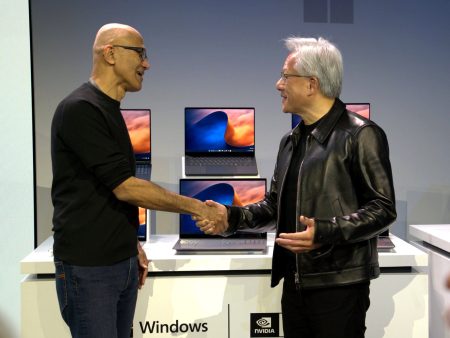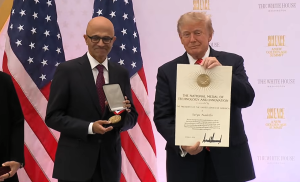


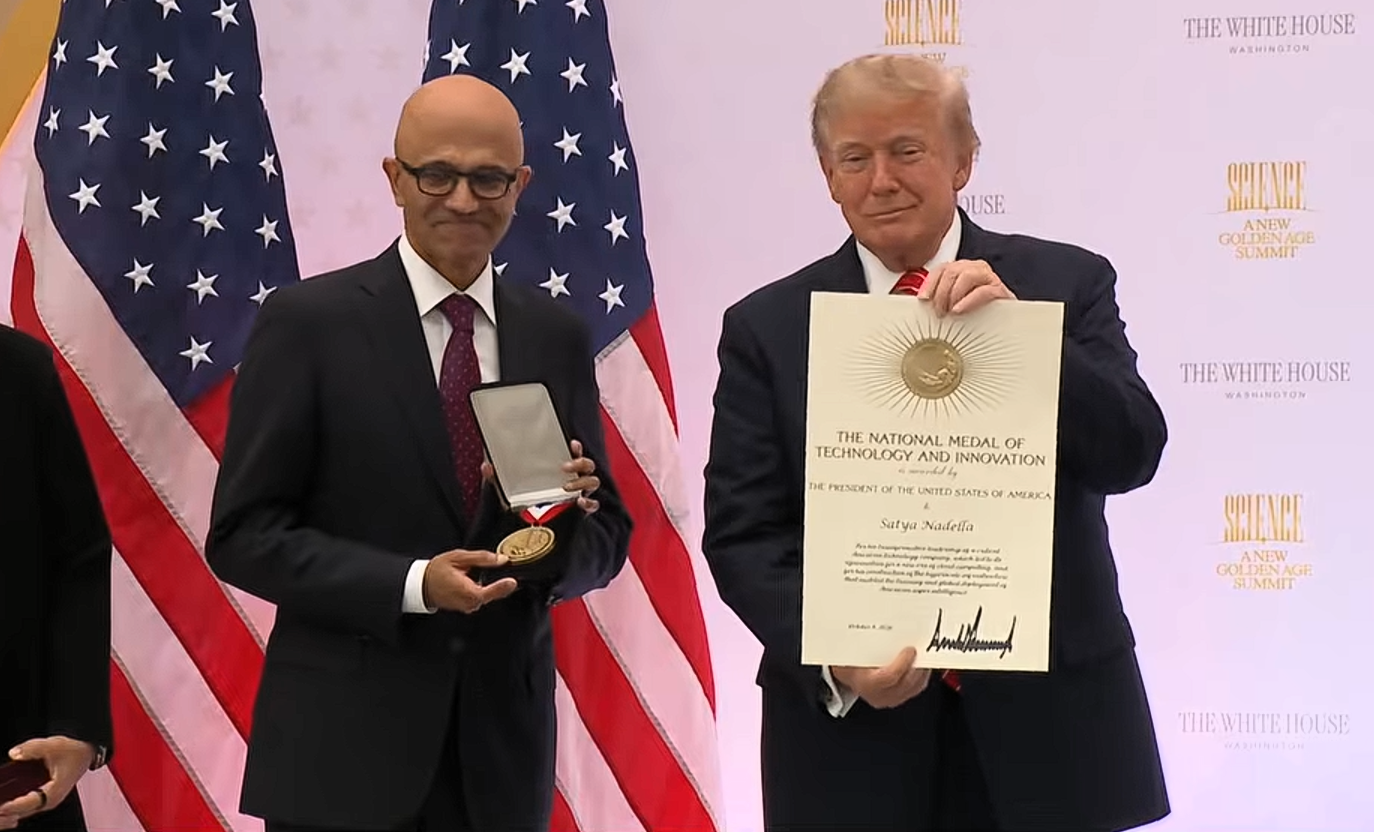
The White House ceremony was designed as a celebration of American ingenuity, a moment of bipartisan glamour with the president bestowing the National Medal of Technology and Innovation on some of the most powerful figures in the country. Satya Nadella, Microsoft’s chief executive, stood beside tech luminaries including Elon Musk as President Trump praised him for making Microsoft “an early leader in superintelligence” and for building the hyperscale infrastructure that made the modern AI boom possible. The official citation was glowing, honoring Nadella for his “transformative leadership of a critical American technology company” and for enabling the global deployment of American superintelligence. And yet, beneath the gold-plated surface of that moment, a sharply contradictory message was being delivered by the very same administration. Just hours before Nadella accepted his medal, Vice President JD Vance had stood in a White House news conference and announced that the federal government was suspending Microsoft from a key immigration program, accusing the company of systematically abusing it. The juxtaposition was striking: one branch of the executive branch praising a corporate titan for its leadership in cutting-edge technology, while another branch was throwing up regulatory barriers designed to limit how that company hires foreign-born talent. It was a vivid illustration of the complicated, and often contradictory, relationship between the tech industry and the political forces that both celebrate and scrutinize it.
Vance did not mince words. At the morning press conference, he delivered a blistering indictment of Microsoft’s immigration practices, claiming that the company had laid off 6,000 American workers in the previous year while simultaneously receiving 6,300 H-1B visas and nearly 3,000 green cards. In Vance’s telling, this was not a coincidence but a deliberate strategy: Microsoft, he argued, was replacing higher-paid American employees with lower-paid foreign workers who had little choice but to accept whatever compensation and conditions were offered because their immigration status depended on their employer. His rhetoric was blunt and accusatory. “There has been no company in the United States, unfortunately, that has abused the system more than Microsoft,” he declared, before softening his tone just enough to say, “Our message to Microsoft is you’re a great American company, but you’ve got to hire great American workers.” The implication was clear: a company that had become synonymous with corporate success and technological dominance was being singled out as the poster child for a broken, exploited visa system. The numbers Vance cited were stark, and they were clearly chosen to provoke an emotional reaction. Layoffs of American workers are always painful, and the idea that a wealthy, successful corporation would intentionally push those workers aside in favor of cheaper foreign labor touches a raw nerve in American economic anxiety. But as with many political sound bites, the reality beneath the headline was more complex, and Microsoft was prepared to contest the narrative.
Microsoft’s response arrived quickly, framed not as a defensive rebuttal but as a measured correction of what it described as misleading statistics. The company pointed out that of the roughly 6,000 H-1B applications it had filed in the previous fiscal year, 80 percent were not for new foreign workers entering the country at all. Instead, they were extensions or status changes for people already employed at Microsoft, individuals who were already living in the United States legally and simply trying to maintain their ability to continue working. The remaining 20 percent, Microsoft said, were for new hires who were already in the U.S. on other legal visas, and that group represented only about 1 percent of the company’s total American workforce. “They are not new arrivals to our country,” the company stated, pushing back against the image of waves of foreign workers flooding in while American employees were discarded. Microsoft also defended its compensation practices, saying it paid H-1B employees the same as any other worker doing comparable work, and that its wage levels were among the highest of all H-1B filings. The company’s statement carefully avoided any direct mention of the suspension itself, but it expressed a desire to provide the administration with further information, signaling that it intended to cooperate rather than litigate the matter in public. Still, the underlying tension was unavoidable. Microsoft employs tens of thousands of people in the United States, and the vast majority of its workforce is American. But the company also relies on highly skilled engineers and researchers from around the world, especially in fields like artificial intelligence, where the competition for top talent is ferocious. For Microsoft, the H-1B program is not a scheme to undercut American wages; it is a critical lifeline for staying at the cutting edge of innovation.
The specific mechanism behind the suspension is the Labor Department’s Permanent Labor Certification program, commonly known as PERM. This program is usually the first step in a long and arduous process by which a company sponsors a foreign worker for a green card, allowing that person to live and work in the United States permanently. To obtain PERM approval, an employer must advertise the job and demonstrate to the government that no equally qualified American worker was available for the position. It is a labor-intensive, highly regulated process that can take years to complete. By suspending Microsoft from this program, Labor Secretary Keith Sonderling announced that the department would not accept any new PERM applications from the company and would not process any applications that were already pending. This is a serious penalty, because it effectively freezes the path to permanent residency for thousands of Microsoft employees who were hoping to solidify their futures in the United States. Importantly, the suspension does not block Microsoft from applying for H-1B visas, which are temporary work visas and need to be renewed periodically. But without the ability to pursue a green card through PERM, those H-1B holders are left in a state of permanent uncertainty, never able to fully commit to the country they have adopted. The Labor Department also suspended Adobe and six major IT outsourcing firms: Cognizant, Infosys, Tata, Wipro, HCL and Capgemini. These companies, like Microsoft, rely heavily on guest workers, and the suspension was clearly intended to send a message across the entire technology sector. At the ceremony later that day, President Trump made no mention of the suspension. Instead, he showered Nadella with praise, calling the award “so well deserved.” The disjointed nature of the day could not have been more apparent.
In Seattle, Washington, where Microsoft is headquartered, the announcement sent ripples through the tech community. Xiao Wang, co-founder and CEO of Boundless, a startup that helps immigrants navigate the U.S. legal system, described the news as part of a “continuous, nonstop deluge of immigration-related news leading up to the midterms.” Wang rejected Vance’s characterization of H-1B workers as “foreign indentured servants,” noting that the program includes wage requirements specifically designed to prevent employers from underpaying their visa holders. He also emphasized the enormous economic benefits of educating and employing international students and workers, many of whom spend years studying at American universities before entering the workforce. If the United States makes it difficult or impossible for these people to stay, Wang warned, those talented individuals will simply go elsewhere, and the American economy will suffer. He cautioned against the idea that layoffs and foreign recruitment are directly related, pointing out that in a giant company like Microsoft, hiring and firing decisions are driven by entirely different strategic considerations. Someone laid off from a gaming division is not automatically interchangeable with an H-1B employee who is a specialist in agentic AI working on a product like Copilot. Layoffs are often about cutting costs or pivoting priorities, while hiring is about building new capabilities. Wang’s broader worry was what he called the “long-term chilling effects” of an aggressive immigration stance, effects that could undermine American prosperity and competitiveness in the decades to come. For him, the question was not simply whether companies are abusing the system, but whether the country is shooting itself in the foot by turning away the very people who help power its most important industries.
The human dimension of this debate was captured by Priyanka Kulkarni, founder and CEO of Casium, an immigration technology company. Kulkarni spent more than a decade at Microsoft building enterprise AI technology, and she personally lived through the H-1B process before eventually becoming a permanent resident. She spoke warmly of her time working alongside colleagues from around the world, people whose expertise had helped build technology that American businesses use every single day. “I worked alongside people from around the world whose expertise helped build technology used by American businesses every day,” she said. Her story is a reminder that behind the statistics and the political rhetoric are real people with real families, real aspirations, and real contributions to the American economy. Kulkarni emphasized that if the United States truly wants to lead in artificial intelligence, it cannot close its borders to the very talent that makes that leadership possible. “That requires attracting and retaining exceptional people, and giving them confidence that they can build a future here,” she said. Her perspective, and the perspective of countless other immigrants in the tech industry, is that the visa system is not a loophole to be exploited, but a vital mechanism for maintaining America’s status as the world’s innovation capital. The same day that Microsoft’s CEO was awarded a national medal for the company’s role in advancing superintelligence, the Trump administration was sending an equally powerful message about its desire to restrict access to global talent. The contradiction was impossible to ignore. The medal and the suspension, the praise and the punishment, tell a complicated story about a nation grappling with its own identity, caught between the impulse to protect American workers and the recognition that innovation does not recognize borders. If the golden age of science the president celebrated is to be real, it will require not just hardware and algorithms, but people, from everywhere, who are willing to dream and to build. And whether those people choose to do that in the United States may depend on how welcome they truly feel.