


Seattle’s economy is at a crossroads, and Mayor Katie Wilson is betting that the city’s future will be shaped not by any single industry, but by a broad coalition of voices pulling in the same direction. On Wednesday, Wilson announced the formation of the Resilient Seattle Economy Task Force, an 18-member group drawn from the city’s most influential sectors — including Amazon, Spotify, the Port of Seattle, organized labor, technology, cleantech, small business, and more. The task force is charged with a deceptively simple but enormously ambitious mission: find ways to tear down the barriers that hold back business growth, make Seattle a more attractive home for companies of every size, and smooth the often frustrating path of starting and operating a business in the city. In her announcement, Wilson framed the effort as both a response to immediate pressures and a long-term investment in the city’s identity. “I’m charging this task force with identifying where the City can make connections, remove barriers and provide support within individual industries and across our economy,” she said. “We need to diversify our economy while expanding opportunities for local entrepreneurs and young people.” The message is clear: Seattle has long ridden the waves of big tech, but the city can no longer afford to put all its hopes in one sector.
The task force’s membership reflects that desire for a wider lens. The roster includes Jared Axelrod, a senior manager of public policy at Amazon, and Katie Garrow, executive secretary-treasurer of MLK Labor, as well as Yifan Zhang, managing director of AI House, a sign that the city is trying to bridge the gap between corporate giants, workers, and the cutting-edge startups that could define its next boom. Joining them are leaders from the Port of Seattle, cleantech firms, small businesses, and other corners of the local economy. This is not a group designed to be a rubber stamp; it is a collection of stakeholders with sometimes competing interests, and that is precisely the point. The task force’s success will depend on whether these leaders can look past their own sectors and find common ground. Their mandate is broad: identify where the city can make meaningful connections between industries, remove the regulatory and logistical hurdles that make Seattle harder to navigate than it should be, and create an environment where businesses not only want to set up shop, but also stay and grow. The emphasis on cross-sector collaboration is intentional, because the city’s biggest challenges — public safety, downtown revitalization, affordability, and workforce development — do not respect industry boundaries. If Seattle is going to recover its swagger, it will need to tackle these issues from every angle, and the task force is Wilson’s attempt to do exactly that.
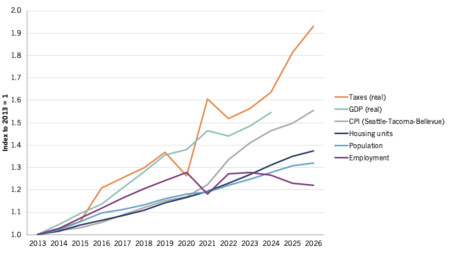
The urgency behind the task force is rooted in a sobering reality check. Seattle recently released a report called Seawall: Building a Resilient Seattle Economy, which looked squarely at the city’s over-reliance on large technology companies and asked a difficult question: what happens when that foundation starts to crack? The findings were stark. Between 2014 and 2023, companies with at least 100 employees accounted for 74.5% of net job growth in the Seattle metro area, while mid-sized companies contributed just 16.6%. In other words, Seattle’s economy is heavily dependent on a relatively small number of big employers — and when those employers hit turbulence, the whole city feels it. The numbers since 2020 paint an even more troubling picture. Seattle lost roughly 24,000 jobs between March 2020 and March 2025, even as city tax collections continued to climb. That strange combination — fewer jobs, more revenue — has shifted an increasingly heavy tax burden onto businesses, making it more expensive to operate in a city that is already grappling with a reputation for being difficult to work with. The report called for Seattle to diversify into sectors like artificial intelligence, cleantech, maritime, life sciences, and space. Those industries offer hope, but they will not thrive on their own. They need the city to be a willing partner, not an obstacle.
Mayor Wilson has already started responding to those economic pressures, and her actions have not gone unnoticed in the business community. In her proposed 2027 budget, Wilson froze JumpStart tax rates, a move she described as a necessary response to “seismic shifts” in the technology sector. The JumpStart tax, which was created to fund affordable housing and other social programs, has been a point of contention for years. Business leaders have argued that it makes Seattle less competitive and penalizes the very companies that drive the local economy. Wilson’s decision to freeze the rates was widely seen as an olive branch, a signal that City Hall is listening to the concerns of employers. But the task force is about more than just tax policy. It also comes at a moment when Seattle’s business community has grown increasingly vocal about public safety. In recent months, dozens of regional CEOs have called on City Hall to implement a 100-day plan with measurable goals and regular progress reports, arguing that a city that does not feel safe cannot truly be open for business. Beto Yarce, director of the Seattle Office of Economic Development, struck a hopeful tone when he said, “Seattle is open for business.” But the tagline will ring hollow unless the city can demonstrate progress on the ground. The task force represents an opportunity to turn that sentiment into concrete action.
The task force’s work plan is ambitious and, importantly, tied to a timeline. This year, it will hold industry-specific roundtables and listening sessions across the city, giving businesses, workers, and community groups a chance to share their experiences and ideas. Initial findings are due in February 2027, with a final report expected in November 2027. That may seem like a long way off, but the task force’s early focus areas are already clear: downtown revitalization, business attraction and retention, cross-sector collaboration, and making it easier to open and operate a business in Seattle. Each of these priorities speaks to a specific pain point. Downtown, long the economic heart of the city, has struggled with empty storefronts, remote work, and lingering safety concerns. Business attraction and retention are about convincing companies that Seattle is not just a great place to be born, but also a great place to grow up. Cross-sector collaboration is about breaking down silos, and simplifying business operations is about making sure that a great idea does not get buried in paperwork. The task force’s membership includes people who understand these challenges firsthand, from Amazon’s public policy team to labor leaders and AI entrepreneurs. Their voices will shape the recommendations, but ultimately, the test will be in the follow-through.
In the end, the Resilient Seattle Economy Task Force is a gamble on the power of collective action. It acknowledges that Seattle’s future cannot be built by one company, one industry, or one level of government. It requires a shared commitment to solving the messy, interconnected problems that have made this city harder to live in and do business in than it used to be. The task force is not a magic wand, and its recommendations will not automatically become policy. But it is a start — a recognition that the status quo is no longer sustainable. Mayor Wilson has staked her leadership on the idea that Seattle can chart a new course, one that preserves the innovation and energy that made the city famous while building a more resilient and diversified economy. Whether that vision becomes reality will depend on the willingness of the task force members to move beyond their own interests and think about the city as a whole. For Seattle’s workers, entrepreneurs, and families, the stakes could not be higher. The city is not being asked to choose between its past and its future; it is being asked to build a future that includes everyone. The task force’s 18 members, and the mayor who brought them together, have at least opened the door. Now comes the harder part: walking through it together.