


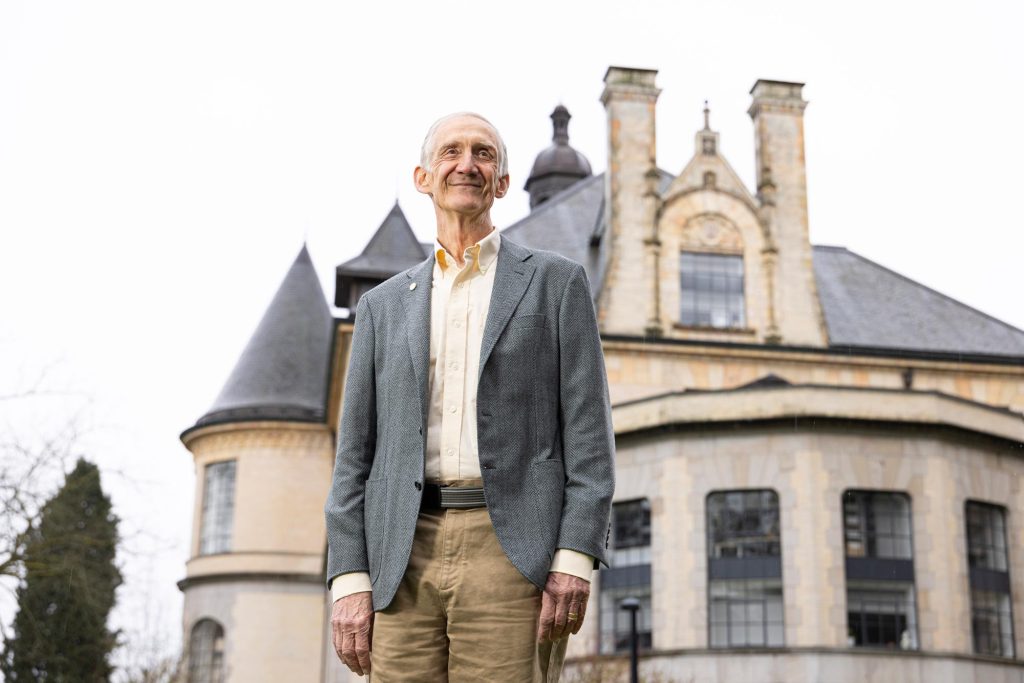
The trophy shelf in Ed Lazowska’s office is already remarkably crowded with artifacts symbolizing a lifetime of relentless intellectual curiosity, academic brilliance, and community building, but he is going to need to clear out just a little more space. The longtime University of Washington professor emeritus, who has served as an irreplaceable fixture in Seattle’s tech ecosystem for nearly five decades, was recently honored with the prestigious 2026 Distinguished Teaching Legacy Award. Published by UW Magazine, the news of this accolade adds yet another shiny crown to a staggering list of achievements that Lazowska has piled up over his forty-eight-year run at the university. His lifetime of work has earned him the university’s Outstanding Public Service Award, the David B. Thorud Leadership Award, and the computer science department’s premier Undergraduate Teaching Award. While these individual honors are indeed impressive, this newest recognition holds a deeply personal, emotional resonance for the veteran educator. Reflecting on the honor, Lazowska noted that while university faculty members are expected to navigate incredibly diverse, complex roles within modern institutions, they are, first and foremost, educators. For a teacher who has spent his entire career championing the minds of young developers, engineers, and researchers, being recognized specifically by his former students and alumni for having a long-term, transformative impact on their lives represents the absolute greatest imaginable honor. This award beautifully humanizes his career, demonstrating that Lazowska’s ultimate legacy is not just written in scholarly papers or commercial success, but is deeply carved into the character, accomplishments, and lives of the people he taught. It shows a man who did not merely deliver academic lectures from a distance, but who cultivated a warm, inclusive environment where students felt inspired to push the boundaries of human knowledge and remake the modern world.
When Lazowska first arrived at the University of Washington back in the autumn of 1977, the Pacific Northwest was a fundamentally different place, far from the booming global technology capital we recognize today. In those early, nostalgic days, the regional technology industry was in its absolute infancy, so much so that Lazowska fondly points out that Microsoft was nothing more than a scrappy team of twelve kids operating out of Albuquerque, New Mexico. Over the ensuing decades, Lazowska did not simply witness the dramatic evolution of the region’s tech ecosystem; he was one of its primary architects, helping to mold Seattle from a timber-and-shipping hub into a powerhouse of digital innovation. Under his energetic leadership, the university’s computer science department underwent a massive, historic transformation, growing from a small academic unit into the elite, world-renowned Paul G. Allen School of Computer Science & Engineering. Lazowska possessed a unique clarity of vision, recognizing early on that the university and the broader region had to grow together in a deeply symbiotic relationship. He passionately championed a fluid, open-door culture of collaboration that successfully bridged the traditional divide between academic theory and practical corporate application. By fostering enduring strategic partnerships with local visionaries, startup incubators, and corporate titans, he helped establish a highly fertile intellectual ground where both the Allen School and the surrounding commercial technology sector could thrive in tandem. For Lazowska, this long and historic path has been an incredibly rewarding ride—one that proves that high-quality, accessible computer science education is the vital, pulsing heart of our modern society, and that the success of our technology is fundamentally tied to the quality of our academic institutions.
The true depth of Lazowska’s educational legacy is perhaps best illuminated not through his own impressive list of publications, but through the deep gratitude of the students who sat in his classrooms decades ago. Among those who enthusiastically nominated him for this legacy award were some of Seattle’s most notable tech veterans, whose highly successful careers serve as a living testament to his teaching philosophy. Robert Short, a 1986 University of Washington alumnus and longtime Microsoft executive, recalled watching with immense awe as Lazowska’s proactive leadership transformed UW’s computer science program into an absolute international powerhouse. Short emphasized that Lazowska provided a unifying driving force and an unwavering focus on attracting, supporting, and growing the absolute finest faculty members imaginable, while simultaneously building lasting relationships across the entire Pacific Northwest region. Similarly, Patrick Jenny, a dual UW graduate from 1986 and 1991 who spent eighteen highly successful years at F5 Networks, wrote warmly about how he became a significantly better leader, a more skilled engineer, and a prouder Husky entirely because of Lazowska’s positive personal impact on his life. These heartfelt testimonies paint a vivid picture of a professor who viewed his students not as temporary faces in a stadium lecture hall, but as life-long colleagues deserving of respect, advocacy, and continuous encouragement. Lazowska understood that the most critical part of an educator’s job is to build confidence, foster integrity, and maintain a lifelong relationship that continues long after the final exams are graded, showing how deep mentorship can ripple through generations of industry leaders and shape the ethical foundation of a whole field.
While his heart has always remained rooted in the human element of teaching, Lazowska’s academic credentials and technical achievements are equally legendary, illustrating his influence as a premier scientific pioneer. He had the distinctive honor of serving as the inaugural holder of the prestigious Bill & Melinda Gates Chair at the Paul G. Allen School, a position that perfectly symbolized his central role in elevating the university to the upper echelons of computer science globally. Furthermore, his research accomplishments led him to become the very first faculty member from UW’s Computer Science & Engineering program to be elected to the highly prestigious National Academy of Engineering, as well as the first to be named a fellow of the prestigious American Academy of Arts and Sciences. Lazowska’s innovative research and classroom instruction focused heavily on the design, implementation, and analysis of computing and communication systems, as well as the pioneering techniques and emerging technologies of data-intensive scientific discovery. Long before “big data” and “cloud computing” became ubiquitous terms in our everyday lexicon, Lazowska was working hard to understand how massive datasets could be used to solve some of the world’s most pressing problems. He recognized that computer science was not merely about writing efficient software code, but about constructing the essential digital infrastructure that would power modern medicine, environmental science, and daily human communication, ensuring that technology was always developed with a clear focus on serving human needs and expanding our collective potential.
Lazowska’s far-reaching impact has never been confined merely within the ivy-covered brick walls of the university; instead, he has spent decades acting as an energetic, essential bridge connecting academic research with the local business and civic communities. He has served as a trusted board member, insightful policy advisor, and technical guide for a wide variety of forward-thinking corporations, venture capital firms, and civic organizations. Currently, his active community engagements include advising cutting-edge institutions like the Allen Institute for Artificial Intelligence, Madrona Venture Group, and Pioneer Square Labs—each a critical pillar in Seattle’s modern startup and technological innovation ecosystem. His remarkable ability to blend high-level academic theory with pragmatic, real-world business strategy helped create a culture where local companies prioritized philanthropic investment back into public education, ensuring a continuous loop of regional prosperity. His tireless efforts and vibrant, community-oriented personality even earned him the playful but highly coveted “Geek of the Year” title at the annual GeekWire Awards in 2017. This unique honor perfectly captures his approachable, charismatic, and lighthearted disposition; despite his massive academic success, Lazowska has always remained incredibly down-to-earth, holding a genuine passion for his community and an infectious sense of humor that makes complex technology feel accessible, exciting, and deeply human to people from all walks of life, showing that brilliant minds can also be incredibly warm and funny.
As Lazowska steps into his well-deserved role as a professor emeritus after an incredible forty-eight years of active service, he remains as deeply optimistic and passionate about the future of computer science as he was on his very first day. Rather than viewing his retirement as a quiet conclusion to a long career, he sees it as the continuation of an ongoing journey, looking forward to the emerging horizons of artificial intelligence, advanced computing, and ethical technology. He continues to firmly believe that computer science is no longer a niche, isolated technical discipline reserved for specialists, but has instead transformed into an essential literacy that is absolutely central to navigating and understanding the modern world. For Lazowska, the grand adventure of computer science is still in its early chapters, and his work will continue to shape how future generations learn, innovate, and connect with one another. His legacy is not a static list of awards gathering dust on a shelf, but a living, breathing network of inspired professionals, world-class academic institutions, and revolutionary technologies that will continue to enrich the Pacific Northwest and the global community for many decades to come. By humanizing the technical world of computers, Ed Lazowska did not just teach his students how to build smarter machines—he taught them how to build a better, more connected, and more compassionate society.