





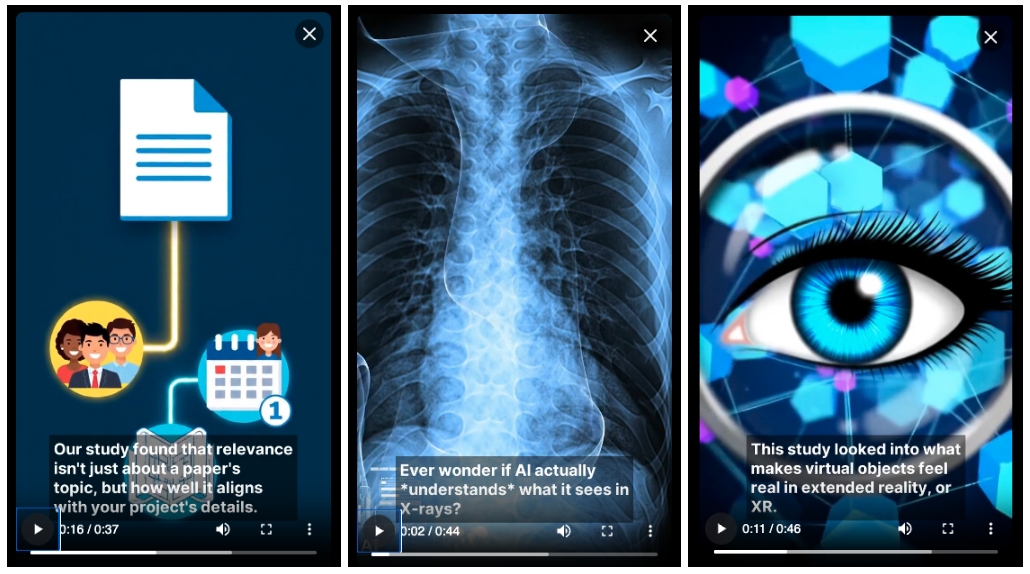
In an era dominated by rapid, algorithm-driven social media feeds, the average internet user is constantly bombarded by a tide of synthetic content, colloquially known as “AI slop.” This content often dresses up pseudo-science in convincing, flashy graphics, muddying the waters of public understanding on crucial, complex topics like medical breakthroughs, climate change, and technological advancement. For academic researchers whose lives are dedicated to rigorous, peer-reviewed discoveries, watching their life’s work get drowned out by sensationalized, inaccurate digital noise is deeply frustrating. Recognizing this growing divide between complex academic research and everyday social media consumers, a visionary team of researchers at the University of Washington (UW) has stepped up to level the playing field. Led by doctoral student Meziah Ruby Cristobal, along with her colleague Donghoon Shin and professor Gary Hsieh, this team has developed PaperTok—a free, innovative tool designed to help scientists easily reclaim their narrative. By transforming dense, jargon-heavy publications into engaging, bite-sized video formats optimized for platforms like TikTok, Instagram Reels, and YouTube Shorts, PaperTok aims to wield generative artificial intelligence not as a weapon of misinformation, but as an engine for accessible, authentic, and engaging science communication.
At its core, PaperTok addresses the profound barrier to entry that prevents many brilliant minds from sharing their work on social media: the steep learning curve of video production and creative scriptwriting. The mechanics of the tool are wonderfully elegant yet prioritize the scientist’s agency at every single turn. A researcher simply uploads their dense PDF manuscript into the PaperTok portal, where the underlying AI gets to work, meticulously scanning the dense academic text to isolate attention-grabbing “hooks” and identify the most crucial, high-impact takeaways suited for a general, non-specialist audience. Instead of generating a finished product in a black box, PaperTok relies on a strict “human-in-the-loop” model, which stands as a refreshing departure from completely automated content generators. This intentional, multi-step design splits the process into clear phases, requiring the researcher’s direct approval and input before moving forward. The scientist can edit the generated narrative arc, refine individual words, adjust the tone, and shape the script of the final 45-second video, ensuring that scientific accuracy is never sacrificed for the sake of brevity. Every video generated concludes with a clear, authoritative citation highlighting the researchers’ names and the publishing journal, cementing the video’s credibility and driving viewers back to verified sources.
When the UW research team of eight developers began testing PaperTok with real-world scientists, they discovered that the tool acted as far more than just a quick video generator; it served as a profound catalyst for creative transformation. Many researchers, accustomed to writing exclusively for peer-reviewed journals with stiff, academic prose, struggle to visualize how their highly abstract theories and complex mathematical models could ever translate into a visual medium. PaperTok acted as an intellectual mirror, offering scientists fresh, surprising perspectives on how to communicate their own discoveries. Seeing the AI attempt to visualize these complex paradigms was a lightbulb moment for many, offering a valuable brainstorming partner that opened their eyes to new storytelling techniques. The process forced researchers to step outside the comfort zone of academic insulation, encouraging them to view their work through the curious eyes of the public. This collaborative friction between human experts and machine learning models sparked exciting new ways of thinking, proving that even the most daunting, technical subjects possess a human heart and a narrative rhythm that can resonate with the broader world.
Despite the overwhelming enthusiasm, the development of PaperTok is an ongoing journey of refinement, marked by honest critiques and real-world trials that the research group welcomed with open arms. During early user testing phases, some researchers pointed out that the generated videos still suffered from the uncanny valley of digital content, occasionally appearing a bit “too AI-ish” or featuring odd, nonsensical background text and synthetic translations. Rather than discouraging the creators, this feedback highlighted the essential truth that technology cannot completely replace the warmth, nuance, and authenticity of a human presenter. The UW team is actively working to iron out these technological quirks, continuously updating the algorithms to make the pacing, visual transitions, and synthesized narration feel more organic and less robotic. Furthermore, in response to direct feedback from participating scientists, the development team plans to introduce exciting features that will allow users to seamlessly incorporate their actual charts, graphs, and original microscopy directly from their published PDFs into the video timeline. This evolution ensures that the visual evidence supporting the science remains front and center, further bridging the gap between entertaining social media trends and the empirical rigor of the scientific method.
The global academic community has already begun to take notice of PaperTok’s incredible potential to revolutionize scientific public relations. This past spring, Meziah Ruby Cristobal traveled to Barcelona, Spain, to present the team’s pioneering research at the prestigious Association for Computing Machinery’s Conference on Human Factors in Computing Systems (CHI)—a premier venue for human-computer interaction. The paper, co-led by doctoral student Donghoon Shin under the mentorship of professor Gary Hsieh, illustrated how computational tools can empower rather than displace intellectual laborers. While PaperTok was initially conceptualized and built to handle papers focused on human-computer interaction, empirical testing across other notoriously dense fields, such as physics, demonstrated that the tool’s underlying framework scales beautifully. Energized by these promising results, the developers are actively planning to expand the tool’s scope, tailoring its narrative templates to support a massive array of disciplines, ranging from the intricate equations of the hard sciences to the qualitative, narrative-driven archives of the social sciences. This expansion represents a democratization of knowledge, giving every academic, regardless of their specialty, the keys to digital-age storytelling.
Today, PaperTok remains a completely free resource for academics around the globe, though its creators have had to navigate the harsh realities of computing economics. Generating high-quality video content is an incredibly resource-intensive endeavor that requires substantial cloud processing power. To keep the project sustainable and free of charge, the UW team implemented a clever system: researchers are asked to provide their own Google Gemini API key during the video generation phase, meaning the nominal computing costs are billed directly to their institutional or personal Google accounts. This minor logistical step ensures that the platform can serve the scientific community indefinitely without collapsing under the weight of server fees. Ultimately, PaperTok represents an exciting paradigm shift in the war against digital disinformation, providing an accessible pathway for researchers to step out of their ivory towers and onto the digital mainstage. By equipping scientists with the means to easily produce clear, visually rich, and engaging short-form videos to share on social networks, PaperTok is not just fighting back against the tide of internet misinformation; it is actively rebuilding the vital, damaged bridge of trust between the scientific establishment and the global public.