





Humanity has always been defined by an insatiable urge to peer over the horizon, to step into the cold darkness of the unknown and find a way to thrive there. From our earliest ancestors who braved frozen ice-age tundras armed with nothing but fire and animal skins, to the modern explorers preparing to walk on the airless, hostile plains of the moon, the fundamental challenge remains unchanged: how do we keep the fragile flame of human life burning in environments designed to extinguish it? NASA’s Innovative Advanced Concepts (NIAC) program exists precisely to answer this question, serving as a beacon for the most daring, unorthodox, and seemingly science-fiction ideas from the minds of top-tier scientists and engineers. NIAC is the place where the conceptual barriers of space travel are systematically broken down into equations, blueprints, and feasibility studies. In its latest funding round, announced in late July 2026, NASA awarded Phase I grants of $225,000 each to eighteen visionary research projects. These nine-month studies do not merely aim to make incremental improvements to current space technology; rather, they seek to revolutionize how we traverse the solar system, map distant worlds, and survive the most extreme and unforgiving environments in our celestial neighborhood. By providing early-stage capital to these high-risk, high-reward concepts, NASA is laying the intellectual and technological groundwork for the next century of human and robotic exploration, embodying the deeply human belief that the dreams of today, no matter how outlandish they may seem, are the foundational infrastructure of tomorrow’s interplanetary civilization.
Among this new class of cosmic pioneers is a project that speaks directly to the physical vulnerabilities of astronauts working on the lunar surface, bridging the gap between high-tech engineering and human endurance. Proposed by Zeno Power Systems—a trailblazing nuclear battery company with key operations in Seattle, California, and Washington, D.C.—the project is poetically named EARENDIL. Taking its moniker from J.R.R. Tolkien’s mythical half-Elven mariner who sailed into the dark, uncharted seas to bring hope and light to Middle-earth, the acronym stands for Extended Astronaut Radioisotope-EVA in Nighttime and Deep-Space Icy Landscapes. Led by A.C. Charania, Zeno’s senior vice president of space business development and a former NASA chief technologist with deep experience in private space ventures like Jeff Bezos’ Blue Origin, the study targets a brutal reality of the lunar south pole: the devastating, absolute cold. During the two-week lunar night, and within the permanently shadowed regions (PSRs) where scientists hope to harvest water ice, temperatures crater to a bone-chilling minus 410 degrees Fahrenheit (minus 246 degrees Celsius). At these depths of cold, standard electronics freeze instantly, structural metals become as brittle as glass, and traditional life-support systems fail to keep up. Rather than forcing astronauts to carry massive, heavy, and quickly depleted lithium-ion battery packs to power electrical heaters inside their spacesuits, EARENDIL proposes a radically elegant solution: integrating compact, lightweight radioisotope heaters directly into the fabric of the suits, keeping explorers warm with the steady, reliable, and unceasing flow of nuclear decay heat.
To build this localized personal heating system, Zeno Power plans to utilize Americium-241, a radioisotope that is harvested as a byproduct of nuclear reactor operations. While Zeno has already established itself as an industry leader in developing compact nuclear devices that convert thermal energy into electricity, the EARENDIL project focuses exclusively on thermal energy—functioning as a dedicated, passive heating system rather than an electrical battery. Working in tandem with partners like Blue Origin under the wider umbrella of a NASA-backed initiative known as Project Harmonia, Zeno’s team will spend the next nine months addressing the deep, complex “unknowns” that naturally accompany any wearable nuclear technology. The feasibility study will meticulously calculate the exact thermal output required to maintain a comfortable human body temperature in a vacuum, design lightweight radiation shielding to ensure the astronaut’s cumulative dose remains well below safe legal limits, and evaluate how the hardware can be seamlessly integrated into the next generation of spacesuits without compromising the wearer’s mobility, comfort, or safety. If successful, this technology will eliminate one of the most significant barriers to sustainable lunar exploration, offering a reliable emergency heat source during habitat power failures, drastically reducing the structural mass of spacesuits, and allowing human explorers to spend hours collecting samples in ancient craters that have not seen sunlight for billions of years.
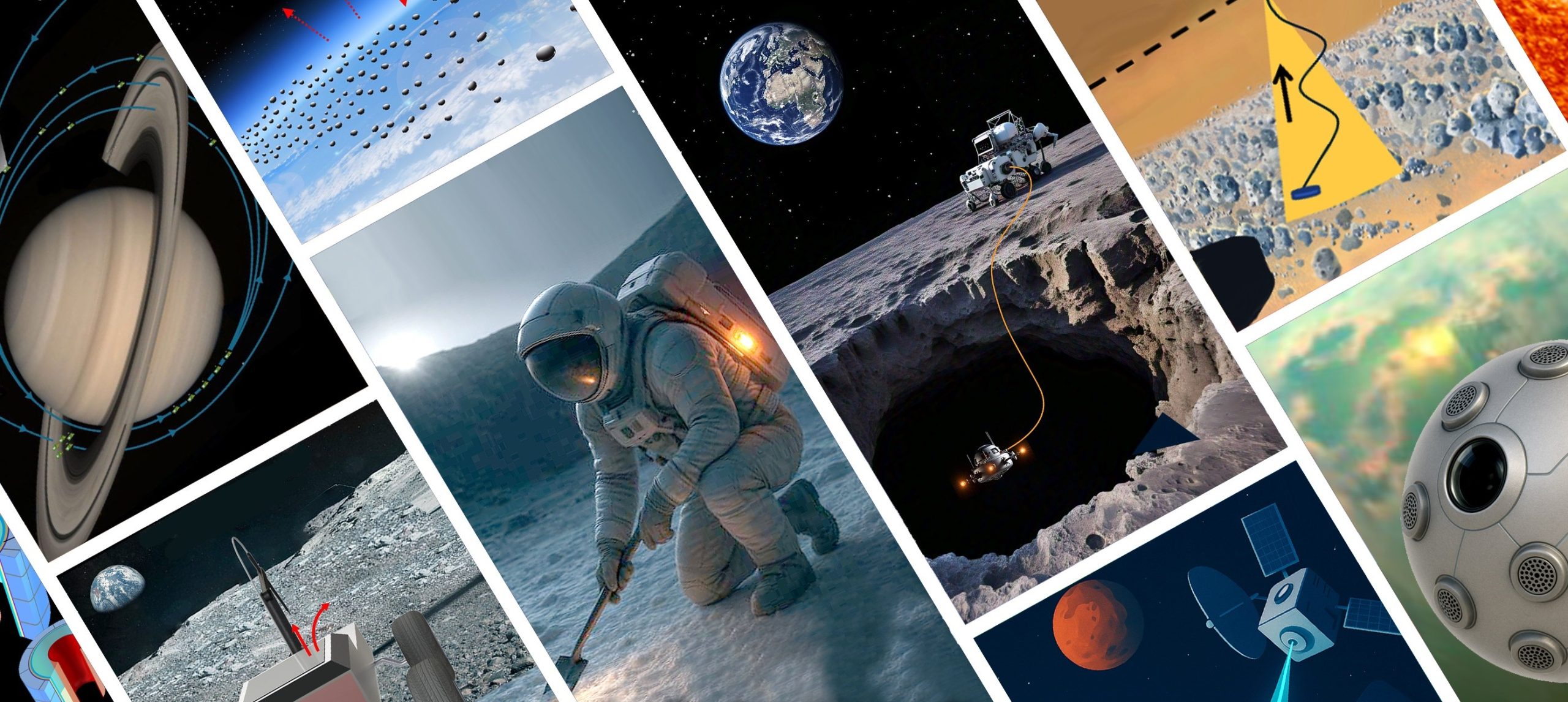
While EARENDIL seeks to safeguard the human body on the moon, the other seventeen projects funded by the NIAC Phase I grants are pushing the envelope of robotic and planetary engineering across the solar system, imagining a future where our reach extends far beyond our current grasp. For instance, Michael Rubenstein of Northwestern University is designing constellations of miniature, steerable “femtosatellites” that could navigate and study the complex dynamics of Saturn’s rings, atmosphere, and magnetosphere from the inside out, offering an unprecedented, high-definition look at the gas giant. Crossing the hot, toxic threshold of our sister planet, David Bugby of the NASA Jet Propulsion Laboratory is developing CANVAS—a multi-layered, highly adaptable architecture designed to help rovers survive the crushing pressures and acidic clouds of Venus. Looking even further into the deep black, Artur Davoyan of UCLA is rethinking propulsion with his coilable stacked solar sails, designed to ride sunlight to unfathomable speeds and carry scientific instruments out of our solar system faster than any chemical rocket ever could. Meanwhile, Saptarshi Bandyopadhyay at JPL is investigating “DimSun,” a highly sophisticated and controversial geoengineering concept that explores the feasibility of using a controllable dust cloud in space to reduce solar insolation and mitigate planetary warming, showing that the technologies designed to explore other worlds might also hold the key to saving our own. Additionally, Austin Phoenix of Virginia Tech is developing ECLIPSE, a variable conductivity lunar insulator designed to passively protect equipment from the wild temperature swings of the moon, while Pablo Sobron Sanchez of the SETI Institute is proposing the Interworld Slingshot Resource Surveys to map resources on distant asteroids during rapid, close-range flybys.
The human desire to see, hear, and map what lies beyond our current sensory horizon is also the driving force behind several astronomical and geological proposals in this NIAC cohort, each aiming to peer into the universe’s most profound mysteries. Paul Stankus of Brookhaven Science Associates is leading two separate, mind-bending studies: one that utilizes precision astrometry between independent, synchronized spacecraft to detect the subtle ripples of gravitational waves, and another that aims to achieve optical Very Large Baseline Interferometry (VLBI) to map the actual continents, coastlines, and atmospheres of alien worlds orbiting distant stars. At the same time, Jeff Nosanov of Orbital Velocity is aiming to peer into the dark hearts of black holes using extreme intensity correlation, a project beautifully dubbed OBLIVION. Closer to home, researchers are focusing on the mysteries hidden beneath planetary surfaces and within planetary atmospheres. Gilly Elor’s “LUX” project from Stone Aerospace explores the feasibility of sending power down fiber-optic cables to enable robots to venture deep into underground lunar caves and lava tubes, while Daniel Drew’s “SPARK” project out of the University of Hawaii proposes solid-state propulsion systems to allow tiny, agile autonomous robots to reconnoiter fragile karst and cave environments on Mars. Benjamin Schafer of UCLA is developing photophoretic tracers for near-space remote sensing to study the upper atmosphere of Earth and other planets, while Keunhan Park of the University of Utah is working on plasmon-enhanced radioisotope thermophotovoltaic power generation to dramatically boost the energy efficiency of deep-space and interstellar probes. Rounding out this stellar list are Marco Quadrelli’s PRAXIS for autonomous exploration of planetary rings, Anish Damodaran’s PS21 for photonic space interferometry, Zhaoyan Liu’s quantum wind lidar for atmospheric sciences, and David Smith’s robotically assembled electromagnetic metamaterials to enhance long-range space situational awareness.
Ultimately, what these eighteen diverse, imaginative, and highly complex projects represent is not just a list of technological milestones, but a profound commitment to the human legacy of exploration and our shared future in the cosmos. These NIAC Phase I grants are the vital first steps in a long-term relay race, passing the torch of curiosity from theoretical physics and engineering laboratories to the launchpads of the future. By daring to ask “what if” we could sail on sunlight, walk safely through a minus-400-degree lunar night, or map the forests and oceans of a planet light-years away, these scientists are refusing to let humanity remain bound by its physical and environmental limitations. Every great leap in human history—from the mastery of fire to the voyages across the Atlantic, from the invention of flight to the first footsteps on the moon—began as a fragile, easily dismissed idea on a piece of paper. As NASA and its private industry partners like Zeno Power begin the hard work of turning these eighteen conceptual seeds into reality, they remind us that the future of space exploration is not written in the cold, unyielding laws of physics, but in the warmth of our collective imagination and our relentless, enduring drive to light up the dark.