





For a man who spent years wrestling with the brittle logic of code at tech giants like Google and T-Mobile, Pascal Matta thought he had seen the limits of complex systems. That was until he decided to build a simple wooden deck onto the back of his Seattle home. What should have been a straightforward home improvement project quickly dissolved into a Kafkaesque nightmare of municipal bureaucracy. He found himself drowning in a sea of PDFs, each one more obtuse than the last, trying to figure out setback requirements, height restrictions, and structural load codes. The software engineer in him was stunned. In the tech world, information was structured, searchable, and fluid. In the municipal world, it was locked away in archaic documents, buried deep in the recesses of city websites, or hidden behind the counter of a city office that closed at 4 PM on Tuesdays. The frustration wasn’t just about the delay; it was about the sheer opacity of a system designed to be navigated by insiders—architects, lawyers, and veteran contractors who had seen it all before. For the average homeowner, it was a digital labyrinth with no Ariadne’s thread, a place where a simple question about a permit could cost thousands of dollars in failed plans and wasted contractor fees.
The deck, it turns out, never got built. Matta walked away from the project, but the frustration stuck with him. It wasn’t just the wasted time or the confusing rules that irked him; it was the realization that the information itself was practically inaccessible. He realized that his experience was not an anomaly but the standard experience for anyone who tried to build or renovate in the city. The answers to the simplest questions—Can I add a bedroom? Do I need a permit for a water heater? How close can my fence be to the property line?—were buried in a patchwork of city codes, state laws, and historical zoning overlays that even experienced professionals struggled to keep straight. And the cost of this ignorance was astronomical. Homeowners would sign a contract with a contractor, pay a hefty deposit, and only then discover that their dream project violated a zoning code or required a variance that would take six months to obtain. By that point, the money was gone, and the project was stalled indefinitely. This wasn’t a problem of knowledge; it was a problem of distribution. The rules existed, but nobody could access them in a way that was timely, understandable, and actionable.
So Matta decided to solve the problem himself, attacking it with the same rigor he had applied to building software at Google. First, he founded Kolmo Construction, a general contracting company that would allow him to apply his technical mindset to the physical world of building. But the software developer in him knew that a single contracting company was just a drop in the bucket. The real fix had to be a tool—a piece of software that could decode the messy, fragmented world of municipal code and put it into the hands of the people who needed it most. The result is kolmo.io/permits, a free, web-based platform that functions as an un-gated database of permit rules. It’s powered by a sophisticated AI layer that sifts through municipal records, linking each rule directly to its specific city source page, complete with exact wording. No more guessing. No more cross-referencing five different PDFs. Just type in an address, and the tool provides a comprehensive, lot-level breakdown of what you can and cannot do with a property.
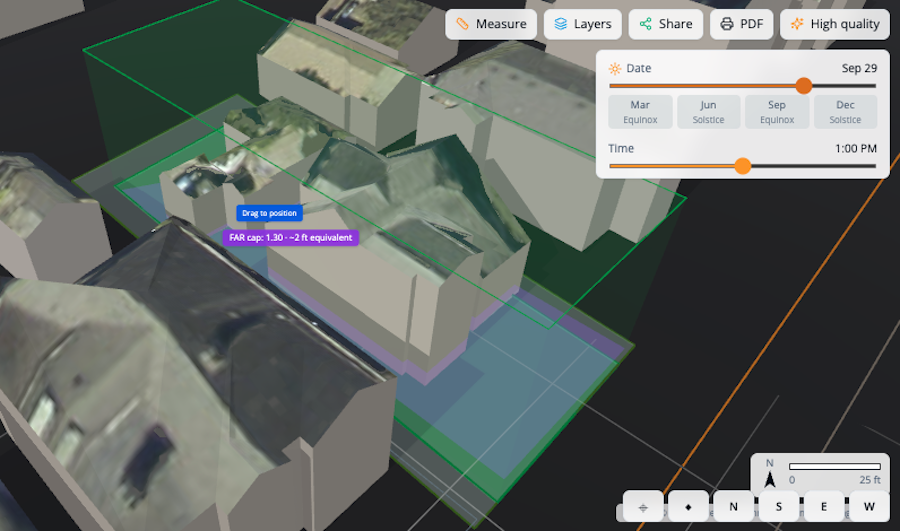
The depth of the tool is impressive. As of its current rollout, it covers 457 verified rules across 80 jurisdictions in King, Pierce, and Snohomish counties in Washington state, with an additional baseline of state-level codes across 82 jurisdictions. But the real magic lies in its interactive capabilities. Users can enter a specific address and receive a 3D rendering of the property’s buildable envelope—a visual representation of the maximum volume of space a building can occupy based on zoning restrictions, height limits, and existing structures. This turns a dense legal document into a tangible, visual reality. From there, the AI can answer complex questions: “Does this lot qualify for two detached ADUs under Seattle code?” or “Do I need a permit to install a heat pump?” It handles everything from plumbing work to tree removal, evaluating local zoning and building codes instantly. Crucially, the tool doesn’t just give a generic answer; it provides the citation, allowing users to click through and verify the information for themselves, bridging the gap between AI-generated convenience and hard, legal fact.
Matta’s initiative arrives at a moment when the issue of permitting backlogs has reached a crisis point in cities across America. The City of Seattle, for example, has announced plans in 2025 to deploy AI to streamline its own housing and small-business permit reviews, acknowledging that the old way of doing things is no longer sustainable. The city has also seen a wave of tech startups, like Govstream AI, raise millions of dollars to modernize government land-use workflows, focusing on the back-end bureaucratic efficiency of processing applications. However, Matta’s tool is fundamentally different. While the enterprise players are building systems for the government agencies—the gatekeepers—Matta built his tool for the people getting the gates shut on them. He is operating from the ground up, democratizing access to information and empowering homeowners and small contractors before they ever submit a single document. It’s a subtle but critical distinction: one approach makes the bureaucracy slightly faster at saying “no”; the other helps people know exactly what “yes” looks like before they even start.
Beneath the sleek user interface is a powerful technical architecture. The AI is powered by Google’s Gemini model, employing Retrieval-Augmented Generation (RAG) to feed the system exact city rules rather than relying on the AI’s hallucination-prone general knowledge. This allows the AI to answer specific questions with precise citations instead of vague guesses. Matta has also exposed the entire database over the Model Context Protocol (MCP), a cutting-edge standard that allows third-party AI assistants—like ChatGPT or Claude—to query the rules directly. This makes the knowledge portable and extensible, opening up endless possibilities for other developers to build on top of it. Even more critical is the system’s commitment to accuracy. A weekly automated process re-checks every single source page for updates, posting the results to a public data-quality log. This isn’t a “set it and forget it” tool; it’s a living, breathing entity that has already caught significant errors, including a mistake in its own fee calculator when Seattle updated its 2026 permit fee schedule. The system is currently designed to self-correct, ensuring that trust is built into the platform.
Maintaining a tool like this isn’t cheap. Matta estimates that simply processing the data for Seattle costs around $2,000 in LLM API tokens alone, a sum that comes directly out of his own pocket. Yet he has adamantly resisted the urge to monetize the platform or put it behind a paywall. He wants the information to be free and open to everyone, because he knows that knowledge is the only thing that can level the playing field. Meanwhile, back on the job site, his software background gives Kolmo Construction a distinct competitive edge. Using internal AI tools he built himself, Matta can walk through a property, take voice notes and photos, and generate a detailed, comprehensive project quote in under a minute. He can give clients clear, accurate answers while he’s still standing at their front door, a level of service that his traditionally-minded competitors can’t match. He’s not just a builder who writes code, or a coder who swings a hammer; he’s a hybrid. When asked whether he prefers the clean, logical world of software or the messy, physical world of building decks, he doesn’t see a contradiction. He sees the intersection. “I think I like what I’m doing now,” Matta says, leaning into the synthesis of his two careers. “I like building decks, but I can see also the potential that I have because I have a software background—how it changes the game, honestly.” It’s a statement that captures the essence of his journey: taking the problem-solving skills of a software engineer and applying them to the most tangible, human aspects of the built environment.