





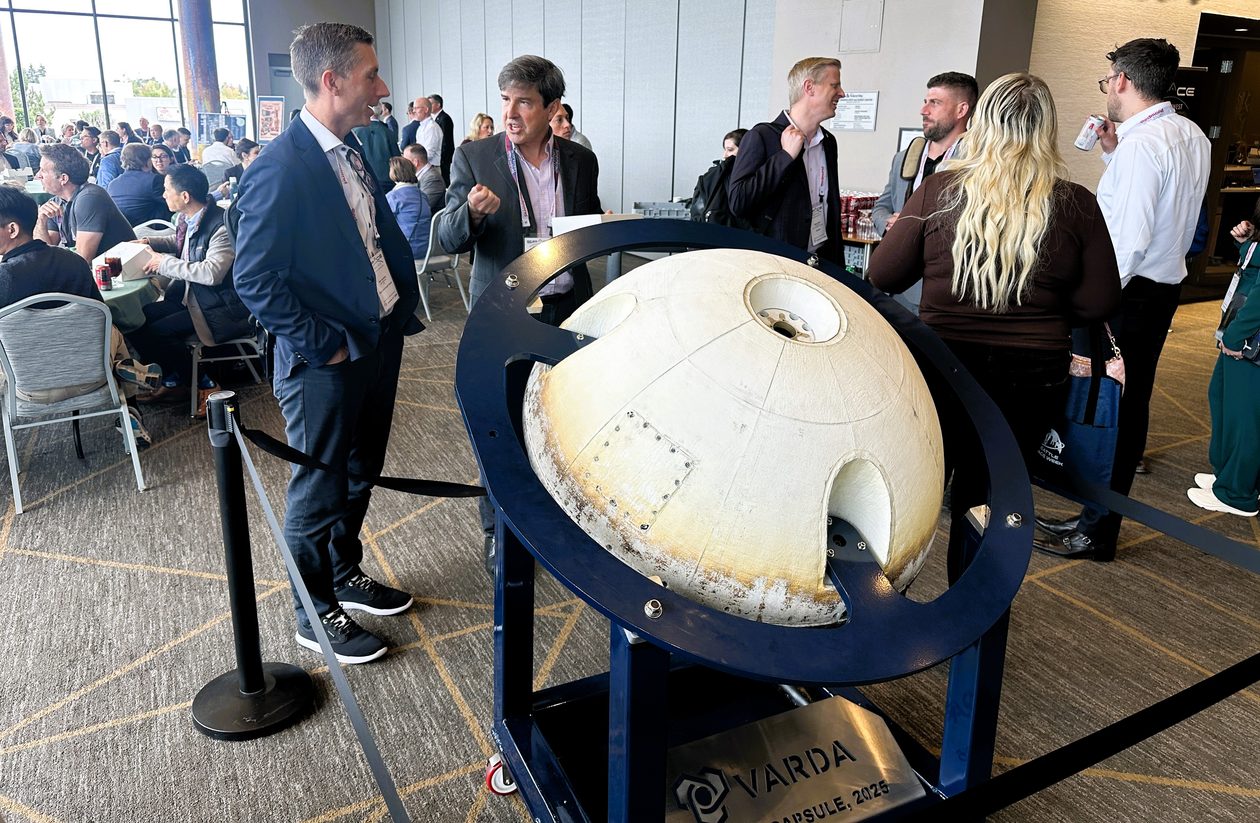
If you had walked into the Space Northwest Symposium in Federal Way, you’d have seen a strange and hopeful sight: Dale Goulding, chief operating officer of Forge Digital, chatting with Michael Reilly, chief strategy officer of Varda Space Industries, while a real Varda orbital capsule sat in front of them. It wasn’t a Hollywood prop; it was a piece of history, a reminder that orbital manufacturing is no longer science fiction. The capsule gleamed under the event lights, and for a moment, the future felt close. But as Seattle Space Week unfolded, the conversations around that capsule carried a more complicated message. Preliminary economic data suggest Washington’s space industry has more than doubled its impact since 2018, and nearly doubled again in the last few years. That’s the good news. The bad news is that many people inside the industry worry the state can’t maintain its momentum against Florida, Texas, and Colorado, which roll out incentives and infrastructure with almost aggressive enthusiasm. The tension became visible when Stoke Space CEO Andy Lapsa, whose company is headquartered in Kent, wondered aloud whether he would choose the Seattle area again if he were starting from scratch. That comment landed with extra weight because Lapsa said it just before taking the stage as a member of Gov. Bob Ferguson’s Washington Space Council. It was a reminder that even the people who believe in this region have moments of doubt. At the Museum of Flight, Kent Mayor Dana Ralph tried to answer that doubt directly. Looking at a gathering of CEOs, investors, and VIPs, she said, “We don’t take you for granted. I want you to hear that out loud.” The room understood: Washington has a chance to keep its homegrown space industry, but only if it stops assuming that the Northwest’s natural advantages are enough. Seattle Space Week set out to confront four hard problems and consider four real prospects. The result was a candid, occasionally uncomfortable, ultimately hopeful conversation about who gets to build the orbital economy.
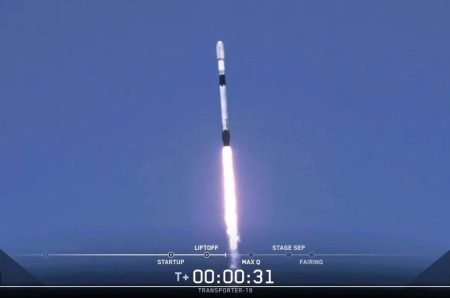
The first hard problem is launch. It sounds paradoxical for an industry that has grown so fast, but the ability to actually get a satellite into orbit has become dangerously scarce. Tim Beard, Stoke Space’s chief financial officer, put it in plain terms: “It’s just crazy how there’s this mismatch between supply and demand right now in the industry. It’s becoming a crisis.” On the demand side, the world suddenly needs thousands of satellites for broadband constellations like Starlink and Amazon Leo. And the next wave isn’t just connectivity; it’s computing. Companies are planning orbital data centers to process artificial intelligence workloads in space, including Starcloud, SpaceX’s Starmind, and Google’s Project Suncatcher. Each of those concepts implies fleets of spacecraft, and each fleet needs a ride. On the supply side, the rocket industry is in a painful transition. Blue Origin and United Launch Alliance are still working through delays with their next-generation vehicles. SpaceX, meanwhile, is eager to phase out the workhorse Falcon 9 as it shifts toward Starship. That leaves a gap that no one can fill overnight. For Seattle-area satellite ventures, which have built reputations and business plans around generous launch schedules, the crunch is existential. You can have the most elegant satellite in the world, but if you can’t get it to orbit, it’s just an expensive paperweight. There is also a deeply human problem: not enough skilled workers. Bill Bruner, CEO of New Frontier Aerospace, says his biggest challenge isn’t ideas or capital; it’s people. He needs technicians who can handle graduate-level, hands-on work, what he called “Grade 13, Grade 14 graduate technical work.” “We need a national solution to that problem,” he said. Ralph echoed that from the public sector, saying Kent and other cities should make it easier for employers to invest in apprenticeship, credentials, and on-the-job training. “We need to build a workforce system that moves with industry, not several years behind it,” she said. That last phrase captures why the problem is so stubborn: the industry changes faster than schools, governments, and training programs usually do.
The third problem is money, or rather, where the money comes from. Mike Reilly, chief strategy officer at Varda Space Industries, has observed Seattle’s funding landscape from the inside. “There are a lot of VCs in Seattle, but they’re not necessarily space VCs,” he said. “I feel like a lot of the space money comes out of L.A. and San Francisco.” That creates an awkward dynamic: local companies may have to pitch their visions to investors who don’t share their mental map of the region, who don’t understand why a factory in Kent is as good as a factory in Austin, and who may be more comfortable funding something closer to home. Brian Monnin, co-founder and chief commercial officer of Sophia Space, suggested that midsize space companies need to get more creative. Debt financing is one avenue, he said, but it shouldn’t stop there. “I think there should be more public-private combinations of firms, traditional banks working alongside debt financiers, working alongside the public for us to fill that vast middle.” The fourth problem is regional rivalry, and this is where the frustration really begins to show. Monnin said Washington simply doesn’t offer the same incentives as other states. “The incentives just aren’t here,” he said. “We’re looking at where we build our Factory One for Sophia Space tiles, and you have to look at the incentives from sovereign funds in New Mexico, Louisiana and others. They’re far more attractive than they are in this state currently.” Stoke Space’s Tim Beard confirmed that the pressure is real. “I need to be pretty direct in that we’re being actively courted by any number of states: Colorado, Texas, Florida,” he said. “They want us to move there, but Washington state is the right place for Stoke. … I hope our policymakers in Olympia, throughout the state, our senators hear this. We want to stay in Washington state. Help us do that.” It is hard to imagine a more straightforward plea from a successful company. The subtext is that Washington has been coasting on its reputation for too long. Other states have built entire recruitment playbooks around tax breaks, land deals, and direct outreach. Washington’s answer so far has often been, “We have Boeing, we have Amazon, we have talent.” That’s true, but it may not be enough to compete in a world where states actively court the next generation of rockets and factories.
Now for the good news, the “light this candle” part of the week. The newly announced Washington Space Council is not going to write a multibillion-dollar check in its first term, but it can do something equally important: create a regular, structured conversation between the people who make space policy and the people who make space hardware. It could become a place where problems like workforce development, incentives, and infrastructure are addressed before they become crises. There is already at least one encouraging precedent. Last year, the Governor’s Economic Development Strategic Reserve Fund awarded $350,000 to support Portal Space Systems’ expansion into a 50,000-square-foot satellite manufacturing facility in Bothell. That is a modest amount by aerospace standards, but it shows that the state can act when it wants to. If those grants become a pattern, Washington might not need to outbid its rivals dollar-for-dollar; it can use its existing strengths to amplify modest investments. Another source of optimism is that the state doesn’t have to win every headquarters to win the space economy. Cowboy Space is based in California, but it recently announced an enormous 291,035-square-foot spacecraft design and manufacturing facility in Kent. BlackSky calls Virginia home, but its satellites are assembled in a 22,000-square-foot factory in Tukwila. SpaceX may be based in Texas, but it continues to produce more than half of the world’s satellites at facilities in Redmond and Woodinville. The same pattern that brought Google and Meta engineering offices to the Seattle area is now pulling space companies into the region: access to talent, supply chains, industrial capacity, and a culture that values making things. Ralph summed it up as well as anyone: “The fundamentals that made this region are still here: talent, a deep supply chain, industrial capacity, a culture of making things, and generations of knowledge that you simply cannot re-create overnight.” It is easy to focus on the negative headlines and forget that this region already builds the bulk of the world’s satellites. That is not an accident, and it is not a legacy that disappears just because a headquarters moves. The companies that want to be close to that ecosystem will keep coming, even if their legal address is elsewhere.
If the launch crisis is the bad news, the enormous pipeline of new rockets is the good news. The first orbital flight of SpaceX’s Starship was a genuine turning point, and Ron Faith, CEO of RBC Signals, called it “a pretty big milestone event.” “Having Starship go into orbit and deploy real satellites … that’s a significant increase in capacity for launch,” he said. But he was quick to add that Starship is only part of the story. “With that said, we’re also seeing many, many more launchers come online.” The list is impressive: Blue Origin’s New Glenn, United Launch Alliance’s Vulcan, Rocket Lab’s Neutron, Firefly Aerospace’s Alpha, Relativity Space’s Terran R, and Stoke Space’s Nova. An artist’s conception hanging around the symposium showed Nova Pathfinder rising into Earth orbit, a reminder that the next breakthrough could come from the company just down the road. For Seattle-area companies that have been squeezed by the current launch shortage, these vehicles represent not just hope but practical relief. A new rocket is never just a rocket; it’s a new set of schedules, contracts, and possibilities. More launchers mean more leverage, more backup options, and more chances to actually fly. It would be foolish to promise that every vehicle on that list will reach orbit on time. This is an industry where schedules are often better described as hope than guarantee. But the sheer number of programs means the launch market will almost certainly loosen over the next decade. And when that happens, the region that has already built the satellite manufacturing capacity could be in an extraordinary position. The same stubborn optimism that guided these rocket developers through years of testing and failure is the optimism that keeps the space economy moving. For the people gathered at Seattle Space Week, that future felt a little closer after Starship’s debut. The next challenge is making sure Washington’s space industry has the runway, the workforce, and the political will to match that momentum. To some extent, the launch crisis might actually be the forcing function that accelerates the transition to a new generation of vehicles, and the Pacific Northwest is well placed to ride that wave.
Finally, there is the hard, physical reality of place. The Seattle area has no NASA center, no orbital launch pad, and no wide-open stretch of ocean to the east. NASA Administrator Jared Isaacman, visiting Redmond, told space fans the agency is unlikely to add new centers anytime soon. “I think it’s unlikely we’re going to be adding any additional centers right now,” he said. That’s a disappointment, but not necessarily a dead end. Governor Ferguson has said the Washington Space Council “will look for ways we might be able to develop Washington-based commercial launch capabilities.” It’s not a promise, but it is a direction. Brian Monnin raised another possibility: the region’s military bases. He wondered why more space companies haven’t forged closer ties with Fort Lewis-McChord or the naval base in Bremerton. From the standpoint of orbital computing, he said, the biggest demand is defense- or security-related. “How we haven’t tapped into that as a state, I think, is a miss.” The geography of the Pacific Northwest makes orbital launch a challenge. There are mountains, weather, and a lot of people. That’s why Blue Origin and Stoke Space both maintain their orbital launch pads in Florida instead of Washington. But when someone asked Beard about launching closer to home, he didn’t say no. He said, “Launching from the Washington coast would be fantastic. Also, my geography is not great, but I think it’s slightly closer to ship a rocket to the Washington coast than it is all the way down to Cape Canaveral. So, that’s one advantage as well. We’d love to see launch here, and I think that we’d be good partners to do that with.” It was a small, tentative opening, but in a week full of hard truths, it felt like a door. The overall mood at Seattle Space Week was neither euphoric nor defeated. It was the mood of an industry that knows it has something worth fighting for and knows that being taken for granted is the easiest way to lose it. Washington’s space sector has grown faster than almost anyone expected, but growth can fade if it is not nurtured. The region still has the talent, the supply chains, the industrial culture, and the generations of knowledge that Ralph said cannot be recreated overnight. What it needs now is the political will, financial creativity, and public attention to match its private ambition. If that happens, the capsule in front of Goulding and Reilly might one day be remembered as the beginning of something much larger. If not, it could become a relic of what almost was. The next few years will determine which story the Pacific Northwest tells itself about the space age.