






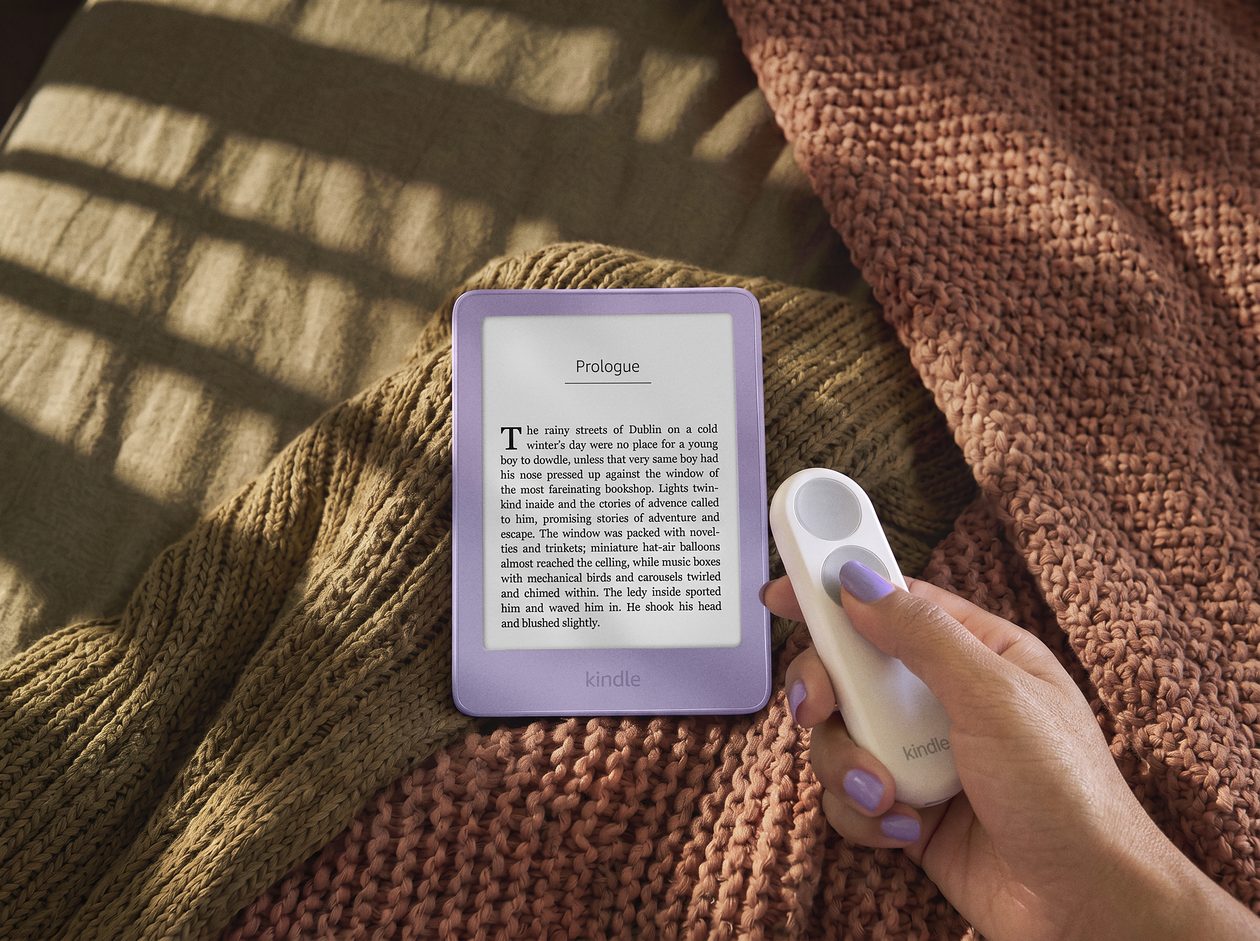
If you’ve ever tried to read an e-reader while tucked under a blanket, pedaling a treadmill, or balancing a snack on a tray table, you know the awkward dance: one hand holds the device, the other reaches for the page-turn button, and somehow the snack or the blanket always loses. Amazon’s newest accessory, the Kindle Click, is designed to end that struggle once and for all. Announced on Thursday as the first official remote control ever made for the Kindle, the Click is a small, $34.99 Bluetooth clicker that lets you prop up your e-reader and turn pages from a distance—no touching, reaching, or shifting your position required. It’s a deceptively simple idea, and one that readers have been asking for, in one form or another, for years. The device, which is available for preorder now and ships on October 28, recharges over USB-C and includes side buttons for adjusting screen brightness, so you don’t even have to pick up the device to set the reading mood. It works with Kindles released in 2024 or later, meaning it’s compatible with the newest generation of Amazon’s e-reader lineup, and it’s meant to slip into your routine whether you’re reading in bed, at the gym, or wedged into a cramped airplane seat. In other words, Amazon has finally given readers the same kind of hands-free convenience we already expect from our TVs and garage doors—a tiny remote that puts the control back in your hand, literally.
What makes the Kindle Click feel particularly timely is where the idea came from. Amazon has acknowledged, via Bloomberg, that the remote was inspired by BookTok—the sprawling, enthusiastic community of readers on TikTok who post everything from book recommendations and reviews to elaborate “reading setups” featuring their Kindles, cozy blankets, ambient lighting, and, in many cases, third-party clickers. For years, TikTok creators have been rigging their own page-turners, buying cheap Bluetooth gadgets from Amazon or Etsy and clipping them to their e-readers to make their reading content more cinematic or just more comfortable. These videos often show a Kindle propped on a stand while the reader lounges, sips tea, or gestures dramatically, all without touching the screen. It’s aspirational, aesthetically pleasing, and apparently, highly persuasive. Amazon took note, and the Kindle Click is essentially the company’s official, polished version of a workaround that tinkerers and book influencers have been using for years. This is a lovely thing to see, especially in a tech world where companies often ignore how real people adapt their products. Instead of fighting the trend or shutting it down, Amazon embraced it, giving the community a purpose-built tool that feels native to the Kindle experience. The remote also solves a practical problem that’s existed since the Kindle first popularized e-readers: the only way to turn a page was to touch the screen or press a physical button on the device itself. That’s fine when you’re sitting upright, but it’s a nuisance when you’re snuggled under a blanket or holding a coffee in your other hand. The Click isn’t just a novelty—it’s a quality-of-life upgrade for anyone who’s ever read for more than ten minutes in a less-than-ideal position.
Amazon didn’t stop with the Click, though. The company is also bringing back something that loyal Kindle fans have mourned since 2024: physical page-turn buttons. When the Kindle Oasis was discontinued, it took with it the last Kindle that had dedicated buttons on the device itself, leaving readers with only touchscreen controls. For many, that was a genuine regression. Physical buttons offer tactile feedback, muscle memory, and the satisfying ability to turn pages without looking at the screen or fumbling with a swipe. The new solution is called the Page-Turn Cover, a $79.99 magnetic accessory that adds physical buttons to the latest Signature Edition versions of the Kindle Paperwhite and Kindle Colorsoft. It’s not built into the e-readers themselves, but rather a cover that wraps around the device and connects magnetically, giving you that old-school, clicky, satisfying page-turn experience whenever you want it. You can slap it on for a cozy reading session at home, or leave it off when you want to keep the device slim and minimal in a bag. It’s a clever compromise: the hardware stays sleek and modern, but the option for physical controls is there for those who miss them. The cover only works with the new Signature Editions, which are the higher-end versions of Amazon’s most popular e-readers, so it’s a bit of an investment if you’re starting from scratch. But for anyone who remembers the Oasis fondly, or who simply prefers buttons over swipes, this feels like a welcome throwback that acknowledges not every reader wants the same interface.
Underneath all these accessories, the new Kindle lineup itself has received a thoughtful refresh. Amazon revealed a redesigned family of e-readers that address some long-standing physical quirks. The screens now sit flush with the edges of the device, which means no more raised bezel catching dust or creating an awkward ledge. The colors on the Colorsoft models now wrap around to the front, making the devices feel more immersive and less like a plastic slab with a screen embedded in it. There are also optional aluminum housings for the base Kindle, giving it a premium, rigid feel that’s a far cry from the soft-touch plastic of past generations. And in a nod to sustainability and regulation, the new Kindles have user-replaceable batteries, designed to comply with European Union rules that push for longer-lasting electronics. That’s a meaningful shift from the sealed devices we’ve grown used to, and it’s good news for anyone who hates replacing gadgets just because a battery wears out. The pricing, though, is a bit more painful. The base Kindle starts at $149.99, or $189.99 if you want the aluminum version. The Paperwhite starts at $199.99, and the Colorsoft at $289.99. The Signature Editions—the ones that support the new Page-Turn Cover—are priced at $249.99 and $319.99, respectively. These prices match what Amazon has been charging since August, when it raised Kindle prices by $40 to $50 across the board, citing increased memory and storage costs. It’s not easy to swallow, but Amazon is clearly betting that the new features, plus the convenience of accessories like the Click and Page-Turn Cover, will justify the premium.
That bet might not be as risky as it seems. Despite the higher prices, Amazon says Kindle device sales hit their highest point in more than a decade last year, with three consecutive years of double-digit growth. Kevin Keith, Amazon’s vice president of devices, shared that tidbit at a media preview, according to Bloomberg. Amazon has never been open about Kindle unit sales or financial results for its hardware, so any glimpse into the health of the e-reader business is notable. The fact that Amazon is leaning into accessories, design updates, and community-inspired features suggests a renewed confidence in the product line, not a retreat. The Kindle has survived the rise of smartphones, tablets, and apps that can all display books, but it remains a dedicated tool for an audience that clearly loves reading deeply, comfortably, and without distractions. The growth numbers suggest that audience is expanding, perhaps as people rediscover the joy of owning a device that does one thing well in a world of increasingly bloated multipurpose gadgets. The BookTok connection only reinforces that: reading has become a social, shareable, even aesthetic activity, and the Kindle is no longer just a utility—it’s a lifestyle device. Accessories like the Click and the Page-Turn Cover are part of that evolution, turning a simple e-reader into a customizable companion that fits into the way people actually read today.
Looking ahead, Amazon’s vision for the Kindle seems to be moving toward something even more radical. Chris Green, Amazon’s vice president of industrial design, told Bloomberg: “At some point we will get to something more like a credit card that’s all display that you’ll be able to flex with your hand for a page turn.” It’s a fascinating glimpse into the future of the product, and a reminder that the Kindle is still evolving. Imagine an e-reader so thin and flexible it bends slightly under the pressure of your thumb, registering the flex as a page turn, no buttons, no touchscreen swipes, no remote required. That kind of design would make the current lineup feel almost chunky by comparison. It also points to a future where the physical and digital books blur even further—a device that mimics the natural motion of turning a page, while still offering all the convenience of a digital library. Of course, we’re not there yet. For now, we have the Kindle Click, a little remote that lets us read without reaching, and a Page-Turn Cover that brings back the satisfying click of a physical button. It’s a good time to be a Kindle fan, especially if you’re the kind of reader who likes to curl up in bed, prop up the e-reader, and just let the story flow. Amazon is listening to its readers, responding to their habits and wishes, and slowly but surely building a device that fits not just in our hands but into the rituals and routines we’ve created around reading. Whether it’s a flexible credit-card Kindle in the future or simply the ubiquitous clicker today, the message is clear: reading is meant to be a pleasure, and the hardware should get out of the way and let you enjoy it.