




Paragraph 1
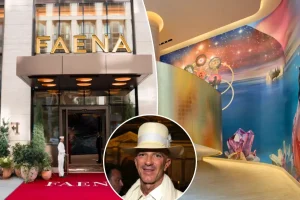
Imagine Miami Beach as a kind of luxury prison yard, where the Four Seasons, the Ritz, and the Fontainebleau all wage a never-ending turf war for guests. It’s a place where hotel general managers might as well carry shivs in the afterlife, because the competition is that ferocious. Collins Avenue is the main battleground, a glamorous strip where the world’s finest hotel flags grapple for glory against scrappy independent innkeepers who dare to dream bigger. If you can make it there, the saying goes, you can make it anywhere—even New York City. And no one embodies that ruthless, theatrical, larger-than-life spirit quite like Argentine hotel honcho Alan Faena. Faena is the example número uno, the original maximalist, the man who turned high-end hospitality into a performance art. His blend of flame-kissed fine dining, naughty nightlife, and monumental artworks—literally massive installations that take your breath away—made him the biggest noise in Buenos Aires and then turned him into a star on Miami Beach. More than a decade later, he is still the most original and authentic hotelier in the business, a man who refuses to do anything by half measures. Now, he has hung his whopping white hat at the base of Chelsea’s most notorious new building, a twisted pair of towers that was supposed to be something else entirely. The question on everyone’s mind is simple: Is this a boutique best-in-show, or the beginning of the next mega-brand? The Post checked in to see how Faena’s Latin locomotion looks in its third location, one year in, and the answer is as wild, vivid, and gloriously over-the-top as you might expect.
Paragraph 2
The backstory of this building reads like a New York crime saga, complete with bankruptcies, mob kickbacks, and a last-minute rescue by billionaires. It was originally supposed to be a Six Senses hotel, drawn up by starchitect Bjarke Ingels. The twisted twin towers at 11th Avenue and West 18th Street were designed to be the most splendiferous addresses on the lower High Line, with condominium prices soaring past the $50 million mark. Then the developer, HFZ, went bankrupt in spectacular fashion. Gambino crime family kickbacks were exposed, construction stalled, and Six Senses said sayonara. The whole project seemed doomed to become another ghost of New York’s real estate excesses. But then Steve Witkoff, the billionaire Trump envoy, stepped in and cleaned up the mess with bags of cash from big cheese Len Blavatnik’s Access Industries. That turned out to be extraordinarily good luck for the feisty Faena, whose hotel group just happened to have been founded in partnership with Blavatnik. The timing was perfect. Six Senses’ Zen’d-out minimalism was scrapped in favor of Faena’s tropical red-carpet aesthetic, a bold and unapologetic departure from the muted, wellness-obsessed style that has come to dominate luxury hospitality. When the hotel finally opened in September 2025, it drew celebrities like Cher and Nicole Kidman almost immediately. And today, standing in the soaring lobby, you would never guess the building’s troubled past. It feels like it was always meant to be this way, as if the towers had been waiting all along for Faena to bring his particular brand of magic to the High Line.
Paragraph 3
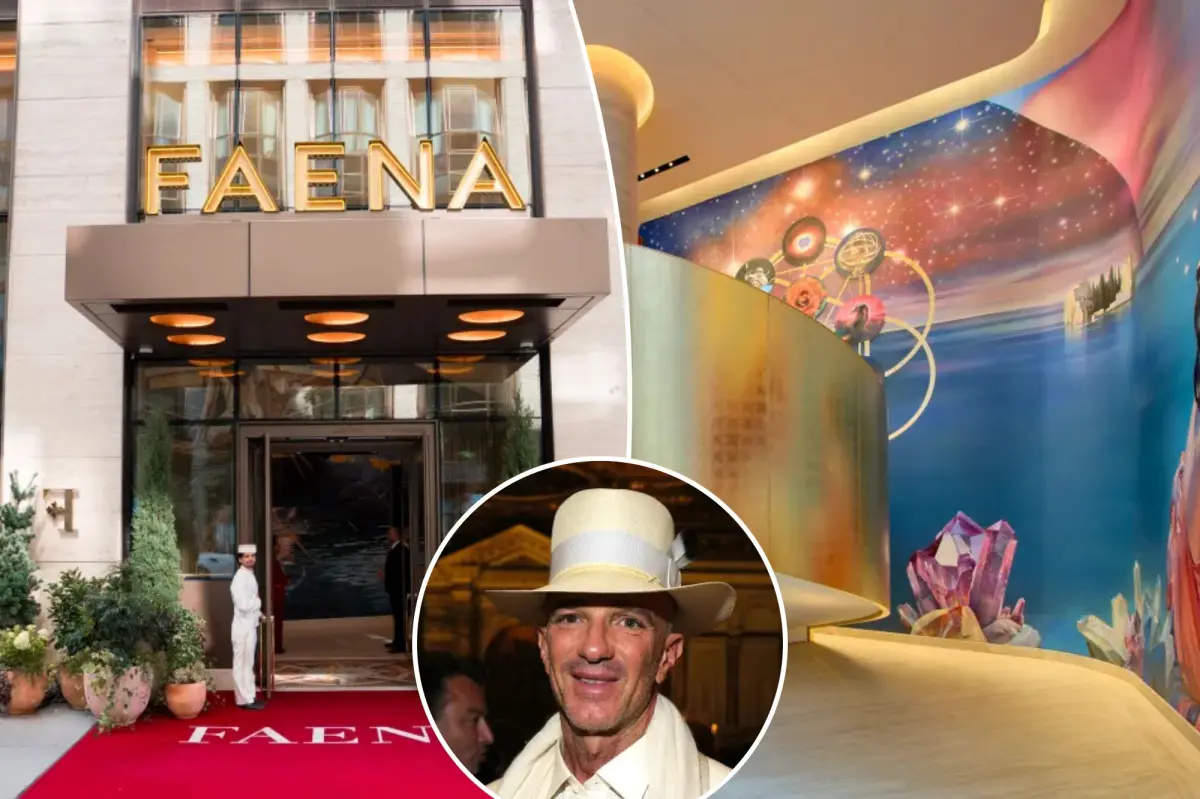
From the moment you approach the 18th Street entrance, you know you are not in just another five-star hotel. Snappy doormen in bygone bellhop garb greet you, each one paired with a Faena signature top hat, that little touch of theatricality that sets the tone for everything that follows. Inside, a winding central staircase is surrounded by maxed-out murals by Argentine artist Diego Gravinese. The space is conceived as a cathedral, and Gravinese’s monumental work—a cousin to Juan Gatti’s metaphysical murals in Miami—is dubbed “The Sefirotic Journey.” It has something to do with Kabbalah, the planets, and possibly a psychedelic freak-out, but don’t try too hard to understand it. It’s stage setting, pure and simple, designed to make you feel like you have stepped into another world. And that world continues into the hotel’s 120 upper-floor guest rooms, as well as the Living Room lounge, the Tierra Santa Healing House spa, and the La Boca restaurant. Faena’s signature symbology is everywhere: artwork featuring cosmic eyes and eggs, animal prints, deep dark hues, velvets, travertine marble floors, sunbursts of Art Deco glamour, luscious live performances, and a hallway-length Keith Haring that feels both unexpected and perfectly at home. It all mixes into a supernatural success. This is a clued-in cacophony that comes together because the aesthetics are more than surface deep. The suites are comfortable, even practical, which is not always the case in hotels this design-forward. You can actually live here, not just admire it. Every detail has been considered, not merely for Instagrammability, but for the way it makes you feel. It is immersive, theatrical, and unapologetically extra, but it works because Faena genuinely believes in the power of beauty and spectacle.
Paragraph 4
The dining and drinking experiences are just as theatrical as the design. The Francis Mallmann restaurant, somewhat tamed in this indoor setting, is rich with date-night sophistication. Mallmann is famous for his flame-kissed cooking, and here he brings that fire to a menu that feels both refined and primal. In the cocktail lounge, waitresses wearing little red dresses beneath red half-capes drop drinks that would put the big bad wolf at ease. It is playful, seductive, and just a little bit dangerous. And then there is the spa, which opened in June and is just about unlike anything else in New York City. It is a gigantic 17,000-square-foot sanctuary with a hammam, five plunges, eleven treatment rooms, an infrared sauna, fitness studios, and South American treatments loaded with “potent indigenous ingredients.” How potent? That, the hotel seems to suggest, is between you and Faena. It is the kind of place where you can lose yourself for an entire day, moving from one sensory experience to the next, emerging feeling like a completely different person. If all of this sounds outré in an era of streamlined and samey-samey snoozing spots, you don’t know the half of it. Faena doesn’t just open hotels; he builds “districts.” Even in real-estate-restricted New York City, he is realizing his own magic kingdom, a self-contained universe where every corner is designed to transport you somewhere else. It is a bold vision, and one that could easily have collapsed under the weight of its own ambition. Instead, it feels effortless, as if Faena has been doing this forever and will continue doing it for a long time to come.
Paragraph 5
The best is yet to come, if you can believe it. Soon, a speakeasy will open somewhere in the hotel—they won’t tell you where, of course—aptly named El Secreto. There will be a door person, described rather colorfully as a “door bitch,” whose job is to segregate the fashionable wheat from the chuddy chaff. If you are lucky enough to slip inside, you will discover a room like a deconstructed disco ball, designed by conceptual artist Sebastian Errazuriz. It sounds like the kind of place where secrets are whispered and memories are made, a hidden gem in a city that has already seen it all. That opening will be followed by a street-level Faena Theater, much like his Miami venue. This cabaret space will vibrate with artwork by Andrés Resinger and Old Hollywood glitz, promising nights of spectacle, music, and drama. It is all part of Faena’s grand vision of creating not just a hotel, but a destination within a destination, a place where guests and locals alike can lose themselves in the magic of performance. The whole project feels zestful, luxurious, out-there—rat-a-tat-tatting away like jungle jazz rhythms. It is a love letter to the past, present, and future of New York, all wrapped up in a package that is unmistakably Faena. You can practically hear the champagne corks popping and the high heels clicking on the travertine floors. It is the kind of place that makes you want to dress up, stay out late, and do something you will probably regret in the morning, but will never forget.
Paragraph 6
So what is it all about, really? Alan Faena says it best: “New York City has historically been the center of innovation, creativity… This hotel embraces and amplifies that spirit, offering a touch of magic…” And that is exactly what he has done. In a city that is constantly looking forward, constantly tearing down and rebuilding, Faena has created a space that honors the past while pushing boldly into the future. It is a place where art, design, food, and hospitality collide in the most beautiful way possible. Whether you are a guest in one of the 120 rooms, a diner at La Boca, a spa devotee, or just someone lucky enough to score a spot at El Secreto, you are part of the show. It is not cheap—rooms start at $1,395 a night—but then again, magic never is. You are not just paying for a bed; you are paying for an experience, for the chance to step inside Alan Faena’s imagination and let him put a spell on you. And if you are willing to surrender to it, if you are willing to stop trying to understand every Kabbalistic reference and just let the colors, textures, and sounds wash over you, you will leave transformed. This is hotelkeeping as art, as theater, as pure, unadulterated joy. In an era of cookie-cutter luxury, Faena stands alone, a true original who has proven once again that if you can make it here, you can make it anywhere. And here, in the shadow of the High Line, he has made it spectacularly.