




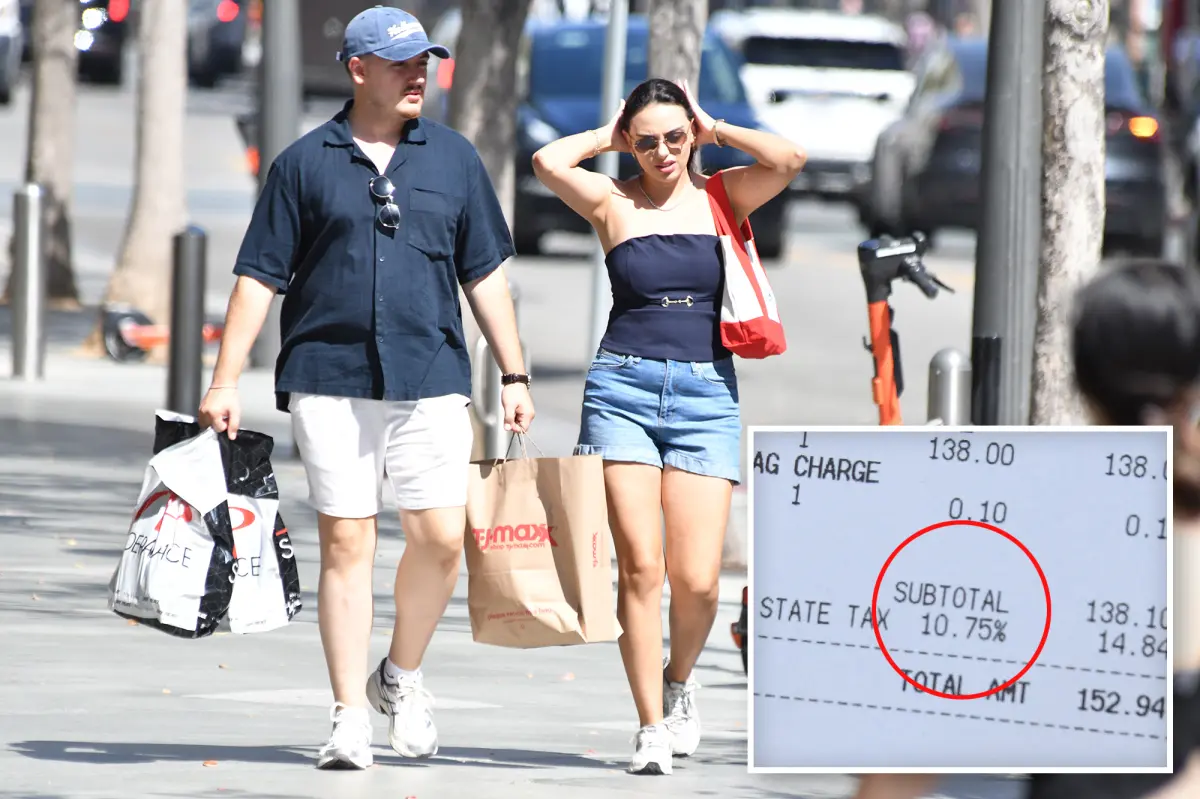
Starting Thursday, Angelenos woke up to a new financial reality every time they reached for their wallets. The sales tax across Los Angeles County jumped from 9.75% to 10.25%, pushing the region into the upper echelon of America’s most heavily taxed shopping destinations. For the average family, that extra half-cent on every taxable dollar can add up to as much as $1,000 a year—money that would have gone to groceries, rent, savings, or a little breathing room. It means 50 cents more on every $100 spent, and $5 more on every $1,000. A family that shells out $100,000 a year in taxable purchases will lose an extra $500; drive a $40,000 car off the lot and the tax hike tacks on another $200. But the pain isn’t spread evenly. Cities that already had their own local sales taxes now find themselves in especially punishing territory: West Hollywood shoppers pay 11%, Santa Monica shoppers pay 11.25%, and in Palmdale, the rate hits a staggering 11.75%—believed to be the highest sales tax in the entire country. To put that in perspective, Miami’s sales tax is 7%, Austin and Houston sit at 8.25%, and New York City is just under 9%. Suddenly, a routine trip to buy a phone, a pair of shoes, or a couch in LA County carries a price tag that feels less like a transaction and more like a second mortgage.
How did this happen? It wasn’t a sudden decision by city officials, and it didn’t come with a sweeping public mandate. It arrived through a ballot measure called Measure ER, placed on the June ballot by the Democratic-controlled LA County Board of Supervisors in a 4-1 vote, with Republican Supervisor Kathryn Barger casting the lone dissenting vote. The pitch to voters was emotional and urgent: hospitals and clinics were bleeding money after Washington slashed health care funding, and unless the county acted, public hospitals could be at risk of closure. Measure ER, supporters argued, was a lifeline. But it barely passed. The final tally was 50.64% to 49.36%, a razor-thin margin of just 25,770 votes out of more than two million cast—1,013,747 in favor, 987,977 against. In a county of roughly 10 million people, that’s not exactly a thunderous endorsement. Yet the outcome was enough to impose the tax on everyone, and it’s expected to pull about $1 billion a year out of shoppers’ pockets, adding up to roughly $5 billion before the measure is scheduled to expire in 2031. For the people who opposed it, the message was clear: a divided electorate was sold a promise, and now everyone is paying for it.
The controversy isn’t really about whether the county needs money. It’s about whether voters were told the truth. Critics, including Aidan Chao, chairman of the Los Angeles County Taxpayers Association, say the campaign behind Measure ER was deliberately misleading. Backed by a nearly $10 million special-interest blitz organized by health care groups and organized labor, the measure was marketed as a way to beat back Trump-era health care cuts and keep emergency rooms open. But as Chao puts it, “They deceived the community into thinking this was a medically focused measure that was all about beating Trump, when in fact it was a new tax that will never go away and will cost families from the low hundreds to $1,000 a year.” His frustration is rooted in a key legal detail: nothing in Measure ER requires the county to spend a single dime of the new revenue on health care. The money flows straight into the county’s general fund, where supervisors can use it for anything they choose. That’s not an accident. By keeping the money unrestricted, the measure only needed a simple majority to pass, rather than the two-thirds supermajority that would have been required if the tax had been legally earmarked for hospitals and clinics. In other words, the very thing that made Measure ER sellable to voters—the promise of saving medical care—is the thing that makes it unaccountable in practice. Chao doesn’t mince words: “It’s not a restrictive short-term health tax; it’s a broad, general forever tax. These taxes are never narrow and short-term; they never go away.”
The human toll of this tax falls hardest on the people who can least afford it. Sales taxes are regressive by nature: a family earning $40,000 a year pays the same extra half-cent on every dollar as a family earning $400,000, which means the tax eats up a much larger share of a smaller paycheck. That uncomfortable truth is one reason some local Democrats joined taxpayer groups in opposing the measure. It also lands at a moment when Angelenos are already feeling squeezed. Measure ER is the county’s second sales tax hike in less than two years—voters approved Measure A, a half-cent homelessness tax, in 2024, and some smaller cities have complained that they pay far more into that program than they ever get back. Now, on top of that, everyday purchases like restaurant meals, clothing, and electronics carry a higher burden. There are small exemptions—most groceries and prescription drugs are not taxed—but for the vast majority of consumer spending, the price tag just went up. Shopper Nikita Levin, 27, who was browsing at Santa Monica’s Third Street Promenade on the day the tax took effect, summed up the mood of many: “I’d like to know more about where the taxes go. Obviously, I think everyone would like to know.” That uncertainty is precisely what bothers opponents. The tax is real, the cost is immediate, and the promised benefits are vague. It’s one thing to ask residents to sacrifice for a clear, transparent public good; it’s another to ask them to trust that the money will end up where they were told it would.
Behind the scenes, the money driving this measure tells its own story. St. John’s Community Health, the nonprofit clinic network that spearheaded the push, contributed at least $4 million. SEIU Local 721, the union representing county workers, added $200,000 and defended the tax as a way to protect thousands of members’ jobs. The California Community Foundation pitched in another $200,000, and the Los Angeles County Medical Association’s political action committee chipped in $50,000. In total, the Yes campaign raised about $9.7 million. Opponents raised less than $10,000. It’s hard to call that a fair debate. The supporters had glossy mailers, paid canvassers, and a familiar celebrity-driven playbook that promised doom if the measure failed. The opponents had almost no money and little chance to get their message out. Then, just one day before the tax took effect, a new twist emerged: the Libertarian Party of LA County filed a lawsuit to overturn the measure. The lawsuit doesn’t stop shoppers from paying the higher tax—cash registers across the county are already ringing up the added cost—but it has frozen the county’s ability to spend the money while the case makes its way through the courts. Instead, the revenue must be held in escrow, waiting to see whether the courts will allow it to stand. That means the county is collecting a tax it may not be allowed to keep, and residents are paying for a government program that currently exists only on paper.
For many, Measure ER has become a symbol of everything that feels broken about how taxes are sold and how public trust is spent. Scott Meyers, a Republican running for Congress in California’s 30th District, which includes parts of LA County like Burbank, Glendale, and the Hollywood Hills, called it “yet another ballot proposition that was deceitfully advertised. It was marketed as a promise of direct assistance to emergency rooms and emergency medical technicians. Instead, the taxes raised go directly into the County’s general fund. It’s yet another tax on money we’ve already been taxed on.” Aidan Chao echoes that sentiment, warning that this should be a wake-up call. “This needs to be a wake-up call to Angelenos and Californians that they can’t continue to be bribed,” he said. “They can’t be for sale.” But the tax is now law, and shoppers are already living with its consequences. Maybe the real lesson of Measure ER isn’t just about one half-percent bump in a sales tax. It’s about the growing gap between what political campaigns promise and what governments actually deliver. It’s about the ease with which well-funded interests can frame a tax increase as a moral necessity, even when the fine print gives elected officials total freedom to spend the money however they want. And it’s about the quiet resignation of ordinary people who walk into a store, see the higher total on the receipt, and wonder if anyone in power is really watching out for them. Until that question is answered, every new tax will face the same doubt, and every promise will be met with the same skepticism. For now, Angelenos are left to do what they always do: adjust, adapt, and hope that somewhere in the county’s general fund, their money is doing some good. But after this fight, many won’t be taking that on faith.