





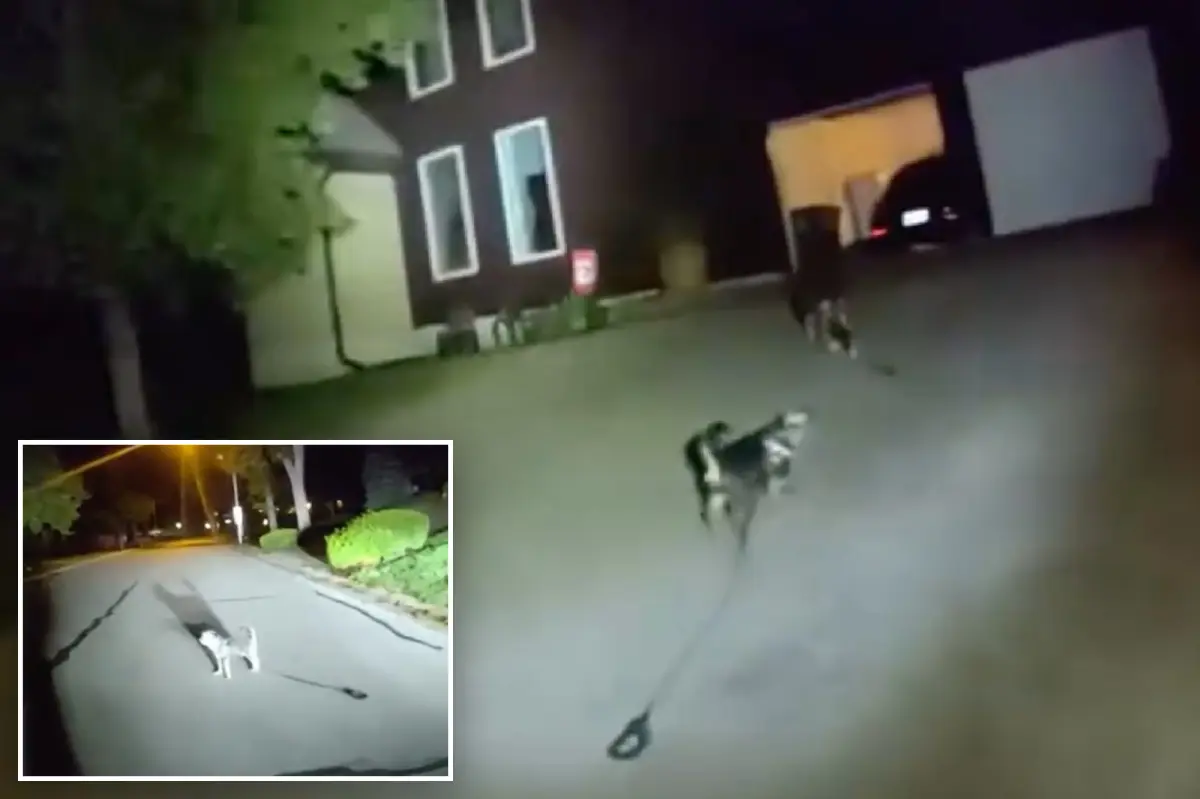
In the quiet, tree-lined streets of Leawood, Kansas, a small but profound drama unfolded on an otherwise ordinary day. It could have been any morning or afternoon in a comfortable American suburb, where the rhythm of life is peaceful and predictable. A police officer was making rounds through a residential neighborhood, body camera switched on as part of routine patrol, when something unusual caught the eye. There, standing in the middle of the street, was a dog. The dog was not merely wandering or chasing a scent; it was clearly on a leash, yet there was no owner on the other end. That simple detail made the scene odd. You do not often see a leashed dog alone in the road. The officer slowed, perhaps expecting a frustrated owner to appear from a nearby yard. Instead, the dog began to bark—not the harsh bark of a territorial animal, but the sharp, persistent bark of a creature trying to communicate. In the bodycam footage, you can almost hear the dog saying, “Here. I am here. Please pay attention.” The officer, likely amused or puzzled, responded with a gentle suggestion: “Hi, why don’t you go on back home?” It was a perfectly reasonable thing to say to a stray dog in a residential area. But this was not a stray. This was a messenger, and it had no intention of going home without the help it had come to find.
What happened next is the kind of moment that restores faith in the quiet bravery of ordinary beings. Instead of driving off and forgetting the strange encounter, the officer made a choice that would change everything: they decided to trust the dog. Perhaps something in the animal’s posture, its insistent barking, or the way it kept looking back over its shoulder told the officer that this was more than a lost pet. The bodycam footage shows the officer following the dog down the road, and the dog seems to understand instantly that it has been heard. It trots forward with purpose, looking back as if to make sure the human is still coming. That half-block journey must have felt like a conversation without words—a police officer, trained to stay calm in life-and-death situations, now following a four-legged guide through a peaceful neighborhood. The Leawood Police Department later described how the officer “followed the dog about half a block to its home.” Every step mattered. The dog was not wandering; it was leading. When they arrived at the house, the garage door was wide open, another oddity that hinted that something was wrong. Another dog emerged from the driveway, adding to the strange parade. The officer, still calm and kind, asked the animals, “Is this where you live?” It is a beautiful moment—a human meeting two worried animals at the threshold of a home, not knowing that behind them lay a quiet emergency.
The mystery was solved when the officer stepped inside and found the homeowner on the floor, unable to get up. The resident had fallen and had been lying there for more than three hours. Three hours is a very long time to be alone and frightened on a cold floor, with pain and confusion settling in and the world continuing as if nothing has happened. In that span of time, the ticking of a clock can be deafening, and hope can grow thin. The officer’s body camera captured the discovery: the officer bending down, offering a calm voice, asking, “Hi, are you OK?” Those four words, spoken gently by a stranger in a uniform, must have felt like rescue itself. For the resident, the ordeal was over. They had not been found by chance. They had been found because a loyal dog had slipped out of the house, perhaps through the very garage door left open in the chaos of the moment, and had gone looking for help. The dog did exactly what many humans struggle to do in an emergency: it stayed focused, found someone, and refused to leave until the problem was solved. The officer contacted medical personnel, stayed with the resident, and ensured that the situation ended safely. The aftermath was reassuring: the resident was treated and was soon recovering at home. The dog likely got a hero’s welcome.
To truly understand the impact of this rescue, we need to imagine the resident’s perspective during those long three hours. Perhaps they had been moving through an ordinary routine—carrying laundry, reaching for a shelf, stepping down unexpectedly—when something went wrong. A misstep, a slip, a sudden loss of balance, and then the cruel sound of a body hitting the floor. The resident must have tried to get up, pushing against the floor, reaching for furniture, calling out for help. But no one heard. The phone was out of reach. The room was empty. There might have been moments of desperation when they wondered if anyone would ever find them. And all that time, the dog was the only witness. Dogs have an extraordinary gift for sensing when their people are in trouble. They respond with a devotion that has been woven into them for thousands of years. This dog did not panic or hide. It stayed close, perhaps nudged its owner, licked their face, and then made a decision. Someone had to do something. The dog’s determination to find help is nearly heroic in its simplicity: a life depended on action, and the animal acted. The bodycam footage shows the dog barking at the officer, then leading the way, as if it understood the concept of rescue entirely. The open garage door was an invitation; the leash was a tool; the barking was a voice. Everything about the animal’s behavior said, “Follow me, please.”
The Leawood Police Department deserves recognition for sharing this story and for the compassion shown by the officer on the scene. In a time when police work is often associated with tension and crisis, this is a reminder that officers also serve as helpers and guardians in moments of unexpected vulnerability. The department released the bodycam footage not for sensationalism, but to celebrate a heart-warming act of loyalty. In their statement, they praised the dog as a “loyal companion” and explained that the resident had been on the floor for more than three hours. They noted that thanks to the dog, the officer was able to locate the resident and get them the help they needed. They could have simply filed a report and moved on, but instead they chose to highlight a story that would resonate with anyone who has ever loved an animal. The officer in the video also demonstrates an important quality: the willingness to listen without words. Many people would have shooed the barking dog away or ignored it as a nuisance. This officer recognized that the dog was trying to communicate something urgent. That kind of quiet attentiveness is a skill, and it made all the difference. In the end, the outcome was positive: the resident was treated by medical personnel and was back home recovering safely.
This small story from a Kansas suburb carries a much larger message about the bonds between people and animals and the many ways we can care for one another. The dog in Leawood did not have the gift of speech, but it spoke loudly enough through its actions. It refused to be ignored. It found a helper. It brought that helper home. And in doing so, it saved a life. There is something deeply human in that story, even though the hero has fur and four paws. It reminds us that love does not always look the way we expect. Sometimes it looks like a barking dog in the middle of a quiet street, a garage door standing open, an officer choosing to follow an animal’s lead. It reminds us that emergencies are not always dramatic—they can be silent, hidden inside homes, happening to people who cannot call out. We are all capable of being the person who notices, who follows, who asks, “Are you OK?” The bodycam footage from Leawood has captured a moment of ordinary heroism that will inspire anyone who watches it. It is a story about loyalty, compassion, and the invisible threads that connect all of us—human and animal alike. And it ends with the best possible outcome: a person safe at home, surrounded by family and the unforgettable companion who refused to abandon them.