

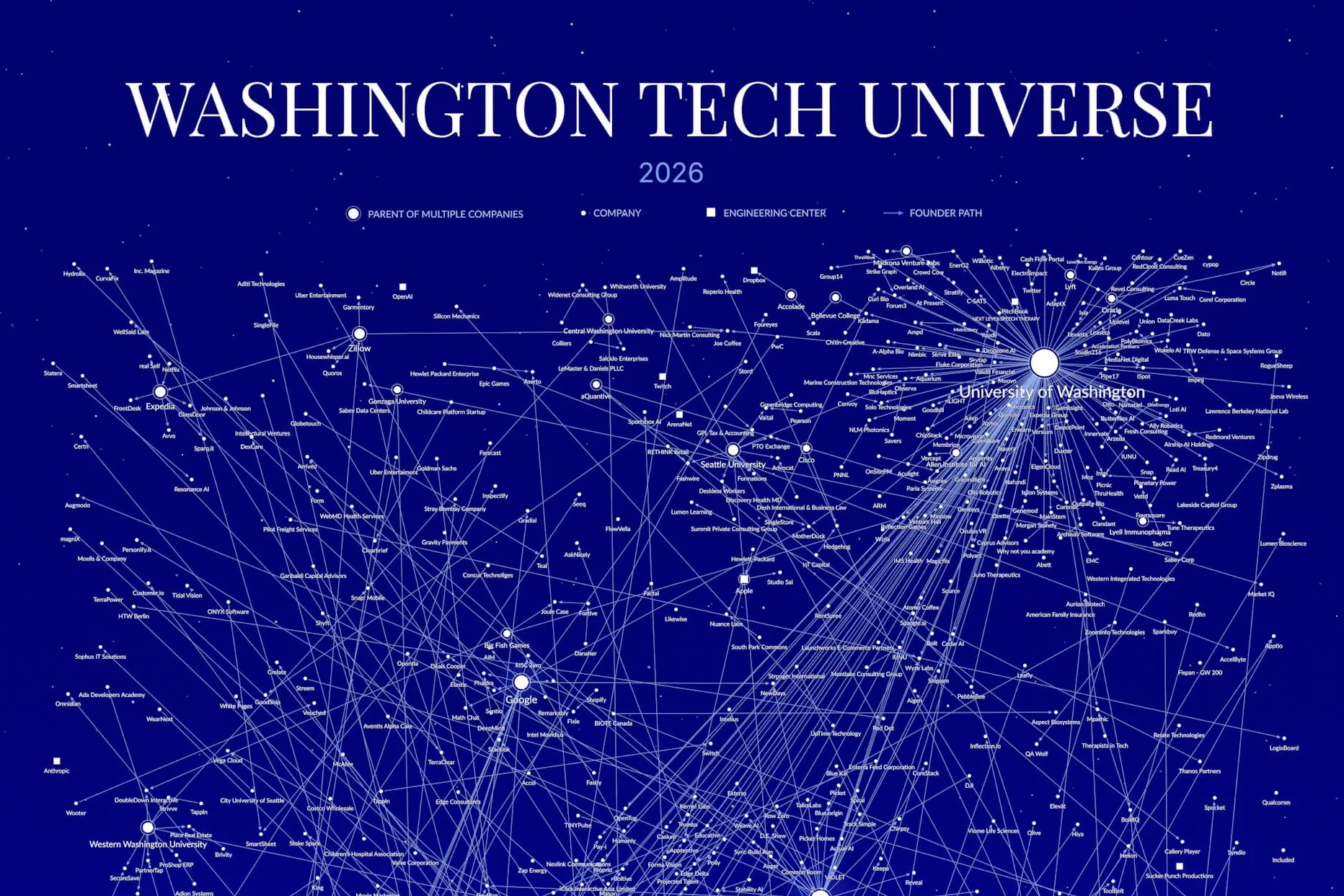
The Pacific Northwest is famous for its dense, ancient evergreen forests, where trees are secretly connected underground by an intricate, symbiotic network of roots and helpful fungi that share resources to keep the entire grove strong. It turns out that Washington State’s technology ecosystem behaves in almost exactly the same way. When the Washington Technology Industry Association (WTIA) unveiled its highly anticipated 2026 “Washington Tech Universe” map at Seattle Tech Week, it did not just present a sterile corporate directory; it revealed a living, breathing family tree of human ambition, shared history, and collaborative destiny. This updated visualization arrives eleven years after its predecessor, born not from a sudden industry crisis or a cold corporate mandate, but from a persistent, collective desire within the community to understand its own rich genealogy. While the prior 2015 iteration was a relatively insular look at Seattle proper, focusing narrowly on acquisitions and local mergers, this bold new cartography of innovation expands its lens to encompass the entire state of Washington, from the rainy shores of the Puget Sound to the sunny valleys of the east. Out of more than 25,000 active tech firms operating across the state’s diverse landscapes, this map meticulously curates a constellation of 625 key companies to illustrate how modern enterprises are born from the shared experiences of real people. As Nick Ellingson, WTIA’s Vice President of Innovation and Entrepreneurship, explained to an eager audience at the University of Washington’s CoMotion Labs, this project was never intended as a vanity ranking of elite corporations or a list of the wealthiest firms. Instead, it serves as a profound visual argument for the power of ecosystem-wide investment, proving that no startup exists in a vacuum and that the success of a single founder is deeply bound to the fertile ground tilled by those who came before them.
At the heart of this vast digital galaxy lie four colossal “gravity wells”—institutions whose cultural and economic pull is so immense that they bend the career trajectories of thousands of professionals toward entrepreneurship. Microsoft reigns as the ultimate progenitor of this ecosystem, acting as the starting point for roughly a quarter of all mapped companies, with 161 firms boasting at least one founder who honed their craft and built their networks within the software giant’s sprawling Redmond campus. Right on its heels is the University of Washington, nurturing 143 companies and asserting itself as an irreplaceable intellectual engine, responsible for an astonishing seventy percent of all university-derived startups featured on the map. Amazon anchors another 58 enterprises with its famously intense, customer-centric alumni who carry a relentless “Day 1” mentality into their own ventures, while Google emerges as a significant new hub with 20 connections—a pipeline of talent that did not even exist on the WTIA’s 2015 map. The data reveals an incredibly tight-knit community where nearly two-thirds of the featured companies can trace their direct lineage to another organization on the map, and forty-four percent of founders worked at two or more Washington institutions before taking the leap to launch their own corporate ships. This cross-pollination of talent suggests that working in Washington tech is rarely a linear, single-company journey; rather, it is a series of overlapping chapters where engineers, researchers, and product managers gather diverse philosophies from different corporate giants before fusing those lessons into entirely new business models.
However, this heavy concentration of creative energy around a few central pillars presents a delicate strategic vulnerability that regional leaders must actively manage if they want to ensure long-term resilience. While local institutions like Microsoft, Amazon, and the University of Washington are deeply woven into the civic, cultural, and economic fabric of the Pacific Northwest and are highly unlikely to leave, other rapidly growing hubs are headquartered in different states. Tech giants like Google, Nvidia, OpenAI, and Anthropic have established massive, highly lucrative engineering outposts in the Puget Sound region, drawing in world-class talent but remaining fundamentally tethered to decisions made in Silicon Valley or elsewhere. Nick Ellingson cautioned that these satellite outposts, though currently serving as incredible breeding grounds for the next wave of local founders, are inherently easier for parent companies to scale back during global economic downturns or corporate restructurings. To buffer the region against the whimsical shifts of out-of-state decision-makers, local advocates stress the urgent need to build a self-sustaining community flywheel that keeps brilliant minds local. By rallying local venture capital, mentorship, and civic support around these departing employees, Washington can ensure that even if an out-of-state corporation downsizes its physical presence, the talented people they brought to the area will choose to stay, plant their own roots, and build the next generation of home-grown, venture-scale employers right here.
Nowhere is this dynamic of talent retention and rapid evolution more visible than in the explosive realm of Artificial Intelligence, which has quietly become the defining theme of the 2026 map. Although AI was never explicitly designated as a filter for inclusion, its overwhelming presence among the newly featured companies—such as Read AI, Karat, Yoodli, Outreach, and Pictory—makes it clear that Washington is a primary epicenter of the global intelligent software revolution. Seattle currently holds a staggering twenty-three percent of all AI talent in the United States, a concentration of brilliance fueled by cutting-edge research institutions like the Allen Institute for AI (Ai2). Operating as a true “founder factory,” Ai2—alongside its newly independent, rebranded spin-out, AI House—has mastered the art of transforming academic breakthroughs into viable, scaling businesses that solve real-world human problems. Meanwhile, pioneer model makers like OpenAI and Anthropic are rapidly establishing their own local footprints, promising to become major entrepreneurial hubs in their own right over the coming decade as their employees branch out to start new firms. These organizations are doing far more than just writing sophisticated machine learning algorithms; they are cultivating a highly specialized, deeply collaborative human network that is redefining how societies communicate, work, and solve complex problems, solidifying Seattle’s reputation as the intellectual capital of the cognitive era.
Bringing this complex web of human relationships into a digestible, beautiful visual format was a monumental task that required blending cold, hard data with artistic intuition and human storytelling. The WTIA team, led by designer and University of Washington alumna Jessica Forcucci, began their journey with a massive dataset of 3,500 active, Washington-based technology companies extracted from PitchBook, each boasting at least one million dollars in funding or annual revenue. This pool was systematically refined by cross-referencing industry benchmarks like the GeekWire 200 and applying strict qualitative filters: companies had to possess active headquarters or major engineering centers in the state and display “meaningful” regional roots through founder or academic lineage. Forcucci and her design team wanted the final “Tech Universe Map” to feel less like a clinical corporate flow chart and more like an astronomical map of connected star systems, illustrating how the invisible gravity of mentorship, shared history, and mutual support binds these companies together. The resulting artwork stands as a testament to the human stories behind the cold statistics, offering a striking visual narrative that helps founders see exactly where they fit within the grander tapestry of the local economy and inspires them to recognize their shared responsibility in keeping the ecosystem healthy.
Looking toward the horizon, the map of 2031 is poised to look radically different as the geographic and technological boundaries of Washington’s tech industry continue to expand far beyond the familiar, wealthy corridors of King County. Ellingson predicts that we are on the cusp of witnessing a powerful democratization of innovation, with robust, self-sustaining technology clusters taking root in historic agricultural and industrial hubs like Spokane, Wenatchee, and the Tri-Cities, bringing high-paying jobs and economic vitality to all corners of the state. At the same time, the state’s technological portfolio is diversifying rapidly, moving beyond enterprise software and e-commerce into capital-intensive, world-changing frontiers such as quantum computing, commercial space exploration, defense tech, fusion, and advanced clean energy systems. To nurture this expansive future, the community must embrace an ethos of radical generosity and collective stewardship that transcends corporate competition. The true secret to Washington’s enduring success has never been its access to capital or its proximity to natural resources; rather, it is a deeply embedded culture of “giving first” and helping the next person in line. By opening doors for emerging entrepreneurs, offering mentorship without expecting immediate transactions, and making introductions purely for the joy of seeing others succeed, today’s leaders will spark the reactions that ignite tomorrow’s brightest corporate constellations, ensuring that Washington remains a beacon of human ingenuity and collaborative progress for generations to come.