





Picture a busy restaurant on a Friday night: the line is out the door, the kitchen is in a low-grade panic, a server has just called out sick, and the manager is buried in a tablet full of alerts that all seem equally urgent. Somewhere in the back of the house, a new hire is making the same mistake for the third time, and by the time anyone notices, a table of regulars has already decided not to come back. This is the chaos that Meadow AI’s co-founders know intimately, and it is precisely the chaos they built their Seattle startup to tame. On a crisp September morning in 2026, the company announced that it had raised $7 million in new seed funding, a round led by Ulu Ventures with participation from York IE, Flying Fish, TenOneTen Ventures, Leadout Capital, and Wedbush Ventures. But to understand what that money really means, you have to look past the term sheet. The round includes the conversion of $6 million in earlier Simple Agreements for Future Equity from a pre-seed financing, which brings Meadow AI’s total funding to $13 million. For co-founders Max Jai Sim and Abbas Guvenilir, and CTO Dragos Velicanu, this is not just a financial milestone—it is a validation of a very human observation: that physical businesses are full of information, yet often blind to it. Meadow AI was founded in 2023 with a mission that sounds simple but is surprisingly hard to execute: give brick-and-mortar operators the same real-time, data-rich understanding of their stores that e-commerce companies have always taken for granted. The company describes its product as an artificial intelligence “co-manager,” a layer of intelligence that watches over physical locations and turns raw audio, video, labor schedules, and inventory data into clear, actionable guidance. That funding announcement, with its carefully worded press release and investor names, is really the story of three entrepreneurs who saw a persistent blind spot in the physical world and decided to build a bridge across it. And while the money will help them grow, the deeper story is about what happens when the physical world becomes as legible as the digital one.
The platform itself is best understood through the lens of a busy shift. Meadow AI ingests video and audio feeds from cameras already in a store, along with labor and inventory data, to continuously monitor team execution, service speed, and overall store conditions. It works like a “digital secret shopper,” but one that never gets tired, never gets distracted, and never has to wait for a quarterly evaluation to speak up. Instead of compiling a report that gets read days later, the software flags bottlenecks and delivers live prompts and coaching to frontline employees while customers are still on-site. If a line is growing at the checkout, if a customer is standing near an empty display, if a kitchen ticket is taking too long, the system notices and sends a gentle nudge to the right person in real time. It also automates the repetitive administrative tasks that eat up hours of a manager’s day—scheduling, compliance checks, inventory counts, incident reports—so that the human beings in charge can do what they do best: be present, lead the team, and take care of customers. The idea is not to replace managers, but to give them superpowers. Instead of staring at spreadsheets in the office, they can stay on the floor with their people, knowing that the AI is watching the data streams and will alert them when something truly needs their attention. This is a fundamentally different approach from the traditional point-of-sale system, which can tell you what was bought and when, but has no idea whether a customer was greeted, whether they waited too long, or whether they left frustrated because of a dirty restroom or a cluttered aisle. Meadow AI’s software is designed to fill that gap, to capture the qualitative texture of a physical experience and translate it into quantitative insights. For operators who have spent years relying on gut instinct and after-the-fact customer surveys, the prospect of a real-time, AI-powered co-manager is almost like adding a new member to the team—one who is everywhere at once and never stops paying attention. It is a compelling pitch, and the company’s early traction suggests that it is landing.
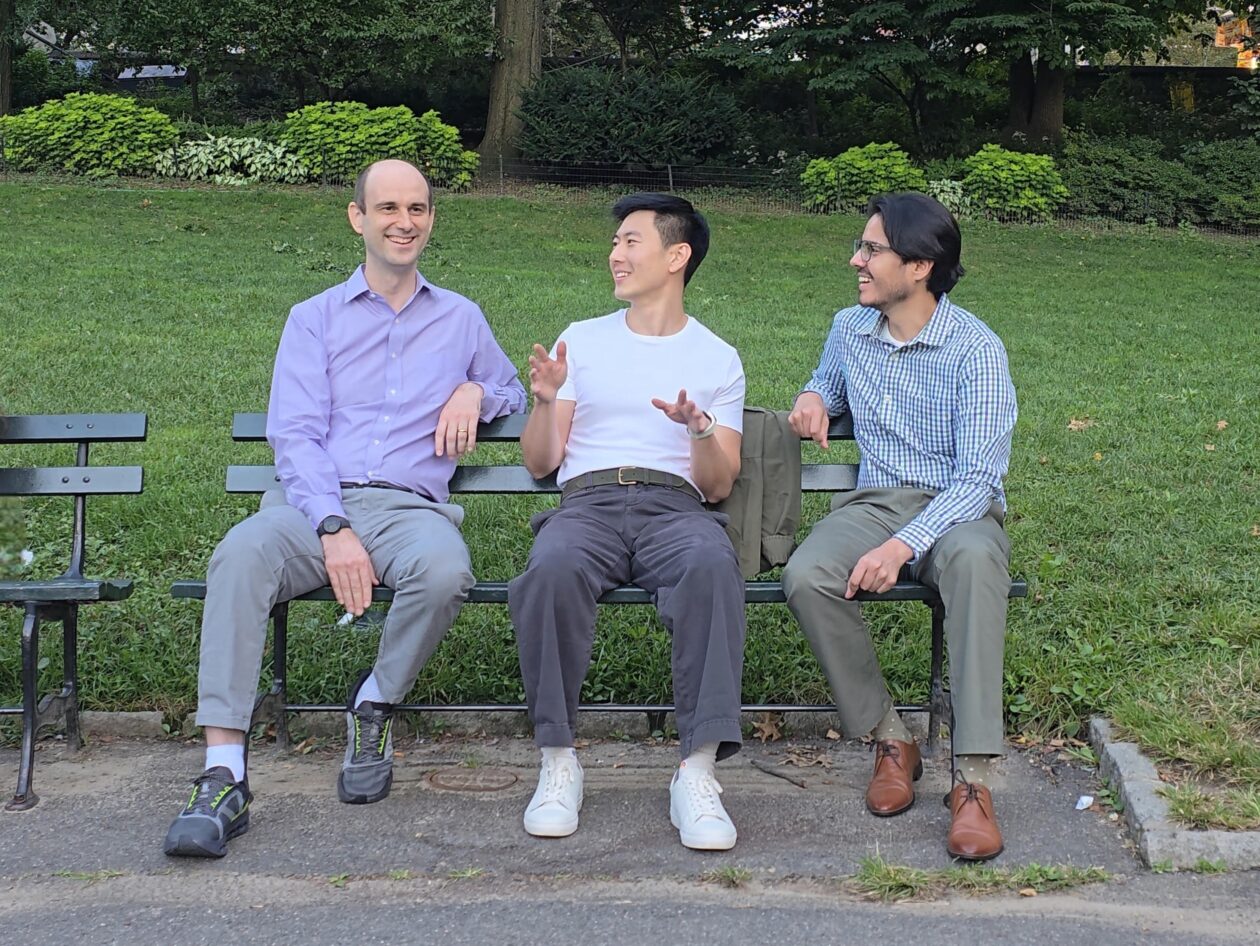
Behind this technology are three founders whose paths to this moment are as interesting as the product they are building. Max Jai Sim and Abbas Guvenilir previously co-founded Modus, a real estate technology startup that raised $14 million before being acquired by Compass in 2020. That experience gave them an education in the slow, analog ways that physical industries operate, and in the enormous value of applying software to spaces that have historically been run on paper, intuition, and institutional memory. Guvenilir went on to lead AI and engineering teams at Nordstrom, where he got an up-close look at the complexities of retail operations—the inventory, the staffing, the endless details that separate a premium customer experience from a forgettable one. Velicanu, meanwhile, brings a very different kind of rigor. He holds a Ph.D. in physics from MIT, where he analyzed particle physics data at CERN, and he previously led engineering at Dave AI. It is hard to imagine a better training for building a system that makes sense of chaotic, noisy reality than spending years sifting through billions of particle collisions to find meaningful signals. Velicanu’s path from the Large Hadron Collider to a Seattle startup might seem like a leap, but it is actually a straight line: he has always been interested in turning overwhelming amounts of data into an understandable, actionable picture. Together, the trio combines expertise in real estate, retail, artificial intelligence, and large-scale engineering, but more importantly they share a frustration with the status quo. They have seen how much physical businesses spend on cameras, sensors, and software, and they have seen how little of that investment actually translates into better decisions on the ground. Most retailers and restaurants already have the infrastructure to know what is happening in their stores—they just lack the intelligence to make sense of it. Meadow AI was founded to be that intelligence, to sit on top of existing systems and point out what matters, moment by moment.
The problem Meadow AI is solving is one that anyone who has ever worked in a store or a restaurant understands on a visceral level. For all the measurable data that physical businesses generate—sales, foot traffic, inventory turnover, average ticket size—the reasons behind those numbers often remain a mystery. An e-commerce site can track every click, every hesitation, every abandoned cart, every mouse movement that precedes a purchase, and then run endless experiments to optimize the flow. A brick-and-mortar business, by contrast, is practically a black box. You might know that sales dropped on a particular Tuesday, but you do not know whether it was because of a competitor’s promotion, a bad weather forecast, a shift change that left the floor understaffed, or simply because the regular greeter called in sick and nobody made eye contact with customers. You might know that a certain store has a food safety violation, but you do not know the small human errors that led to it. You might know that a customer wrote a scathing online review, but you cannot go back in time to see exactly what they experienced. Meadow AI attacks this blind spot head-on. By ingesting audio and video alongside labor and inventory data, the platform can correlate cause and effect: a long wait time, an ungreeted entry, a lapse in service standards, a bottleneck at the register. It can show a manager not just that a shift went poorly, but why it went poorly, and it can coach employees in the moment to prevent the next bad experience. Velicanu captured this mission in a news release when he said, “Physical businesses generate an enormous amount of information, but most operators still don’t have a clear, real-time understanding of what’s happening across their locations. We’re trying to make the physical world as understandable and actionable as the digital world.” That sentence is the heart of the company. It is also a recognition that the tools of the digital age have largely passed over the people who run stores, restaurants, hotels, and entertainment venues—people who have been expected to do more with less, to adapt to new expectations, and to do it all without the kinds of insights that a data scientist could pull from a website in five minutes.
The market has responded emphatically. Meadow AI reported that its software grew by 6x over the past year, and the founders project another 5x growth over the next twelve months. The platform has expanded to more than nine brands across the restaurant, retail, hospitality, and entertainment sectors, and it has already generated more than $3 million in contracted annual recurring revenue and more than $1.4 million in live annual recurring revenue. Those numbers are impressive for a company that is only a few years old, especially in an industry where operators are famously skeptical of new technology. The new funding round—the $7 million seed led by Ulu Ventures with support from a diverse group of investors—will be used to accelerate that momentum. Alongside the funding announcement, the company revealed that former Toast VP of Enterprise Solutions Tanvir Bhangoo has joined as chief revenue officer. Bhangoo’s background in scaling enterprise solutions for restaurant and retail accounts makes him a natural fit for the company’s next phase, which is all about moving from early adoption to broad expansion. Meadow AI has grown to 17 employees and is actively hiring, with plans to expand its engineering, product, and go-to-market teams. The emphasis on hiring is telling. This is not a company that wants to be a niche tool for a handful of tech-forward restaurants; it wants to become the standard way that physical businesses understand their own operations. The co-founders are betting that once operators see what their stores look like through the eyes of an AI co-manager, they will never want to go back to working blind. And the early customer list, combined with the revenue numbers and the caliber of the new leadership, suggests that this bet is paying off.
Looking ahead, Meadow AI’s vision is both ambitious and refreshingly grounded. The company is not promising some science-fiction future where robots run restaurants and humans become obsolete. Instead, it is promising something more practical and, in a way, more powerful: a world where the people who show up every day to run physical businesses can finally see what is happening in their world with the same clarity that an online retailer sees a website. That clarity means a manager can catch problems before they become reviews, can praise an employee for great service while it is happening, can make a scheduling decision based on how a shift actually flows rather than how it looked on paper. It means fewer bad experiences for customers, less frustration for workers, and more profit for owners. It also means a cultural shift in how we think about the physical world. For two decades, the promise of the internet was that everything could be measured, optimized, and personalized. But the physical world—the places where we eat, shop, gather, and live—resisted that kind of treatment. Meadow AI is trying to change that, not by forcing physical businesses to behave like websites, but by bringing the best of digital intelligence into the messy, human reality of bricks and mortar. The $7 million seed round is a vote of confidence in that vision, and the company’s growth trajectory suggests that the market is ready for it. But the real test will come in the day-to-day moments: the line that shrinks because someone was alerted in time, the customer who feels seen because a manager was on the floor instead of in the back office, the employee who gets better because the coaching arrived in the moment it mattered. Those are the outcomes that Meadow AI was built to create, and they are why the founders’ story resonates beyond the tech industry. It is a story about removing the blindfold from the people who keep the physical world running, and giving them the tools to do what they have always wanted to do: serve people well. With 17 employees, a growing roster of customers, a new chief revenue officer, and $13 million behind them, the founders are just getting started, but the direction is clear. The physical world is about to become a lot more understandable, and the people who live in it will be the better for it.