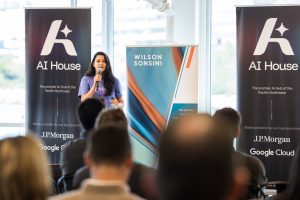






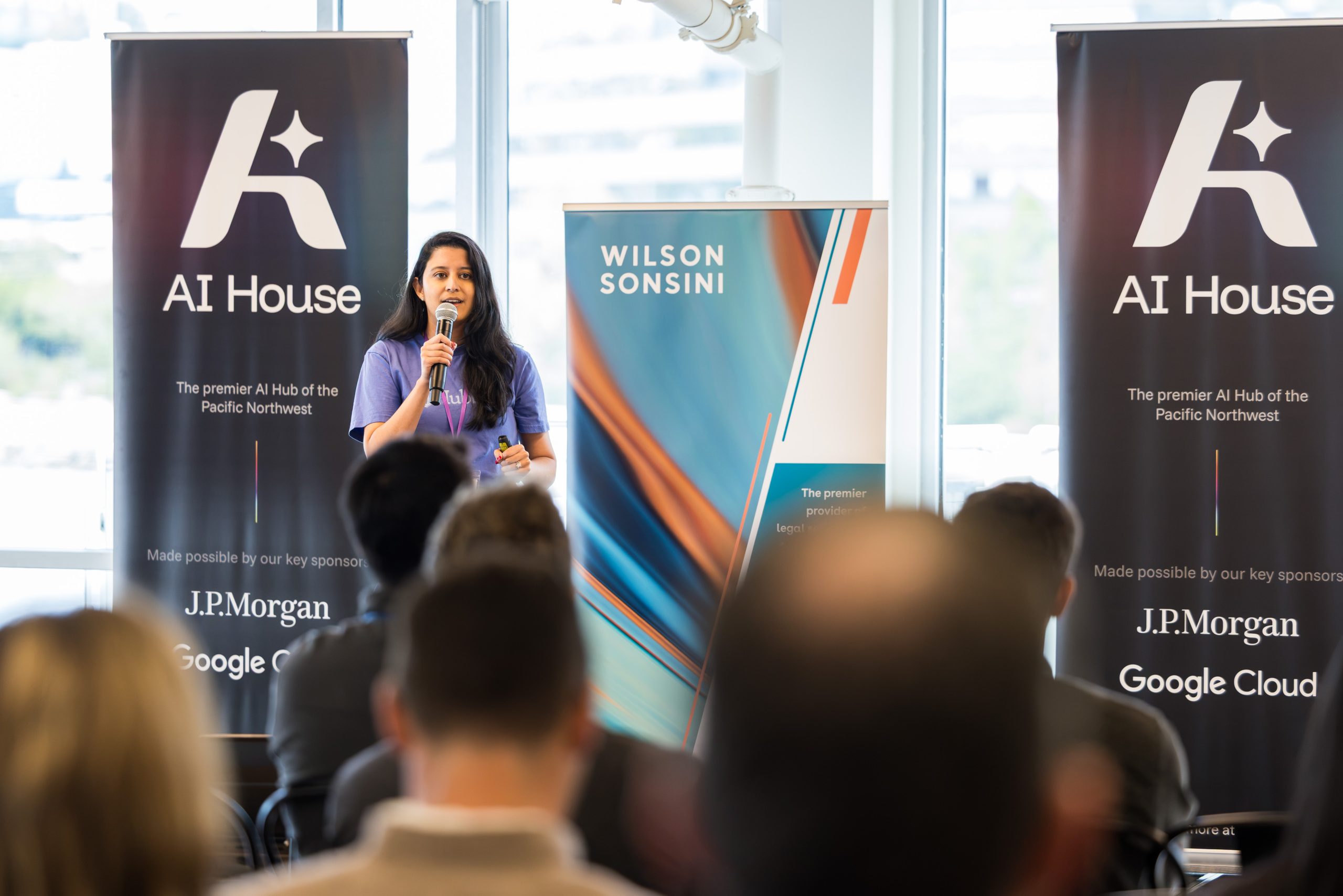
Seattle has long been a city where ambitious founders build serious companies, but when it comes to early-stage funding, the region has often felt like an afterthought compared to the Bay Area or Boston. That frustration finally found an outlet this week, when AI House, a Seattle-based startup incubator and venture fund, hosted its first-ever demo day designed to lure outside capital into the local ecosystem. Investors traveled from as far as New York, Colorado, and the Bay Area to gather at AI House’s offices on Pier 70, where 25 early-stage startups took the stage. The energy was electric, not just because of the pitches, but because the event itself was a statement: Seattle is tired of being overlooked, and it’s ready to show the world what it has built. “We all complained about not having enough capital here, but no one was doing anything about it,” said Yifan Zhang, an AI House managing director who conceived the event. So AI House reached into its own network, invited investors from across the country, and, as Zhang put it, “people flew in from all over for this.” It was a deliberate, collective effort to close the gap between Seattle’s thriving startup scene and the money needed to fuel it.
The roster of attendees reflected the event’s ambitions. Investors included Mike Vernal, a partner at San Francisco-based Conviction; Emily Melton, founder and managing partner of Threshold Ventures; and Rob Go, co-founder of Boston-based NextView Ventures. These are names that typically orbit Silicon Valley, and their presence in Seattle signaled that the region’s startups were being taken seriously on a national stage. Many well-known Seattle-based VCs also turned out, creating a rare mix of local familiarity and outside curiosity. Zhang explained that she wanted the lineup to showcase the breadth of Seattle’s startup community—companies grounded in real problems and revenue, alongside technologists pursuing “crazy ambitious things.” That balance was on full display throughout the day. Theo Ellis, CEO of Seattle mortgage-tech startup Friday Harbor, captured the sentiment when he called the event “Seattle’s answer to YC Demo Day,” a nod to Y Combinator’s famous Bay Area showcase. Ellis acknowledged that Seattle startups aren’t always in the flashiest spaces, but they have something arguably more valuable: real customers and fast growth. “It’s not exactly nuclear-powered robots landing on Jupiter,” he said of his own mortgage-lending technology, “but it’s an enormous market with a lot of businesses willing to pay for it.” That grounded, no-nonsense attitude defined much of the day.
The pitches themselves painted a vivid picture of a startup community that is both pragmatic and boldly imaginative. Friday Harbor, for instance, revealed that it underwrote 0.6% of all U.S. residential mortgage applications in August and is beginning to raise its Series A round—a perfect example of a company solving a deeply unglamorous problem with huge market potential. Other companies spanned industries from mining to music. Moria, co-founded by Chris Mutzel and Jimmy Voorhis, uses AI to produce technical studies for mining companies, and Voorhis said one customer expanded a $100,000 contract to $900,000 in just two months. Hubble, a Y Combinator Summer 2026 company led by CEO Prabha Dublish and CTO Aaron Leon, is building an API to retrieve patients’ medical records, with Dublish laying out her vision to become the “Plaid for medical records.” Atlas, co-founded by former Ai2 researcher Chandra Bhagavatula and Martín Ramírez, is developing AI to run much of a company’s day-to-day operations. And Reflection Robotics, led by former Nvidia robotics research manager Arsalan Mousavian, is building AI models that allow factory robots to learn precise tasks from a single demonstration. These are not incremental improvements; they are ambitious bets on how AI will reshape entire industries.
There were lighter moments too, adding personality to an otherwise serious day of fundraising. Alejandro Castellano, co-founder and CEO of Caddi, opened his pitch with a wink: “We’re not a golf company, so relax.” Caddi builds AI agents to automate back-office work at professional services firms, and the joke was a playful nod to the stereotype of flashy demo-day pitches. Eidol, an AI House portfolio company from Los Angeles, brought a different kind of star power. Its software listens to a live singer and keeps pre-recorded vocal tracks in sync with the performance, and founder Clayton Janes pitched alongside the company’s chief artist officer, Kay Hanley, the lead singer of the band Letters to Cleo. It was a memorable moment that showed how AI can serve artists, not just enterprise software buyers. Other startups included Comment.io, co-founded by former Microsoft and Textio product leader Jon Gordner and CTO Max Winderbaum, which helps people review and approve work produced by AI agents; Axel, an AI travel agent that says it finds flight and hotel deals below public prices, with about $30 million in annualized bookings; Suede, founded by former merchandising director Danielle Dantche, which automates product listings and purchase orders for independent boutiques and has processed $9.9 million in inventory over the past 90 days; Ergoly, which helps small service firms train and deploy AI workers for each of their clients; and Finch, founded by former Brightflow AI CEO Jeffrey Priebe, which builds AI to plan and run in-person events that companies use to meet potential customers. The diversity was staggering, but it all felt distinctly Seattle—practical, ambitious, and rooted in solving real-world problems.
The event also gave a platform to companies that have been quietly building for years, many of which have been covered by GeekWire. Alongside Friday Harbor, the lineup included Optimly, Vantari, Jinn Labs, GateIn, Casium, Orbital Robotics, Viata, Ridge AI, Caddi, Lev, Aria (formerly Alpyne Labs), and Synthesize Bio. But the demo day was not just about the companies already on the radar; it was about surfacing new talent. Several startups were relative unknowns, at least in their current incarnations, and they seized the opportunity to introduce themselves to a room full of influential investors. For AI House, this was intentional. The event was designed to show multiple sides of Seattle: the builders creating real revenue, and the dreamers chasing massive technological leaps. That mix is what makes the region special, and it was on full display from morning to evening. The energy never flagged, and the conversations spilled out of the pitch room into the hallways and the pier outside, as founders traded stories and investors compared notes. It felt less like a traditional pitch event and more like a community coming together to prove a point—to themselves and to the visitors who had traveled so far to see them.
Closing the event, Jacob Colker, AI House co-founder and managing director, made an impassioned pitch to the out-of-town investors, building on themes he has championed in recent columns and during Seattle Tech Week in July. The region, he said, is full of “space, science, tech, bio, health, startup builders,” with far more good ideas than local investors can fund. “The reality is there’s just not enough capital in the Pacific Northwest.” That blunt truth was the very reason the room had gathered. Colker predicted that the visiting investors would find “great investment opportunities and great deals” in Seattle, and he urged them not to overlook the city. “Seattle is worth your time, your investment, your focus, your energy,” he said. The words hung in the air as the event wound down, a fitting close to a day that was as much about belief as it was about business. For the founders who pitched, the investors who listened, and the organizers who made it all happen, the message was clear: Seattle is no longer waiting for validation. It is building, it is growing, and it is ready for the world to pay attention. The demo day may have been a first, but if the energy in that room was any indication, it will not be the last.