





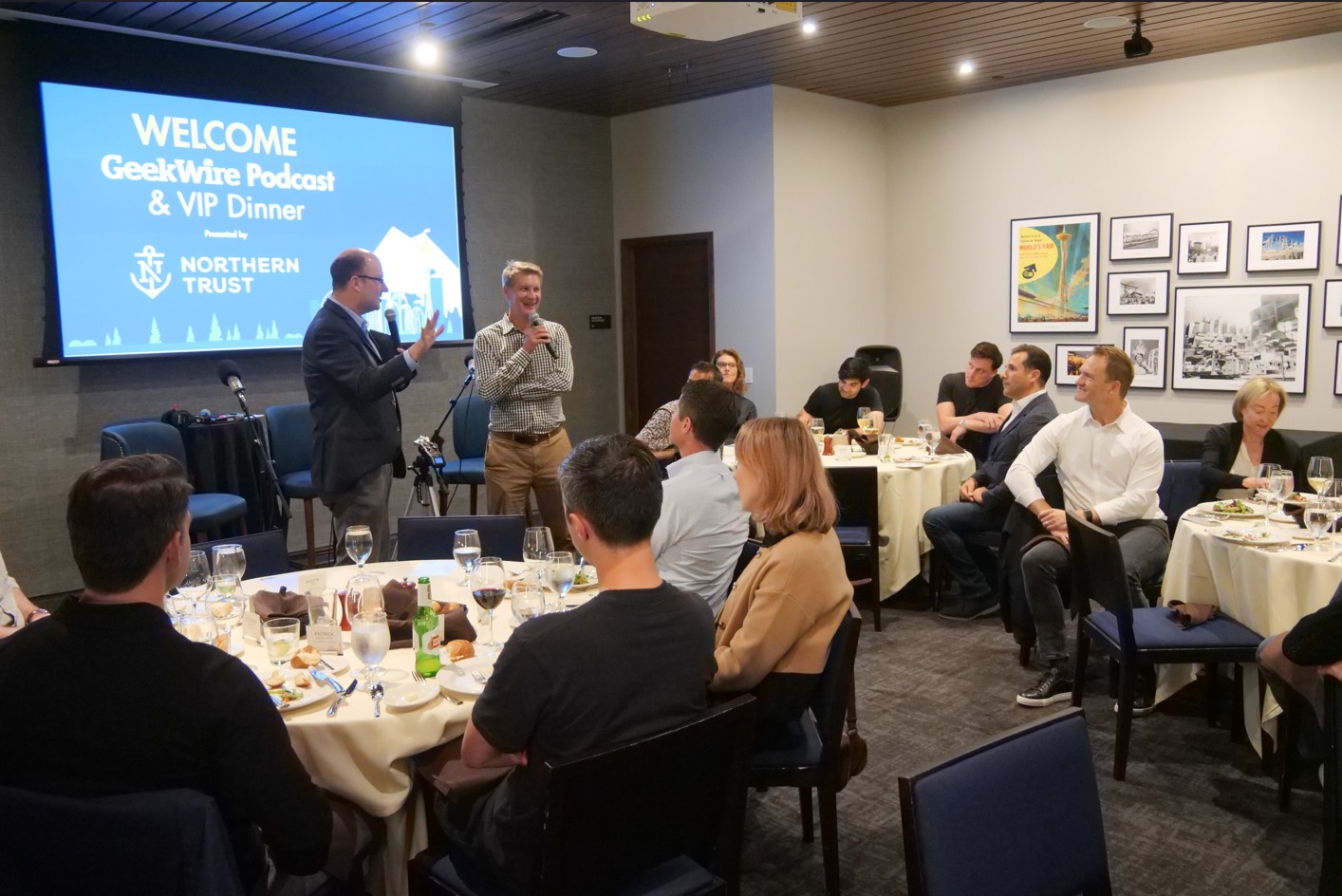
On a late-September evening in downtown Seattle, the dining room at Daniel’s Broiler was alive with the sound of people who build things for a living. Founders, CEOs, and investors had gathered for the GeekWire Podcast and VIP dinner, presented by Northern Trust, and the mood was warm, a little nervous, and full of the kind of energy that only happens when people who usually communicate through screens finally sit across a table from one another. Todd Bishop and John Cook, the co-founders of GeekWire, opened the show with a story that felt like a preview of a strange and complicated future. Amazon had just blocked Meta’s new Muse AI assistant from shopping on Amazon.com. The official reason was that Muse didn’t identify itself as an AI, and that violated Amazon’s conditions of use. On the surface, that sounds like a small technical disagreement between two giant companies, the kind of thing that gets resolved in a legal office or a press release. But as Todd and John explained, the standoff is an early sign of a much bigger fight over whether AI agents have the right to use websites and apps on behalf of real people. And Amazon, more than almost any other company in the world, has an enormous amount riding on the answer. Because if AI agents become the new way we shop, search, and browse, then the rules of the internet are about to be rewritten. The question is not just whether Meta’s Muse can buy a product on Amazon. The question is who gets to decide how the digital world works, and whether the humans who built it will still be in control.
At the center of the dispute is a question that sounds simple but isn’t: When an AI goes shopping for you, should it have to say hello? Amazon’s position is yes. If an automated system is going to crawl the site, compare prices, and possibly make purchases, Amazon wants to know that it’s a bot, not a person. That’s not just about keeping the site secure; it’s about the terms of service that every user agrees to, and about Amazon’s ability to control how its store is used. But from Meta’s perspective, Muse is simply doing what a helpful personal assistant should do. It’s trying to save time. It’s trying to make life easier. And in the rush to build the next great AI product, maybe it didn’t stop to introduce itself. The implications go far beyond one shopping trip. If AI agents become the way we interact with the internet, every website will have to decide whether to welcome them, tolerate them, or block them. The tools we use to search, shop, and socialize could become battlegrounds, with companies like Amazon fighting to protect their own interests while also trying to build their own AI experiences. During the podcast, the hosts asked Muse to respond, and the answer was impressively sophisticated and evenhanded. It didn’t sound defensive or petty. It acknowledged that Amazon has a right to set rules for its own website. It agreed that transparency is important. But it also made a calm, reasoned case for why AI agents like itself should be allowed to help consumers, as long as they do so openly and respectfully. Whether that response was genuine understanding or just a well-trained algorithm, it was a sign of how mature these systems have become, and how much more complicated they are than simple tools.
This was not the kind of conversation you can have in a quiet studio and then release into the void. It needed the texture of a live room, the clinking of glasses, the murmur of people who know what it’s like to build something from nothing. The event was part podcast, part dinner party, part civic forum. The guest was Mike Fridgen, a longtime Seattle entrepreneur and a venture partner at Madrona, who is now working on a stealth startup. He couldn’t say much about his new company, but he could say a lot about the city he has chosen to build in. The question was straightforward: Is Seattle still a good place to build a company? Fridgen’s answer was not a Chamber of Commerce pitch. He talked about the region’s talent, the density of engineers and product thinkers who have shipped some of the most important technology in the world. He talked about Seattle’s history, the legacy of Boeing, Microsoft, and Amazon, a culture that has always been more about making things than about pitching things. But he also talked about the challenges. The cost of living has become brutal. The city has struggled with homelessness, addiction, and a sense that the civic infrastructure hasn’t kept up with the economic boom. The political climate has grown more polarized. And yet, he argued, the raw ingredients are still here. There is a reason people come to Seattle to build things that last, and there is a reason some of them leave and then come back. The room nodded. These were people who had lived the answer, not just heard it. They had felt the city’s pull and its push. They had argued with city council members, hired people from all over the world, and watched Seattle change in front of their eyes. And they were still there, still building, still hoping.
The conversation inevitably turned to taxes, specifically Seattle’s JumpStart payroll tax, a levy on the payrolls of the city’s largest employers that was designed to fund housing and services for people experiencing homelessness. In the new budget from Mayor Katie Wilson, the tax was held flat, which gave the business community a small exhale but no real resolution. Fridgen didn’t pretend that taxes don’t matter. They matter as a signal, he said. They matter to founders who are deciding whether to put their company’s next office in Seattle or somewhere else. But they are not the first thing on a founder’s mind. The first thing is talent. Can I hire the people I need? Can I pay them enough? Can I create a place where they want to work? Taxes are part of the calculation, but they’re not the whole calculation. The deeper issue is what kind of city Seattle wants to be. A city that taxes its biggest employers has to show that it can use that money well. A city that asks businesses to invest in the community has to show that it values the businesses themselves. The debate over JumpStart is really a debate about the social contract, about what we owe each other, and about how to pay for the things that make a city livable. The fact that the new mayor’s budget held the tax flat was a compromise, a pause, a moment of uncertainty. For the founders and CEOs in the room, that uncertainty was uncomfortable, but not paralyzing. They have built companies in harder times. They know that a city, like a startup, is never finished. It’s always in the middle of becoming something else, and the people who love it have to be willing to stay in the mess.
Then the floor opened up. Ellie Fields, the CEO of Ridge AI, asked how business leaders can engage productively in building the region, not just complaining from the sidelines. The answer, it seemed, was about showing up in the messy middle: joining civic boards, mentoring young founders, working with schools, and talking to elected officials even when it’s easier to tweet insults. Business leaders have resources and credibility; they can use them to build bridges instead of walls. Stefan Kalb, the CEO of Latch, asked a question that has haunted Seattle for years: Why does the region have so much less venture capital than the Bay Area? The answer is a mix of history, geography, and culture. The Bay Area spent decades building a dense network of money, talent, and risk-taking; Seattle was shaped by big companies and industrial research, not by speculative capital. But the gap is not a permanent curse. There are signs that more funds are paying attention to Seattle, and there is a growing sense that the region’s understated style might actually be an advantage. Less hype, more substance. Finally, Mary Jesse, the founder of ACME Brains, asked perhaps the most important question of the night: How do we get past polarization? The answer was not a policy proposal. It was a reminder that the person on the other side of the argument is a person. It was a call to listen before responding, to find the values we share, and to focus on concrete problems rather than abstract identities. Nobody claimed to have a magic formula. But the fact that a room full of competitive, opinionated people could ask that question out loud, and actually listen to the answer, felt like a small victory. It felt like the kind of conversation that doesn’t happen nearly enough in public life.
The evening closed with a satellite-themed GeekWire Trivia Challenge, a playful nod to the night’s final guest, Austin Link, the co-founder of Starfish Space. For a few minutes, the room was full of laughter and the sound of people trying to remember details about space exploration. It was a reminder that technology is not only serious business; it’s also fun, curious, and deeply human. Then Link made an unexpected announcement, something that seemed to come out of nowhere and, in a way, captured the spirit of the entire night. It was one of those moments that makes live events special: you can’t plan it, you can’t reproduce it, and you can’t fully capture it in a podcast. It was a glimpse of the future being built by people who are not waiting for permission. As the episode wrapped, with music by Daniel L.K. Caldwell playing in the background and the room slowly emptying, the conversations continued in small groups. People exchanged business cards, laughed about the trivia, and returned to the topics that mattered to them: AI, capital, taxes, trust. The podcast will live online with related links and show notes, but the moment was bigger than that. At its best, GeekWire has always been about connecting the dots between technology and the human beings who create it. This was one of those nights when the dots were all in the same room. And the message, from the Amazon-Muse standoff to the questions about Seattle’s future, was clear: the future is not something that happens to us. It’s something we build together, one conversation at a time.