





Here is a comprehensive, humanized feature article summarizing the recent developments at Juno Propulsion. Written in a narrative, journalistic style, it expands on the raw data to provide context, explain the technology, and highlight the people behind the engineering, while hitting the requested length and structure.
Paragraph 1: The Big Bet on a Cleaner, Faster Future
For most startups, the phone call from a federal funding agency is a moment of pure, unadulterated adrenaline. In the competitive world of aerospace, a government grant isn’t just money—it’s validation of a concept, a stamp of approval that can open doors to commercial deals and future talent. Recently, the team at Juno Propulsion, tucked away in the Seattle suburb of Tukwila, Washington, received exactly that jolt of confidence. The National Science Foundation (NSF) has awarded the young company a $1.2 million Phase II grant under its prestigious Small Business Innovation Research (SBIR) program. While the dollar amount is impressive, what truly matters is what the NSF is betting on: Juno’s audacious plan to replace the toxic, flammable, and expensive chemical propellants that have dominated space travel for decades with a revolutionary, non-toxic propulsion system. It’s a mission that aims to make spaceflight not only more efficient but also fundamentally safer—a critical step as humanity pushes deeper into orbit, beyond the Moon, and eventually toward Mars. This isn’t just about building a better thruster; it’s about cleaning up the “dirty secrets” of the aerospace industry and paving a new, green highway to the stars.
Paragraph 2: The Engineering Magic Behind the Detonation
To understand why the NSF is excited, you have to look under the hood at the physics that Juno is commercializing. Traditional rocket engines operate through a process called deflagration—a subsonic burn where fuel and oxidizer rapidly combust together. It’s a controlled, steady burn, like a campfire. However, Juno is focused on Rotating Detonation Rocket Engines (RDREs). Unlike a standard chemical burn, detonation is a supersonic shockwave that travels faster than the speed of sound, compressing and igniting the propellant almost instantaneously. This shockwave spins continuously around a ring-shaped combustion chamber, like a cyclone of fire, extracting far more energy from the same amount of fuel. The result is a massive leap in thermodynamic efficiency and specific impulse—which is the rocket engineer’s metric for “miles per gallon.” This means Juno’s engines can deliver the same thrust using significantly less propellant, or conversely, allow a spacecraft to carry more payload for the same weight. While the concept isn’t new—the Soviets flirted with the idea decades ago—recent advances in additive manufacturing, materials science, and computational fluid dynamics have finally made RDREs practical. Juno pairs this hyper-efficient engine architecture with a clean, non-toxic propellant combination, such as oxygen and methane. Compared to the industry standard of hydrazine—a highly carcinogenic, corrosive monopropellant that requires hazmat suits for handling—Juno’s system is practically a breath of fresh air. It makes launch preparation safer for ground crews, reduces the cost of satellite fueling, and enables longer, more complex missions that simply aren’t viable with heavier, less efficient chemical systems.
Paragraph 3: From a Phase I Feasibility Study to a Phase II Product
Of course, turning a brilliant physics concept into a flight-ready component is a long, arduous process, which is why the NSF’s SBIR program is structured to catch companies at different stages of their journey. Juno’s story with the federal agency began back in 2024, when it received a modest $275,000 Phase I grant. That funding was the “seed money” that allowed the engineers to do the theoretical heavy lifting: they validated their detonation models, conducted ground-based component testing, and proved to the NSF that the physics actually work. Now, the new Phase II grant provides the catapult to scale from a lab experiment to a robust engineering marvel. With this $1.2 million in hand, Juno will advance the technology towards the creation of a flight-like Product Development Unit (PDU). This is the critical phase where the engineering gets real—where interfaces are hardened, thermal management is optimized, and the engine is subjected to the intense vibration and thermal stresses it will face in the vacuum of space. The ultimate goal of this Phase II effort is to bring the system to a Technology Readiness Level (TRL) of 8. On the standard 1-to-9 scale used by NASA and the Department of Defense, TRL 8 means “actual system completed and qualified through test and demonstration”—essentially, a system that is proven to work in its operational environment and is ready for production. This is the final stepping stone before TRL 9, which signifies a system that has actually flown and successfully operated on a mission. Achieving TRL 8 is a monumental hurdle, but it proves that the technology is not merely a promising concept, but a durable, bankable product.
Paragraph 4: The Crucial 2027 Test Flight — Project Iris
While laboratory testing on Earth is crucial, it can never fully replicate the harsh conditions of space—the thermal vacuum, the microgravity, and the radiation. Knowing this, Juno has already charted its course for a real-world debut. The company has signed on to fly an on-orbit demonstration mission called Project Iris, scheduled to launch aboard Momentus’ Vigoride 8 satellite platform in 2027. This mission is the ultimate hands-on test for the technology—a chance to fire the engine in the environment it was designed for, gathering invaluable data on how the detonation wave behaves in space, how the engine heats up in a vacuum, and how the clean propellant flow handles orbital maneuvering. For a startup, securing a ride to space is half the battle; securing a capable, reliable partner like Momentus—who specialize in space tugs and orbital services—provides a significant advantage. The lessons learned from Project Iris will feed directly back into the PDU development sponsored by the NSF. In aerospace, this iterative loop is crucial. The data gleaned from the 2027 flight will allow Juno’s engineers to tweak the design, fix any unforeseen gremlins, and validate the engine’s performance on paper with concrete evidence from orbit. If Project Iris succeeds, it will not only elevate Juno’s credibility to the stratosphere but also provide the necessary flight heritage that many risk-averse commercial satellite operators demand before they bet their multimillion-dollar spacecraft on an unproven engine.
Paragraph 5: The Story of Alexis Harroun and Ari Martinez
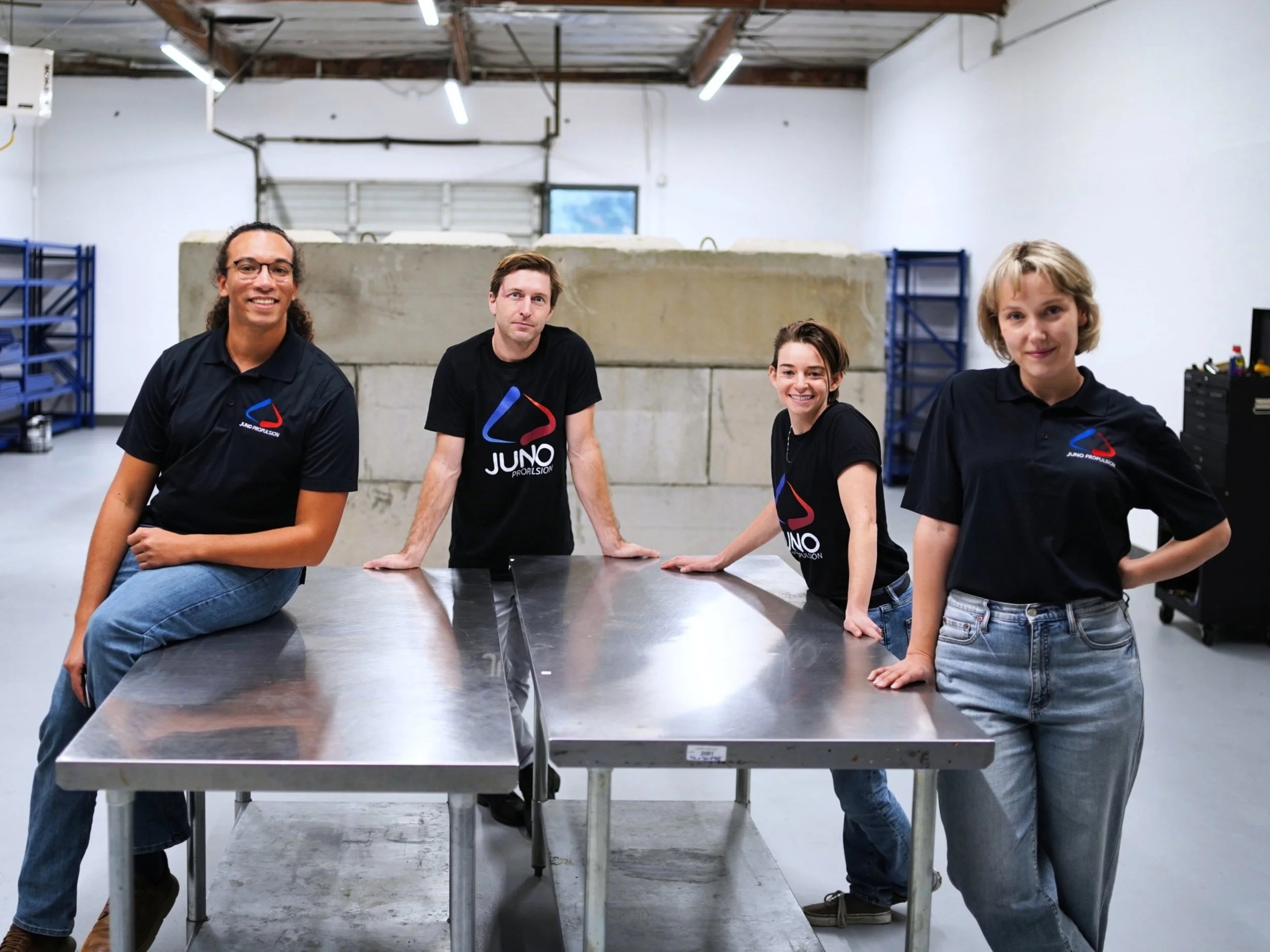
Behind every cutting-edge propulsion system is a team of brilliant, stubborn dreamers. For Juno, that leadership starts with CEO Alexis Harroun and Chief Technology Officer Ari Martinez, who met while earning their Ph.D.s at Purdue University—a school renowned for its aeronautics and astronautics program. This partnership was forged in the academic trenches, where they shared a frustration with the limitations and hazards of modern propellant systems and a shared vision for a safer future for human spaceflight. Harroun’s resume is a veritable “who’s who” of Pacific Northwest aerospace. She holds an undergraduate degree in aeronautics and astronautics from the University of Washington, and before heading to Purdue, she interned at none other than Blue Origin, Jeff Bezos’ space venture. That internship likely gave her a firsthand look at the industrial scale of rocket manufacturing and the immense challenges of pushing new tech into operations. Now, Juno isn’t going it alone in its scientific quest. The new NSF grant explicitly partners the company with the University of Washington and UW Professor Carl Knowles’s lab. This is a symbiotic relationship: the academic lab provides deep theoretical understanding, advanced diagnostic instrumentation, and a fresh pipeline of eager graduate students, while Juno provides real-world engineering problems, access to industry data, and a path to commercialization. It’s a classic tech transfer arrangement that maximizes the return on taxpayer dollars, ensuring that the research coming out of UW isn’t just staying in a dusty journal, but is actively being turned into hardware that flies.
Paragraph 6: Solid Business Backing and a Vision for the Future
Finally, while the government is betting on the science, private investors are betting on the business. In addition to the NSF largesse, Juno recently closed a $1.4 million pre-seed financing round. The round was led by SOSV, a prominent global venture capital firm known for its deep support of hard-tech climate and space startups. They didn’t invest alone; the cap table also includes Hypernova Fund, Leslie Ventures, Activate, Collaborative Fund, Safar Partners, and Cape Fear Ventures. This syndicate of investors brings not just capital but also strategic guidance, industry connections, and a market validation signal that the technology has commercial legs. So, what does the future look like for Juno? If the PDU hits TRL 8 and Project Iris flies successfully in 2027, the company will be uniquely positioned to serve a booming market. Commercial satellite constellations need efficient propulsion for orbital insertion and station-keeping; defense agencies are interested in maneuverable spacecraft; and future deep-space exploration missions require engines that can make the most of limited propellant mass. By combining the high-energy physics of rotating detonation with the operational simplicity of non-toxic fuels, Juno is attacking the two biggest headaches in propulsion simultaneously: performance and safety. They are aiming to make hydrazine a thing of the past and to give engineers a tool that lets them think bigger about what space missions can achieve. For now, the team is rolling up their sleeves, armed with a new grant, a clear roadmap, and the quiet confidence that comes from knowing they are not just building a product—they are building a highway to the stars.