





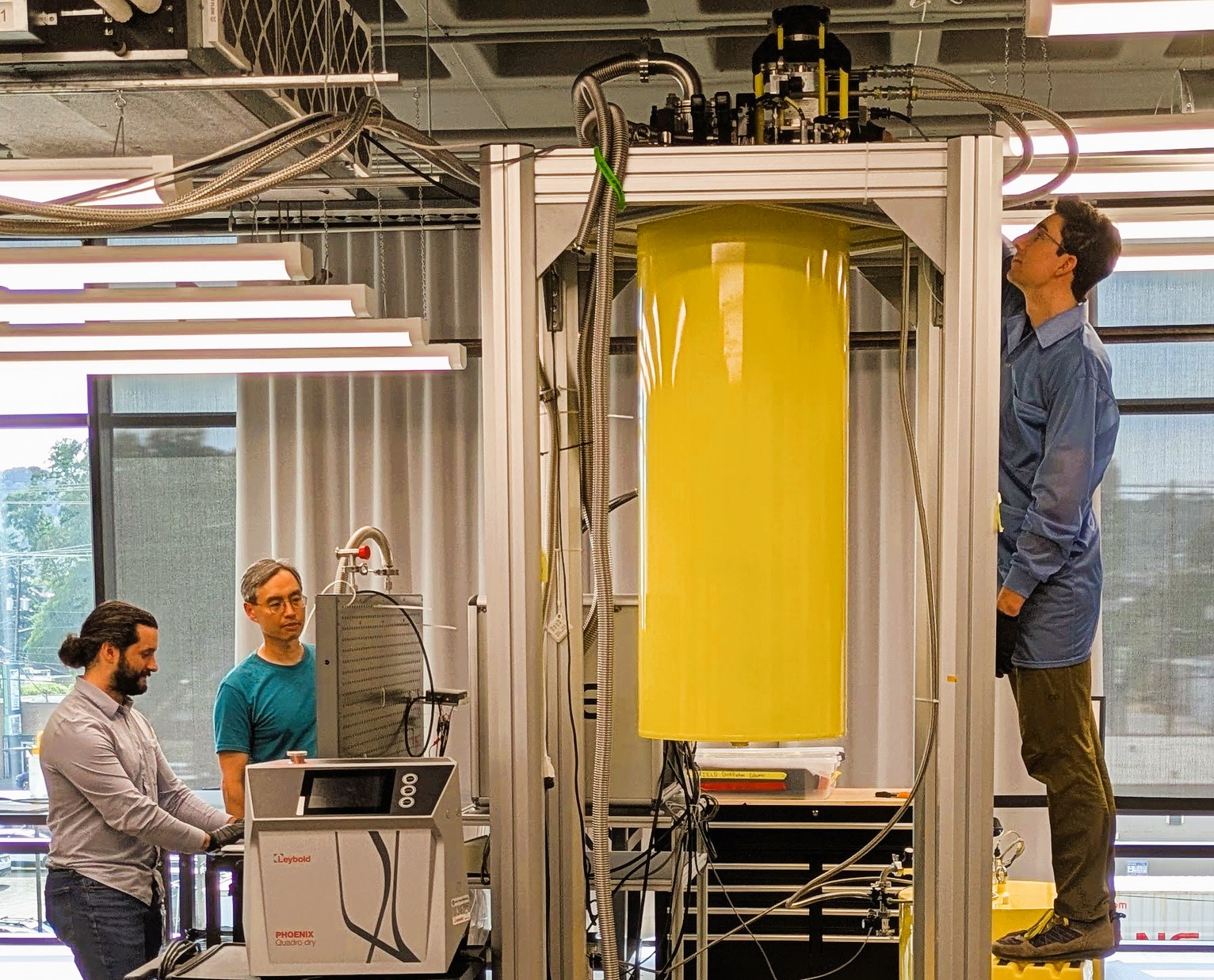
Deep within the sterile, softly humming confines of Interlune’s cryogenic laboratory in Seattle, mechanical engineer Sam Heyd, Chief Technology Officer Gary Lai, and chemical engineer Brenden Pelkie stand huddled around a complex network of stainless-steel plumbing, vacuum-insulated valves, and monitoring screens. This sophisticated machinery houses “Cold Capture,” a proprietary technology that has recently achieved a monumental breakthrough by extracting 99% pure helium-3 from standard, industrial-grade helium. For decades, helium-3 has been treated as a near-mythical resource—an isotope of unimaginable value but one so vanishingly rare on Earth that its widespread commercial use remained a distant dream. By successfully separating this precious gas under extreme conditions, the Interlune team has not only proven a critical concept for future space industries but has also unlocked an immediate, earthly supply chain. The achievement marks a profound shift for the company, showing that the road to mining the heavens does not begin on a launchpad, but rather on the laboratory floor, where practical engineering meets the wildest dreams of the science fiction frontier.
To truly understand why this breakthrough is causing such a stir in both scientific and financial sectors, one must look at the quirky, asymmetric physics of the helium atom. While ordinary helium-4—the stuff that fills birthday balloons and cools MRI machines—is relatively abundant, its sibling isotope, helium-3, is an incredibly rare cosmic anomaly, making up a mere 0.000137% of the helium found on our planet. This missing neutron makes helium-3 uniquely invaluable, particularly in the rapidly advancing world of quantum computing where processors must be cooled to fractions of a degree above absolute zero to preserve delicate quantum states and prevent data-destroying thermal noise. Because of its near-magical properties as an ultracold refrigerant, alongside its critical roles in highly sensitive radiation detectors, advanced medical imaging, and potentially clean nuclear fusion reactors of the future, its market value has soared to astronomical heights, reaching up to $20 million per kilogram. However, extracting it remains an engineering nightmare because, as Gary Lai explains, helium-3 and helium-4 are almost chemically identical, meaning traditional chemical separation processes are virtually useless. Interlune’s Cold Capture system conquers this by exploiting the subtle, quantum-physical differences between the two isotopes at temperatures approaching absolute zero, where liquids begin to behave like superfuids and minuscule mass variations allow for high-purity distillation.
What makes Interlune’s business model so exceptionally clever is that they are not waiting for a futuristic lunar fleet to start generating revenue; instead, they are capitalizing on the earthly resources already flowing through our industrial veins. Every single day, massive industrial liquefaction plants around the world process millions of liters of helium, oblivious to the trace quantities of helium-3 swirling within their pipelines. Rob Meyerson, the seasoned aerospace executive who co-founded Interlune after leading Jeff Bezos’s Blue Origin, realized that instead of building massive, independent extraction facilities, they could simply “plug” their Cold Capture technology directly into this existing global infrastructure. This pragmatic approach recently earned the company a prestigious $1.25 million small-business grant from the United States Department of the Air Force, allowing them to scale up their technology from a successful 2025 pilot experiment into a robust commercial operation. Interlune’s projections suggest that deploying this technology across domestic sites could triple the current United States production rate of helium-3, a vital boost given that the company has already secured high-profile supply agreements with the U.S. Department of Energy and Maybell Quantum, a leading innovator in quantum hardware.
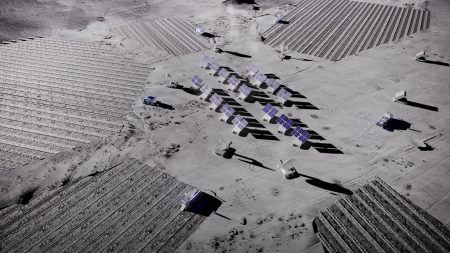
While these terrestrial operations will establish vital cash flow, validate the technology, and build a hungry market, Interlune’s true, long-term gaze remains fixed firmly on the night sky. The reason is simple geometry: Earth is protected by a powerful magnetosphere and a thick atmosphere that acts as a shield, deflecting the relentless stream of charged particles known as the solar wind. The Moon, however, has spent the last four and a half billion years entirely naked to the cosmos, acting as a giant, dusty sponge that has absorbed vast quantities of solar particles, including helium-3, into its powdery surface soil, or regolith. Scientists estimate that there are millions of tons of helium-3 embedded in the lunar crust, waiting to be baked out of the soil and shipped back to Earth. If Interlune can successfully deploy autonomous harvesting rovers to scoop up this dirt, heat it to release the trapped gases, and bring the pure helium-3 back home, they can fundamentally rewrite the rules of global energy, quantum technology, and deep-space exploration, turning the Moon into a viable, self-sustaining industrial outpost.
The roadmap to this celestial future is not a vague projection but a meticulously scheduled series of missions designed to take place over the next few years. The adventure begins in late 2026 with the “Crescent Moon” mission, where an Interlune-designed prospecting camera will hitch a ride to the lunar surface aboard Astrobotic’s massive Griffin-1 lander to map, analyze, and estimate the localized concentrations of helium-3 in the lunar soil. This initial scouting mission will pave the way for a crucial, NASA-supported experiment in 2028 appropriately named “Prospect Moon,” which will test actual physical extraction techniques directly on the lunar surface to see how easily these gases can be wrung from the rugged lunar regolith. If these prospecting runs are successful, follow-up commercial missions will not only focus on harvesting helium-3 for terrestrial shipment but will also capture valuable hydrogen and oxygen, which can be combined to create life-support water and liquid rocket fuel. This dual-use strategy ensures that Interlune will not just be exporting materials to Earth, but will also be producing the literal lifelines and propellants needed by other aerospace companies to explore even deeper into parts unknown.
Behind this bold timeline is a remarkable story of disciplined financial growth and deeply human dedication from a startup founded only in 2020. While many space companies burn through hundreds of millions of dollars on speculative engineering prior to proving their business, Interlune has stayed remarkably lean and focused, raising a quiet $18 million seed round in 2024 and launching a highly targeted $5 million investment offering in January 2026 to push their key technical milestones across the finish line. The company’s journey represents a beautiful blend of practical, blue-collar chemical engineering and lofty, planetary ambition. As Sam Heyd, Gary Lai, and Brenden Pelkie adjust their valves in Seattle, they are physically constructing the bridge that will connect our earthly high-tech demands with the massive, untapped resources of our local solar system. It is a striking reminder that the next great giant leap for mankind might not be driven solely by national pride or flags planted in the dust, but by the quiet, cold hum of cryogenic pumps and the undeniable warmth of human curiosity.