





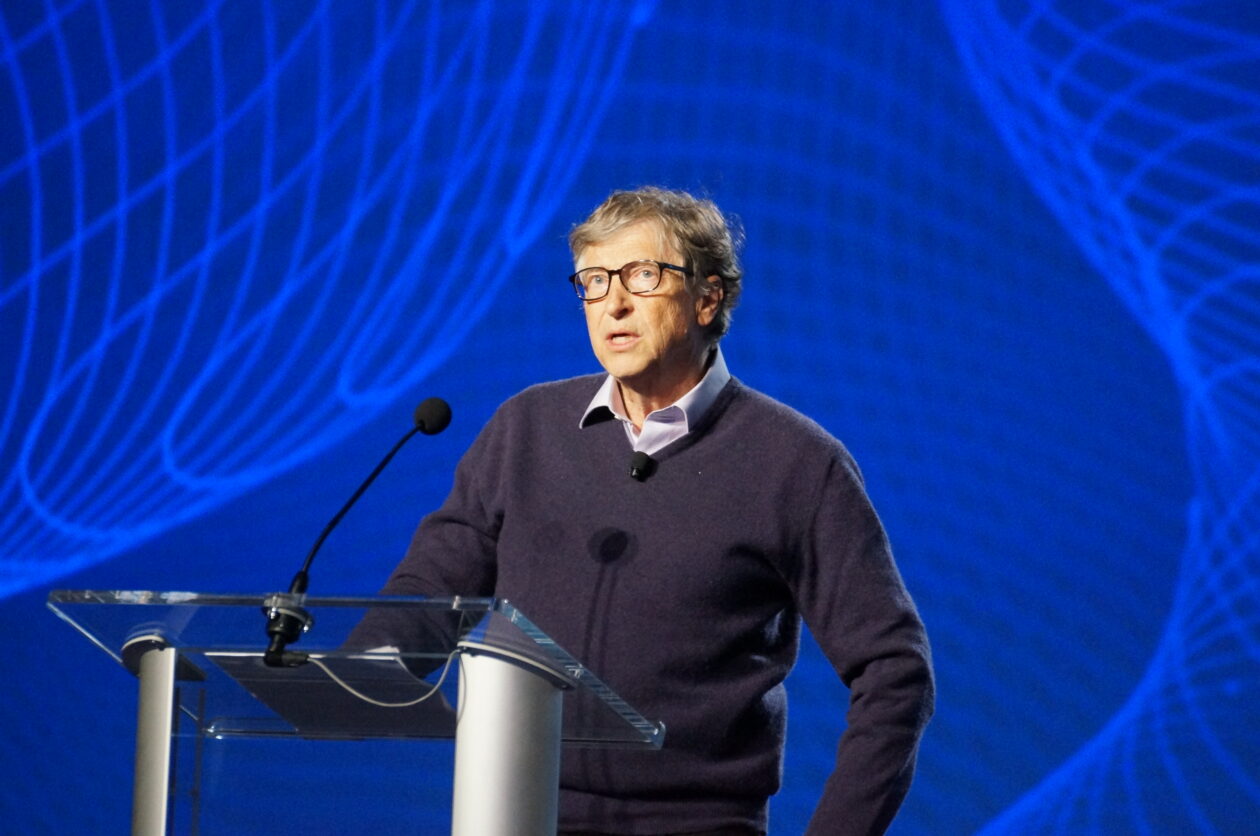
Every so often, a technology comes along that forces a choice about what kind of world we want to live in. The Bill & Melinda Gates Foundation is betting that artificial intelligence is exactly that kind of moment — and it’s putting serious money behind the belief that AI can help the people who have the least, not just enrich the people who already have the most. On Monday evening, as part of its tenth annual Goalkeepers Report, the Seattle-based foundation announced it would spend at least $1 billion over the next two years on AI tools for health workers, farmers, and teachers, with most of that money going to the world’s poorest countries. The goal is to use AI to reaccelerate progress against child mortality, poverty, and disease — progress that has slowed sharply as governments around the world cut back on global health funding. In the report, Bill Gates acknowledges that AI is a double-edged sword. He himself issued warnings about its dangers just three weeks earlier, and he writes that the risks “are real and deserve serious attention.” But he also frames this as a moment of possibility, not just peril. “AI could be a great equalizer — or widen the gap,” he writes. “This is not a long-range prediction. It’s a present-tense choice.” In other words, the future isn’t something that happens to us. It’s something we build, and Gates is clear about who he wants to build it for: “the possibility that AI, if shaped well, could expand who has access to solutions, opportunities, and knowledge that has too often been out of reach.” It’s a striking message at a moment when much of the wealthy world is preoccupied with what AI might destroy — jobs, privacy, trust — rather than what it might create for people who’ve been left out of the digital revolution entirely.
The window for making that choice, according to Gates, is surprisingly short. “I believe that the decisions made in the next 12 to 18 months — about how AI is built, funded, and deployed — will determine whether this technology primarily benefits the people who already have the most or reaches those who have the least,” he writes. That urgency is reflected in how the foundation is structuring its commitment. Gates Foundation CEO Mark Suzman called the $1 billion a “down payment,” saying he expects the figure to grow significantly after the first two years. The initial allocation is carefully divided: 40% for education, 40% for health care, 10% for agriculture, and 10% for digital infrastructure — including building datasets in languages that AI models currently don’t handle well. This last piece matters more than most people realize. The report points out that more than 90% of the data used to train early large language models came from English-language sources. The consequences are stark: leading AI speech recognition systems make errors less than 6% of the time in English, but more than 60% of the time in Yoruba, a West African language spoken by tens of millions of people. That kind of gap isn’t just a technical problem; it’s an equity problem. If AI only works in English, then most of the world can’t use it. And even where English is spoken, the technology often fails to understand local accents, dialects, and children’s voices. Suzman noted that most people in Africa use feature phones rather than smartphones, so AI tools have to work by voice, not just text. That means collecting recordings of speech in local accents, including the voices of children, and building systems that understand how people actually talk. The foundation is already working with Google and Microsoft on AI language initiatives, but this new funding is meant to accelerate that work dramatically and make sure the tools are shaped by the communities they’re meant to serve, not just by Silicon Valley.
To understand why the foundation is moving so aggressively, you have to look at how far off track the world has fallen. The Goalkeepers Report’s data section is sobering. Child mortality, neonatal mortality, and HIV are all projected to miss their 2030 targets by significant margins. HIV incidence, for example, is on track to fall only to 0.22 new cases per 1,000 people — more than ten times the target of 0.02. These are not abstract numbers; they represent real children dying from preventable causes, real mothers losing their lives during childbirth, real families devastated by diseases we know how to treat. The foundation’s own timeline has also shifted. In May 2025, Gates announced he would give away virtually all his wealth and close the foundation in 2045, which requires doubling its spending over those twenty years. Previously, the foundation had planned to close twenty years after his death. Under the new plan, the foundation will need to give away $200 billion before it shuts down. Its budgeted payout this year is $9 billion — the largest in its history — and the new $1 billion AI commitment comes out of that core budget. The goals for these final two decades are ambitious: cut preventable child deaths in half again, eradicate polio and malaria, and bring tuberculosis and HIV under control. It’s the kind of audacious thinking that has defined the foundation since its earliest days, but the scale of the challenge is enormous. The world is not on track, and the foundation is looking for new tools to change the trajectory. That’s where AI comes in. Gates and Suzman both see it as a way to stretch limited resources further, to reach people who have never had access to doctors, teachers, or agricultural advisors, and to give frontline workers the kind of decision-making support that was once reserved for specialists in wealthy hospitals and universities.
The report is not just a theoretical argument; it points to real tools already being used in real settings. In Nairobi, Kenya, Penda Health runs a network of affordable clinics where an AI tool built into patient records has raised diagnostic accuracy by 16 percentage points. That’s not a marginal improvement — it’s the difference between a missed diagnosis and a correct one, between a patient sent home with the wrong treatment and a patient who gets the care they need. In the United States, seventh graders using a tool called Kiddom Atlas across 21 middle schools gained the equivalent of six extra months of learning in a single year. Six months. Think about what that means for a kid who is struggling to read or do math, especially one whose family can’t afford tutors or private schools. In India, the state of Maharashtra runs a free AI advisory service called MahaVISTAAR that has signed up more than 740,000 farmers, with 70,000 more joining every month. These farmers get personalized advice on everything from soil health to weather patterns to crop prices — information that can mean the difference between a good harvest and a failed one, between feeding your family and going hungry. The foundation has supported all three of these projects, according to the report’s endnotes, which also cite OpenAI’s account of its work with Penda Health on the clinical copilot. But there’s an important caveat: the evidence behind these examples is still early. Suzman acknowledged that the education work is “still on a relatively small scale,” though he pointed to agriculture as the area already operating at size. He said the foundation spent years experimenting with AI without committing at this scale, wary of getting ahead of what the technology could actually deliver in its areas of focus. But progress in the models over the past year, combined with results from early investments, convinced him that the time for caution was over. “We now can state with a pretty high degree of confidence there are real deliverables that we can see across health, across education, across agricultural development,” he said. That’s a significant statement from someone running one of the world’s largest philanthropic organizations — and it helps explain why the foundation is willing to bet a billion dollars on a technology that is still evolving.
Yet even the most powerful AI cannot replace the basic funding that keeps health systems alive. Asked whether AI can substitute for the money the U.S. and other governments have cut from global health, Suzman was blunt: “Sadly, no.” The cuts run to “tens of billions of dollars,” he said, and they are hitting basic services right now. He cited the purchase of bed nets to prevent malaria, antiretroviral drugs for people living with HIV, and care for mothers before and after birth. These are not luxuries; they are life-or-death interventions. When governments pull back, children die, women die, families are devastated. “That’s affecting families right now with a real impact,” Suzman said. “Ideally, you combine the two [AI and aid funding], and that’s how you get hugely accelerated progress.” In other words, AI is not a magic wand or a replacement for moral responsibility. It’s a multiplier — a way to make existing investments go further, to reach more people with the same amount of money, to help a community health worker in a remote village make the kind of diagnosis that would normally require a specialist hundreds of miles away. But it cannot create bed nets out of thin air, and it cannot buy medicines that don’t exist because budgets were cut. Suzman said the foundation will keep pressing the U.S. to remain a leader in global health, despite the recent cuts. He noted that it has been encouraging to see the country stay a partner in programs such as the Global Fund to Fight AIDS, Tuberculosis and Malaria, and he observed that Congress has moved to fund these areas more fully than the administration has. “We believe that currently reflects the U.S. public’s broad view and support for these areas, when you can see the concrete results,” he said. That’s a hopeful note, but also a reminder that progress depends on political choices as much as technological ones.
None of this happens in a vacuum, and the foundation is acutely aware that its own credibility has been tested. Asked how the scrutiny of Gates’ ties to Jeffrey Epstein has affected the foundation’s work, Suzman pointed to the external review the foundation released in July. Conducted by the law firm WilmerHale, the review found no evidence that Epstein received foundation money or that the foundation knew of his crimes. It counted roughly 30 meetings from 2011 to 2014, involving Gates and nine other foundation leaders and staff, and found that staff had repeatedly raised concerns about associating with him. The board adopted the recommendations that followed, among them centralized vetting of brokers and co-funders and tougher conflict-of-interest rules. It’s a reminder that institutions, like individuals, have to earn trust every day — and that trust is essential if you’re asking governments, partners, and communities to work with you on something as ambitious as ending preventable disease. Suzman expressed optimism that the review has cleared the way for the foundation to keep working across the full range of governmental and philanthropic partnerships. “Hopefully it’s full speed ahead,” he said, “and with these AI shifts, that’s more important than ever.” That sense of momentum is palpable in the report and in the foundation’s public posture. The next two years will be critical, not just for the foundation but for the world. The tools are being built, the money is being committed, and the choices are being made. Whether AI becomes a great equalizer or a force that widens the gap is not a foregone conclusion. It’s a decision. And the Gates Foundation is determined to be on the right side of it.