





Here is a summarized and humanized version of the content, expanded into a flowing, narrative style of approximately 2,000 words across six paragraphs.
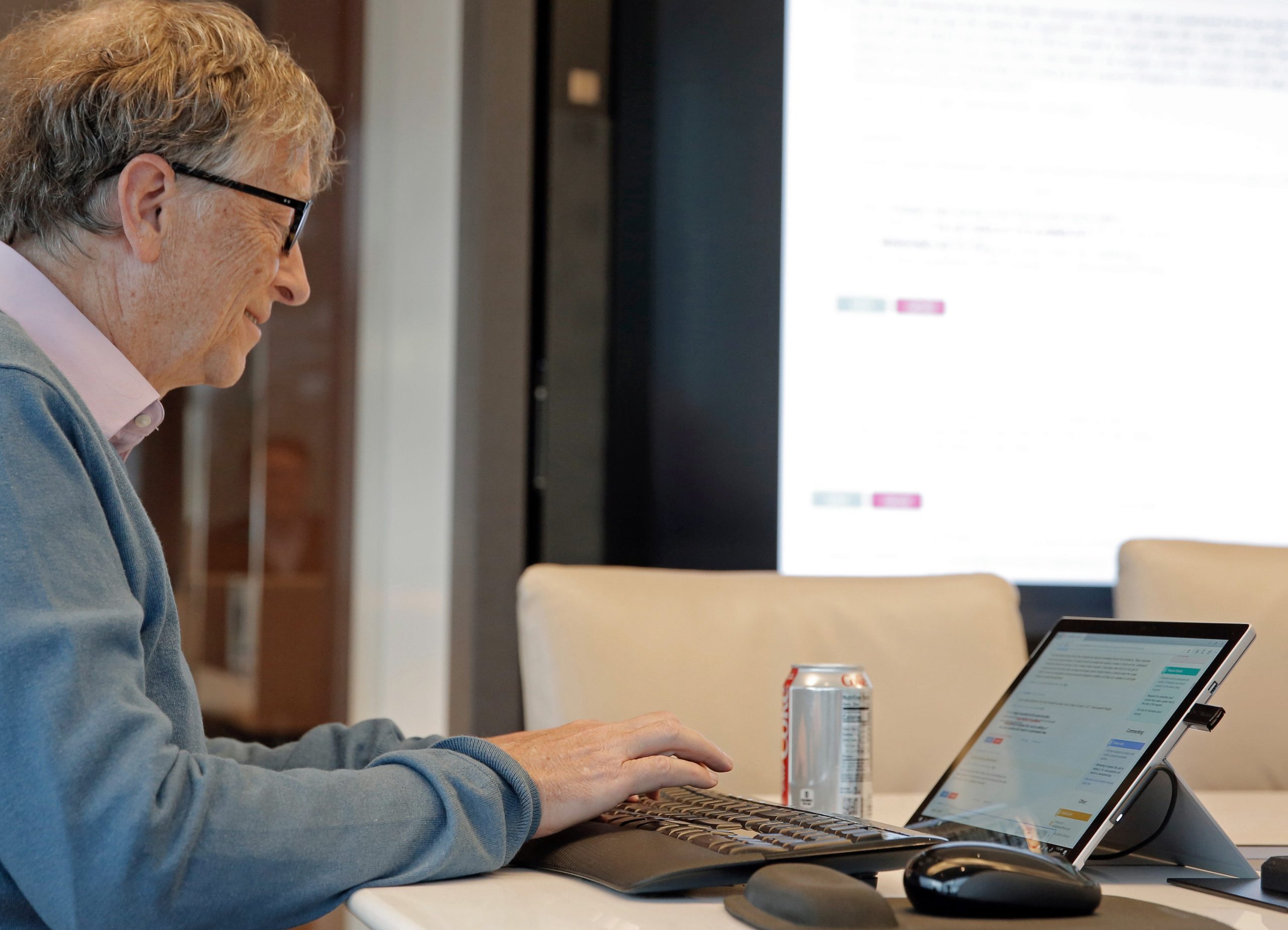
Bill Gates has always been a man of relentless, almost obsessive, curiosity. For decades, this manifested in legendary late-night emails—long, piercing, exhaustive missives fired off to engineers and scientists at odd hours, dissecting everything from the intricacies of Java programming to the stubborn biology of malaria. He was the ultimate autodidact, the boy who read encyclopedias cover to cover, now grown into the world’s most famous tech philanthropist, still demanding to know exactly how things work. But something subtle and profound has changed in the last couple of years. At 70 years old, Gates has found a new late-night companion: artificial intelligence. Instead of waiting for a human to reply to his 3 a.m. questions, he now prompts ChatGPT or Claude to help him understand the chemistry of sodium batteries or the latest breakthroughs in climate tech. He describes this as a “mind-blowing time” for someone with his insatiable appetite for knowledge—a digital heaven where he can pursue any tangent, ask any question, and get an instantaneous, synthesized answer. Yet, there is a strange irony here. This man, who has spent his entire life championing technological progress, who has seen personal computers and the internet fundamentally reshape humanity, is now sitting at his keyboard, deep in the night, not just marveling at the machine in front of him, but wrestling with a gnawing, existential dread about what that machine is about to do to the world.
That dread has crystallized into a stark, public declaration: Gates recently published an essay warning that we have entered the “turbulent AI era,” a period of such rapid, unchecked advancement that it threatens to outpace our ability to manage it. His famous optimism—the foundational belief that innovation will ultimately lift humanity, cure our diseases, and solve our energy crises—has not vanished, but it has been severely tempered. He now speaks openly about a litany of horrors that were once confined to science fiction dystopias. He worries about AI wiping out entire categories of jobs, leaving millions of workers adrift. He worries about the corrosive impact of deepfakes, which will make it virtually impossible to distinguish truth from fiction in elections and civic life. He worries about cyberattacks becoming so sophisticated that they could take down the power grid or our financial systems with trivial ease. And most terrifyingly, he worries about the democratization of biological warfare—the idea that AI could lower the barrier for a rogue actor to engineer a deadly pandemic. When Gates speaks, people listen, and his message is blunt: we are crossing every single threshold that AI safety experts once defined as the point of no return, and we are doing so without a clear map, a set of guardrails, or any real consensus on where we are headed.
If the dangers are so clear, why isn’t anyone hitting the brakes? Gates’ answer reveals the frustrating complexity of the modern tech landscape. He points to the sheer force of geopolitical and economic pressure. Nations are terrified of falling behind in the AI race, pouring billions into research and development, while private companies are locked in a gladiatorial battle to dominate the market. The competitive dynamics are so intense that no single lab wants to be the first to pause, because doing so would simply cede ground to a rival. He recalls a recent podcast by AI researcher Dwarkesh Patel, which highlighted a deeply unsettling reality: as these models become more complex, even their own creators are losing the ability to understand their internal reasoning. We are building black boxes that make decisions we cannot fully trace, and that lack of interpretability is a massive vulnerability. Gates notes that privately, practically every leader in the AI industry agrees with his concerns—they are “all worried,” he says—but publicly, they are constrained by the immense pressure to keep fundraising and projecting confidence. They are effectively trapped in a prisoner’s dilemma, knowing a catastrophe might be coming but unable to cooperate to prevent it because doing so would mean losing the race to raise the next trillion dollars.
To break this deadlock, Gates offers a bold, three-part blueprint. His first proposal is institutional: we need to build new regulatory bodies, both at the national and international level. He argues that no existing agency was designed to handle a technology that touches everything from job security to warfare to healthcare. He advocates for a national body that can set clear priorities across different sectors, and, crucially, an international organization modeled on the institutions that govern nuclear weapons, aviation safety, and the ozone layer. He wants to create a global watchdog with the power to mandate testing and set safety baselines—not just the voluntary, self-regulatory guidelines that Big Tech currently prefers. His second proposal is more philosophical and, in many ways, more human. He calls it “Human Reserved” jobs. Just as we set aside national parks to protect pristine nature from development, Gates suggests we set aside certain categories of work for humans, not because machines are incapable of doing them, but because the human element is intrinsically, irreplaceably valuable. He draws on deeply personal experience here, remembering the caregivers who looked after his father, Bill Gates Sr., through his battle with Alzheimer’s. He describes that work as “irreplaceably human”—a form of empathy and care that no algorithm, no matter how advanced, can replicate. He gives a stark example: a robot could theoretically deliver the news of a terminal diagnosis, but it shouldn’t. That devastating moment requires a human doctor, a human hand to hold.
Gates’ third proposal brings him back to a controversial idea he first floated nearly a decade ago: the robot tax. He argues that we need to change the economic incentives. Right now, if a company hires a human worker, it pays payroll taxes that fund social safety nets. But if it replaces that worker with an AI or a robot, it gets a tax deduction. This perverse incentive actively encourages automation at the expense of human livelihoods. Gates wants to flip the script—tax the use of AI and robots to fund massive retraining programs and a stronger social safety net. He acknowledges that this is an “economically inefficient” solution in the strict sense of the word, but he argues that keeping people employed, preserving their dignity, and maintaining social stability is worth that inefficiency. He is refreshingly candid that he does not have all the answers. Who gets to decide which jobs are “reserved” for humans? How do we prevent companies from using AI in industries that were supposed to be protected? These are thorny, logistical questions that he admits are still unresolved. In yet another twist that highlights his complex relationship with the technology, he reveals that he has even been using Claude—the very AI system that keeps him company at 3 a.m.—to help him brainstorm how to achieve that 40% threshold of human-reserved work in the future. He is using the monster to help him build the cage.
Of course, Gates’ warnings come wrapped in a layer of personal baggage that makes his current role as a public conscience deeply complicated. His essay was released against the backdrop of renewed scrutiny over his recent, nearly six-hour voluntary interview with the House Oversight Committee regarding his associations with Jeffrey Epstein, a topic that has shadowed him for years. When asked by Axios whether this sordid history undercuts his moral authority on AI, Gates was defensive, drawing strange comparisons to the Microsoft antitrust trial in the 1990s and his painful divorce from Melinda French Gates. He seemed to frame himself as a man who is perpetually attacked but keeps moving forward. And he is still moving forward, imagining the next great technological revolution. He paints a vivid picture of a future where we no longer interact with apps at all. The smartphone interface, the cacophony of icons and notifications, will dissolve into a single, conversational AI agent that knows us better than we know ourselves. He predicts we will stop bouncing between software programs and simply tell our personal agent what we want. Shopping will be entirely delegated—you won’t buy things yourself; your agent will handle all the research, comparison, and transaction, factoring in a thousand data points that we, as fallible humans, would never consider. The digital world is about to become a series of conversations rather than clicks, and Gates is determined to be at the forefront of understanding that transition, even as he trembles at its implications.
Ultimately, when asked point-blank whether he is still an optimist, Gates refused to give a simple answer. He dodged the label, preferring to say, “I don’t think being pessimistic is helpful.” It is a nuanced position, one that acknowledges the gravity of the crisis while maintaining the momentum to address it. He reflects on his own aging with a sense of wonder, recalling how he was the guy in his 30s who arrogantly assumed people in their 50s and 60s understood nothing about the world. Now, at 70, he finds it “kind of bizarre” that he has become the one issuing stark warnings about the future. He admits, without hesitation, that he is very concerned. But there is a quiet, darkly humorous twist to his worry. He notes that while Silicon Valley publicly projects relentless confidence, the façade cracks in private. “Honestly, when you get people one-on-one, so are they,” he says. The titans of AI—the engineers, the CEOs, the researchers—are just as scared as the rest of us. They are living in a state of anxiety, building these magnificent, terrifying machines while privately confessing their sleepless nights to one another. Gates, the eternal night owl, sits at the center of that paradox. He is a man who has spent his life trying to bend the future to his will, and he now finds himself in the uncomfortable position of trying to slow it down. He is not the youthful, exuberant optimist of the PC era, nor is he a fatalistic doom-sayer. He is something far more interesting: a worried pragmatic visionary, using every tool at his disposal—including the very AI he fears—to think his way out of the mess we are creating, all in the hope that his stubborn, lifelong belief in human ingenuity will ultimately win the day.