





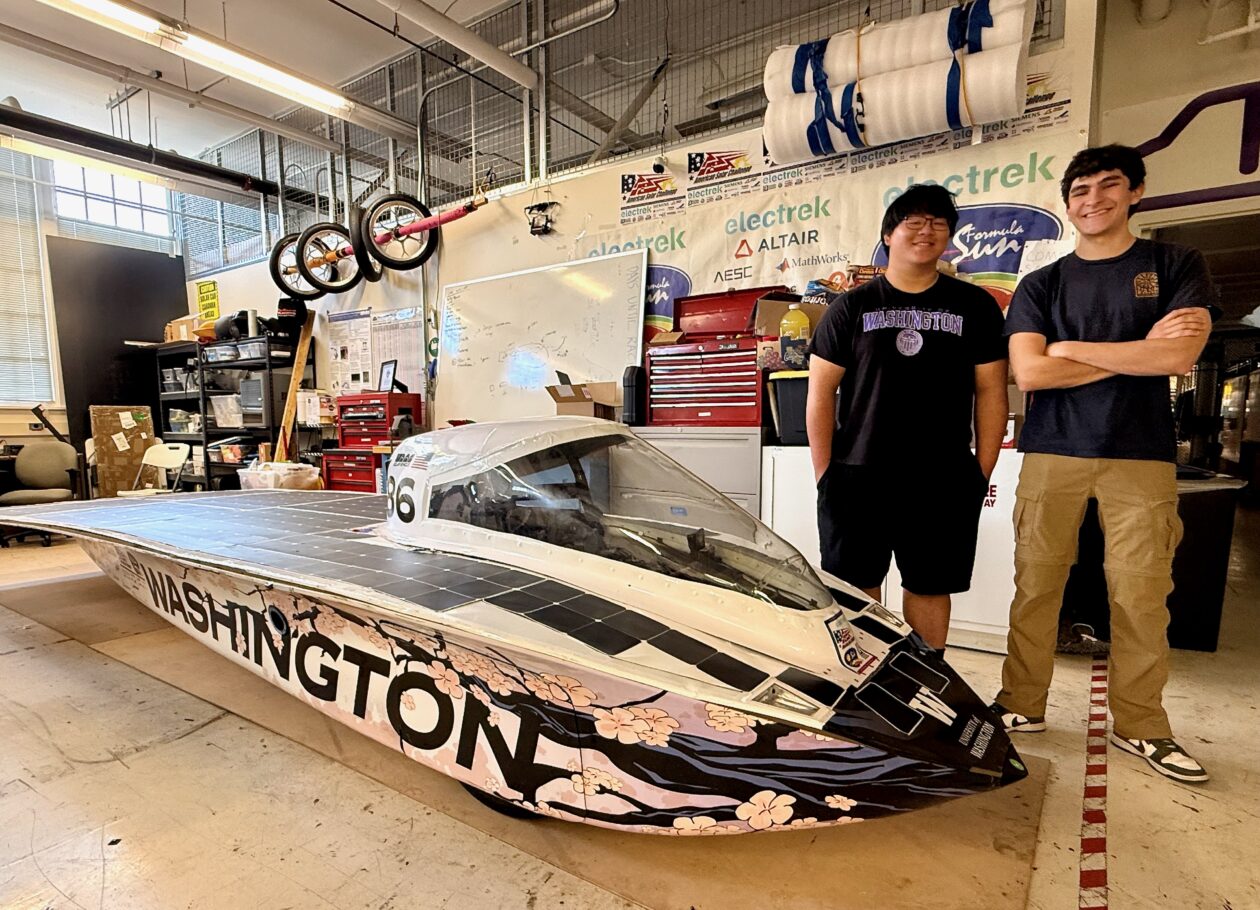
In a cramped, cluttered corner of the Mechanical Engineering building at the University of Washington, a dozen students huddle around a machine that looks less like a car and more like a flattened spaceship. It is late, the fluorescent lights hum, and the air smells of epoxy, sawdust, and coffee. This is the headquarters of the Solar Vehicle Team at UW (SVTUW), a scrappy, student-led collective that has spent the better part of a year pouring its heart into an impossibly sleek, solar-powered vehicle named Sakura. They do not have the gleaming labs or bottomless budgets of elite international programs. Their workspace is tight, their toolboxes are borrowed, and their time is fragmented between lectures, exams, internships, and part-time jobs. Yet in this unglamorous corner of campus, a group of roughly fifty undergraduates—spanning mechanical engineering, electrical engineering, computer science, business, and even aerodynamics—has managed to build something extraordinary. They are not waiting for perfect conditions or generous funding. They are working with what they have, learning by doing, and proving that passion and stubbornness can carry a project further than any checkbook.
This summer, that stubbornness paid off in spectacular fashion. The team loaded Sakura onto a trailer and drove to Minnesota for the American Solar Challenge, a grueling, seven-day, 1,778-mile race from the Upper Midwest all the way to Texas. The route took them through rolling farmland, small towns, and open highways, under blazing sun and threatening storms. For a young team still figuring out how to keep a custom-built vehicle alive on open roads, just reaching the starting line felt like a victory. In fact, team president Rudy Heredia-Jantz, an electrical and computer engineering senior, admitted with a laugh that the car wasn’t even fully functional until the night before departure. “Frankly, we have no idea how we pulled it off,” he said. “This car—it was a little bit of a miracle. We did not have it up and running until the day before we left for competition. We didn’t even have it moving. We just spun the rear motor, threw it in the trailer, and figured we’ll blow something up eventually.” And blow up they did. Twelve tires burst along the way, worn down by heat, friction, and the relentless demands of the road. But the Huskies kept rolling. Against seasoned international juggernauts with years of development and multi-million-dollar budgets, UW not only finished the race, but crossed the line in fourth place overall—and as the top-ranking American team. They also took home the Aesthetics Award and the Spirit of the Event Award, proving that their success wasn’t just mechanical, but human.
Sakura, named after the Japanese word for cherry blossom, is a marvel of efficiency and careful design. Weighing roughly 500 pounds with a driver inside, the car stretches 19 feet long to accommodate its array of solar panels while keeping its profile narrow and aerodynamic. Underneath the sleek shell, every component tells a story of resourcefulness and engineering ingenuity. The solar array consists of 386 Maxeon Gen 7 photovoltaic cells, covering six square meters and capable of producing up to 1,540 watts of power directly from sunlight. The student-built 5.125 kWh lithium-ion battery pack, arranged in a 36S9P configuration with a nominal voltage of 121 volts, stores that energy for the long stretches between clouds. A secondary backup battery handles system startups. The car is powered by a 2 kW Mitsuba hub motor that can push the lightweight vehicle up to 65 mph on open highways. Inside the cockpit, the driver sits before a custom steering wheel equipped with push-to-talk communication, digital telemetry displays, and regenerative braking controls. An onboard Samsung Galaxy smartphone streams real-time battery and motor analytics back to the pit crew, turning every mile into a live data experiment. To build this level of complexity on a shoestring budget, the team leaned heavily on local industry support. The vehicle’s lightweight frame uses carbon fiber sandwich panel flooring donated by Boeing, held together with specialized fiberglass tape. “It’s the perks of being a Seattle-based team—we work with some amazing materials,” Heredia-Jantz said. But even with aerospace-grade composites, the build relied on plenty of improvised hustle. Mechanical lead Elijah Yan, a second-year student, laughed: “The car is held together with cardboard and duct tape, essentially.”
The race itself was as much a mental challenge as a physical one. While Sakura rolled down the highway, a dedicated strategy team tracked its health from a trailing support vehicle. Using a custom dashboard that pulled data from the onboard smartphone, students monitored battery state-of-charge, individual array voltages, and motor temperatures in real time. They combined live telemetry with incoming weather forecasts to calculate optimal cruise speeds on the fly, relaying instructions to the driver via walkie-talkie. This real-time power management was crucial—steep climbs or hard accelerations could trip the battery’s protection systems, and even a brief glitch could cost the team hours. The system was put to the test just before the cross-country journey at the Formula Sun Grand Prix, an annual three-day track race where cars run on a single initial charge plus whatever sunlight they can harvest along the way. Despite pushing their power distribution system to its limits, the track time gave the team crucial baseline data and momentum. By the time they hit the open roads of the American Solar Challenge, they knew exactly how far they could push Sakura, when to ease off, and when to let the sun do the work. It was a delicate dance of energy conservation, regenerative braking, and calculated risk—a game of chess played at 65 miles per hour. And it worked. The team didn’t just survive the route to Texas; they blew past expectations, finishing fourth against competitors with decades of experience and vastly larger budgets.
For the students involved, the project has been a crash course in engineering, teamwork, and resilience. Elijah Yan, who joined as a mechanical lead with no prior experience in vehicle design, described the learning curve as immediate and thrilling. “Building a car is just not something I’ve done before, so it’s very new to me, and it’s super cool to learn that type of stuff—suspension stuff, how to do vehicle dynamics,” he said. That sentiment echoes across the team. Operated entirely by undergraduates, SVTUW handles every aspect of the operation in-house—from sponsor outreach and logistics to hands-on fabrication. There is no professional shop manager, no paid engineer, no corporate polishing. Just students who show up before sunrise, miss sleep, and teach themselves how to weld, solder, program, and design. The club has evolved from a small group into a broader interdisciplinary effort, now entering its fourth year with roughly fifty members. It remains officially affiliated with the university’s Mechanical Engineering Department, but it draws in students from across campus. For many, the solar car is their first real engineering project—their first chance to apply textbook theory to something tangible. The pressure is intense, but so is the reward. When Sakura finally rolled out of the shop and onto the open road, it marked the culmination of 11 months of frantic, sometimes exhausting work—a lightning-fast turnaround for a machine built entirely from scratch. As Heredia-Jantz noted, simply making it to the starting line felt like a triumph. Finishing fourth felt like a dream.
Now, the team is already looking ahead. While repairing Sakura for upcoming competitions, students are designing their next-generation vehicle from scratch, overhauling power distribution, reinforcing the chassis, and building a new solar array. They are taking everything they learned from the road—every blown tire, every overheated motor, every late-night fix—and turning it into a faster, smarter, more reliable machine. But the project means something deeper than lap times or rankings. In a city known for grey skies, these students are building sun-powered technology by pure faith. Administrative lead Caoilin Krathaus captured it best: “I believe this team is building something special in the early morning hours on UW’s campus: talent that shows up before sunrise, a refusal to wait for better resources before doing great work, and a stubbornness that looks a lot like faith. It reminds me of the story behind Boys in the Boat, and what I’ve always thought of as the true Husky experience.” There is something profoundly inspiring about that—a group of young people who refuse to wait for permission, resources, or ideal conditions. They have built a car out of carbon fiber, duct tape, and determination. They have raced across the country, outlasting better-funded teams and proving that ingenuity beats money. And they have done it together, in a cramped corner of a campus workshop, under the hum of fluorescent lights, fueled by coffee and camaraderie. Sakura is more than a solar car. It is proof that ordinary students, with enough passion and hard work, can harness the power of the sun—and each other—to do something extraordinary. As the new vehicle takes shape, one thing is clear: this team is just getting started.