



Anthropic—the AI company behind Claude—just filed to go public under the ticker ANT, and for most of us the news is far more personal than it sounds. Even if you have never bought a single stock in your life, you may soon own Anthropic through the index funds and ETFs that sit in your 401(k), your IRA, or your pension. Because Anthropic is expected to debut at a market value somewhere between $1.5 trillion and $2 trillion, major index providers will almost certainly add it to their benchmarks within weeks of its first day of trading. Once that happens, the funds that track those benchmarks have no real choice: they have to buy. You don’t get to opt in. You don’t get to say, “I’ll wait and see.” You become a shareholder of a company that barely existed a few years ago, valued at more than the entire annual economic output of many large countries. It is an extraordinary moment, but not for the obvious reason. The IPO isn’t really about Anthropic’s mission, its technology, or even its chatbot. The whole debate comes down to two numbers that nobody actually knows: how much revenue Anthropic will have in 2028, and how much of that revenue will be profit. That’s it. Not whether AI is the next electricity or the next internet. Not whether Claude is smarter than GPT. Not whether regulators will step in. The trillion-dollar question is whether Anthropic can become a business in the traditional sense—one that makes real money from real customers at a scale that justifies that enormous price tag. Everything else is commentary, and the commentary is almost always a distraction.
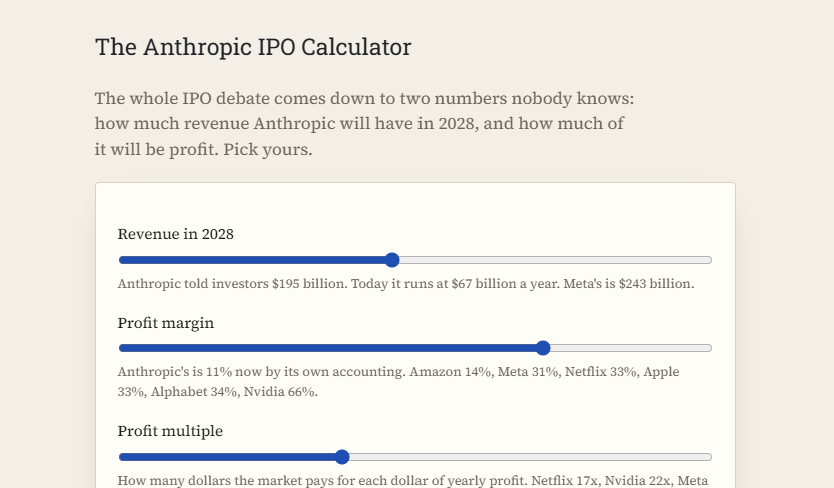
To help myself think through this—and maybe you too—I put together a deliberately simple calculator. It strips away the mountains of jargon and forces you to confront the two variables that actually matter. You pick how much revenue Anthropic will generate in 2028, and you pick what its profit margin will be at that moment. The calculator then compares the result to the bankers’ reported valuation range of $1.5 trillion to $2 trillion. It is not a professional financial model. It ignores taxes, debt, stock-based compensation, competitive dynamics, and the messy way technology companies actually recognize revenue. That is exactly the point. If a valuation doesn’t make sense with the simple numbers, no amount of complexity or clever accounting is going to save it. The fundamental logic of stock valuation has not changed since people first traded shares in sailing ships. You are buying a share of future cash profits, not a share of the headlines. If Anthropic earns $100 billion in 2028 but keeps almost none of it as profit, then a $2 trillion valuation is a wild gamble. If it earns $100 billion and manages to keep a meaningful slice—say, twenty or thirty percent—then the bankers’ number starts to look rational, or at least defensible. The calculator asks you to be honest about what you actually believe. Do you believe Anthropic’s own forecasts? Do you believe in the kind of growth where AI becomes indispensable infrastructure for the global economy? And, crucially, do you believe Anthropic can ever overcome today’s cost structure, in which enormous sums go to chips, data centers, energy, and the most sought-after AI researchers on the planet? These are not abstract technical questions. They are questions about markets, human behavior, and the messy, unpredictable way new technology becomes old technology.
The calculator offers four scenarios, and each one tells a different story. The first, “Anthropic’s forecast,” assumes the company’s own projections are roughly right. In that world, AI has become a massive profit engine, Claude or its successors are woven into the daily operations of businesses everywhere, and the top line grows at a pace that makes most of corporate history look slow. In that world, the IPO valuation is still aggressive, but it’s not absurd. It’s the price you pay for a platform that might genuinely own the next few decades of computing. The second scenario, “Half the forecast,” is more uncomfortable. It’s not a failure. Even half of Anthropic’s forecast would make the company one of the largest tech companies in history by 2028. But half the revenue, with roughly the same costs, means a much thinner path to the trillions. The bankers’ valuation starts to look like a price that assumes everything goes right. The third scenario, “Forecast, today’s margin,” is the one that keeps long-time investors up at night. It applies Anthropic’s current economics to its future revenue. And today’s economics are not pretty. Anthropic is investing aggressively in the future, which is exactly what a bold technology company should do—but it means that today’s profit margin is thin, or possibly nonexistent. If Anthropic reaches its revenue forecast but still spends nearly everything it makes on keeping up with the race, then profit remains small, and the valuation looks increasingly like hope dressed up as math. The fourth scenario, “No growth at all,” is the darkest. If 2028 revenue is just today’s revenue, then Anthropic is a very famous, very expensive startup, and the valuation math collapses. I am not going to tell you which button to press. The honest answer, as always, is probably somewhere between the extremes. But that is precisely why a simple tool is useful. It forces you to choose the world you genuinely expect to live in, rather than hiding behind vague words like “disruptive,” “transformative,” or “long-term potential.”
Now let’s talk about the part that will affect your financial life even if you never open the calculator. The rise of index funds and ETFs has been one of the quiet, powerful stories in investing over the last few decades. Most Americans now encounter the stock market through broad, diversified funds, not by picking individual winners and losers. That has been, for the most part, a wonderful development. It means lower fees, less stress, and a smaller chance of catastrophic mistakes. But it also means something that very few people stop to consider: when a giant company goes public, you are going to own it whether you want to or not. Anthropic is the perfect example. Within weeks of its debut, major index providers will almost certainly add it to the benchmarks that millions of people use for retirement savings. At that point, a typical S&P 500 index fund will buy Anthropic shares as automatically as it buys Apple, Microsoft, or Amazon. The stock will rise or fall based on the performance of the AI industry, and your account statement will reflect it. You don’t get to vote on the IPO price. You don’t get to decide whether the company should be growing that fast. You don’t get to say, “I think the valuation is ridiculous.” The index fund managers who vote on your behalf—the BlackRocks, the Vanguards, the State Streets of the world—will make those calls for you. That is not necessarily a reason to panic. But it is a reason to care. If you own an index fund, you are not a neutral bystander in the AI revolution. You are a forced participant. You have a seat at a table where the bets are enormous, the cards are still face down, and the future of the entire technology industry will be decided in public markets over the next several years.
To make any of this more than arithmetic, you need to understand what Anthropic actually is. It is one of a very small group of laboratories trying to build frontier AI. Its models are among the best in the world, and it has carefully cultivated a reputation as the “safety-first” AI company—a brand that appeals to customers and regulators nervous about the power of the technology. But Anthropic operates in an extraordinarily competitive arena. It is racing against OpenAI, Google, Meta, and a growing army of startups with massive funding and even bigger ambitions. The technology itself has moved from curiosity to utility in an astonishingly short time, but the economics of the industry are still unsettled. Customers are willing to pay for AI that saves them time and money, but they are also price-sensitive, skeptical, and increasingly able to switch from one model to another with minimal effort. The costs of staying in the game are staggering: every new generation of models requires more computing power, more data, more energy, and more specialized talent than the last. Today’s margin, such as it is, reflects a company that is sacrificing the present for a future it hopes will be enormous. That is a brilliant strategy if the future is as large as the most optimistic believers imagine. It is a terrifying strategy if the future turns out to be merely very large. And then there are the wildcards that no simple calculator can capture. Governments may decide to regulate AI in unpredictable ways. Courts may rule on copyright and data issues in ways that shake the business model. Automation could eliminate more jobs than it creates, triggering a public backlash. Anthropic’s safety-first posture could turn out to be a huge advantage—or a competitive handicap, if it moves too cautiously while rivals race ahead. A valuation is never just a number. It is a story about the next decade, told in the language of financial markets.
So what should you do with all of this? I’m not an investment advisor, and this is not investment advice. But I can tell you how I think about it. I put my own assumptions into the calculator, and I try to be brutally honest with myself about which scenario I actually expect. I remind myself that the future is not a single point. It is a range of possibilities, and the honest answer is almost never the extreme on either side. The responsible way to handle an IPO like this is to accept uncertainty, avoid putting too much weight on any single story, and remember that a brilliant technology can still be a bad investment. For most people, that means a few simple things. Don’t buy Anthropic stock just because it’s exciting. Don’t sell your whole portfolio because someone says “bubble.” Understand that this IPO is a massive transfer of risk and reward from private investors to public markets, and that you are part of those public markets, whether you meant to be or not. Keep asking the two questions that really matter: How much revenue will Anthropic have in 2028, and how much profit? If you can’t answer those questions, you are not ready to value the company—and neither is anyone else, no matter how many spreadsheets they carry. The bankers have their guesses. The index funds have their mandates. The salespeople have their pitches. But the future will be determined by millions of customers, developers, regulators, and investors who make choices every day. The Anthropic IPO is one of those rare moments when the abstract debate about artificial intelligence becomes very concrete. It has a ticker symbol. It has a price range. And soon it will have a place in your retirement account, whether you asked for it or not. That should make you pause. It should make you curious. It should make you ask better questions. The best we can do is pay attention, stay humble, and remember that the numbers are simple—but the world they describe is not.