



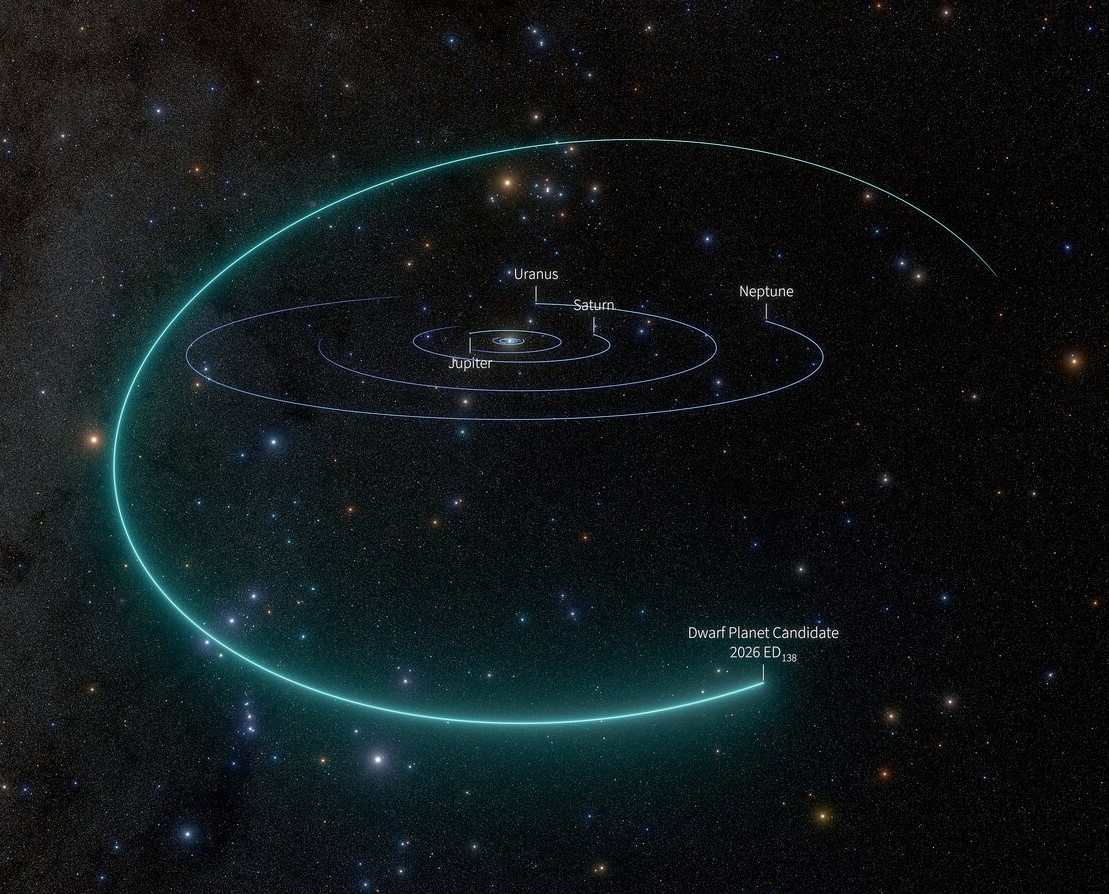
Imagine a tiny, frozen world drifting alone at the edge of the solar system, so far from the Sun that sunlight takes more than six hours to reach it. For years it has been silently tracing a vast, tilted orbit beyond the planets, invisible to us, waiting for a telescope powerful enough to notice. That moment has finally come. Astronomers working with the Vera C. Rubin Observatory in Chile have spotted a distant icy body, officially designated 2026 ED138, that appears to be a strong candidate for dwarf planet status. If confirmed, it would join Pluto and a handful of other worlds in the solar system’s most exclusive cosmic club. The discovery was announced by University of Washington astronomer Mario Jurić and Matthew Holman of the Harvard & Smithsonian Center for Astrophysics at a meeting of the American Astronomical Society’s Division for Planetary Sciences in Spokane, Washington. Jurić, who serves as the Rubin team’s solar system lead scientist, described the find as a showcase for the observatory’s revolutionary ability to scan the sky with unmatched speed and sensitivity.
What makes Rubin so special is not just that it can see faint objects, but that it can see so many of them so quickly. The observatory’s Simonyi Survey Telescope is named after the family of Seattle software billionaire Charles Simonyi, and it has been designed to conduct a decade-long survey of the southern sky. Even before the official start of that survey in June, the Rubin team had already detected more than 11,000 new asteroids. That kind of productivity is exactly what Jurić means when he talks about Rubin’s “unprecedented capacity to explore the sky through a combination of speed, depth, and precision.” He explained that once a new object is identified, researchers can search back through months or even decades of archived images, finding it in places where nobody thought to look before. This ability to “precover” objects, as astronomers call it, is transforming the way scientists determine orbits and understand the distant solar system. The discovery of ED138 is a perfect example of that process in action. It began as a faint blip in the data, then gradually grew into a world with a story to tell—a story that astronomers are only beginning to piece together.
So what exactly is 2026 ED138? Based on current observations, it is an icy world currently located about 46 astronomical units from the Sun. One astronomical unit, or AU, is the average distance between Earth and the Sun, roughly 93 million miles. For comparison, Pluto is currently about 40 AU from the Sun, so ED138 is sitting even farther out in the cold, dark reaches of the outer solar system. Its orbital path is tilted, taking it well beyond the realm of the major planets. Astronomers suspect that ED138 did not always live out there. Billions of years ago, it probably formed much closer to the Sun and was later flung into a wider orbit by gravitational interactions with Neptune, the great blue giant of the outer planets. This kind of gravitational billiards was common in the early solar system, when the giant planets migrated and scattered countless small bodies in all directions. Today, ED138 appears to be a substantial world in its own right. By analyzing its distance, brightness, and assumed composition, scientists estimate its diameter at somewhere between 600 and 1,500 kilometers—roughly 373 to 932 miles. At that size, an icy object should have enough gravity to pull itself into a round shape, which is the key physical requirement for a dwarf planet.
The moment of discovery had all the drama of a scientific detective story. On October 13, Matthew Holman was running data through a search code he had developed with Kevin Napier, a colleague at the Center for Astrophysics. The code was designed to flag unusual objects in the flood of information coming from Rubin. ED138 stood out immediately because of its exceptional size and brightness. Holman’s first reaction, as he later recalled, was “excited disbelief.” He had to check whether he or the code had made a mistake. After all, objects like this are extraordinarily rare. To confirm that ED138 was real and not some glitch in the software, Holman, Jurić, and their colleagues went hunting through archived observations. They found 30 images of the object dating back to March 4, and the Asteroid Institute’s ADAM Precovery service uncovered even more, reaching all the way back to 2016 in the archives of a different astronomical survey. That wealth of historical data confirmed that ED138 was indeed a special case. “Finding an object this big, roughly 1,000 kilometers across, is something that happens maybe once in a generation,” Jurić said. “It’s the largest trans-Neptunian object found in about 20 years, and Rubin turned it up while we were still commissioning the telescope.”
To understand why this discovery matters, it helps to recall what exactly makes a dwarf planet a dwarf planet. In 2006, the International Astronomical Union, or IAU, defined dwarf planets as planetary objects that are big enough to crush themselves into a roundish shape—technically, a state known as hydrostatic equilibrium—but not big enough to clear their orbital neighborhood of other debris. This definition was created in the wake of Pluto’s demotion from full planet status, and it remains the official rule. So far, the IAU has officially classified five objects in our solar system as dwarf planets: Ceres in the main asteroid belt, plus Pluto, Eris, Haumea, and Makemake in the region beyond Neptune. But ED138 is far from alone in its unofficial status. It joins a growing list of celestial objects that are thought to be dwarf planets but have not yet been formally added to the IAU’s list. “The official list hasn’t moved since 2008,” Jurić noted, adding that he is not sure whether there is even an active process for reviewing candidates. That may seem surprising, but the scientific process can move slowly when it comes to official designations. For now, ED138 remains a candidate, but a very promising one, and astronomers are hopeful that additional observations will cement its place in the solar system’s family portrait.
What comes next for this newly discovered world? Jurić and his colleagues have a clear plan. The most direct way to prove that ED138 is a dwarf planet would be to show that it is round, or in hydrostatic equilibrium. That can be done through occultations, which happen when the object passes in front of a distant star, briefly blocking its light. By carefully measuring how the light dims and brightens, astronomers can determine the object’s shape and size with remarkable precision. Given that ED138 appears to be in a dense field of stars, the chances of catching such an occultation are good. Additional clues can come from thermal measurements, which reveal how much heat the object radiates, as well as from light curves, which show how its brightness varies over time. If the brightness stays steady, that suggests a smooth, round body; if it varies significantly, the object may be lumpy or elongated. These observations will take time, but they are well within reach. Meanwhile, Rubin’s survey is just getting started, and ED138 is almost certainly the first of many dwarf planet candidates the observatory will find. With its ability to scan the southern sky night after night, to catch faint glimmers from the outer solar system, and to look back through years of archived images, Rubin is opening a new chapter in our understanding of the distant, icy frontier beyond Neptune. And at the heart of that chapter is a small, round world, quietly waiting in the dark, finally ready to tell us its story.