





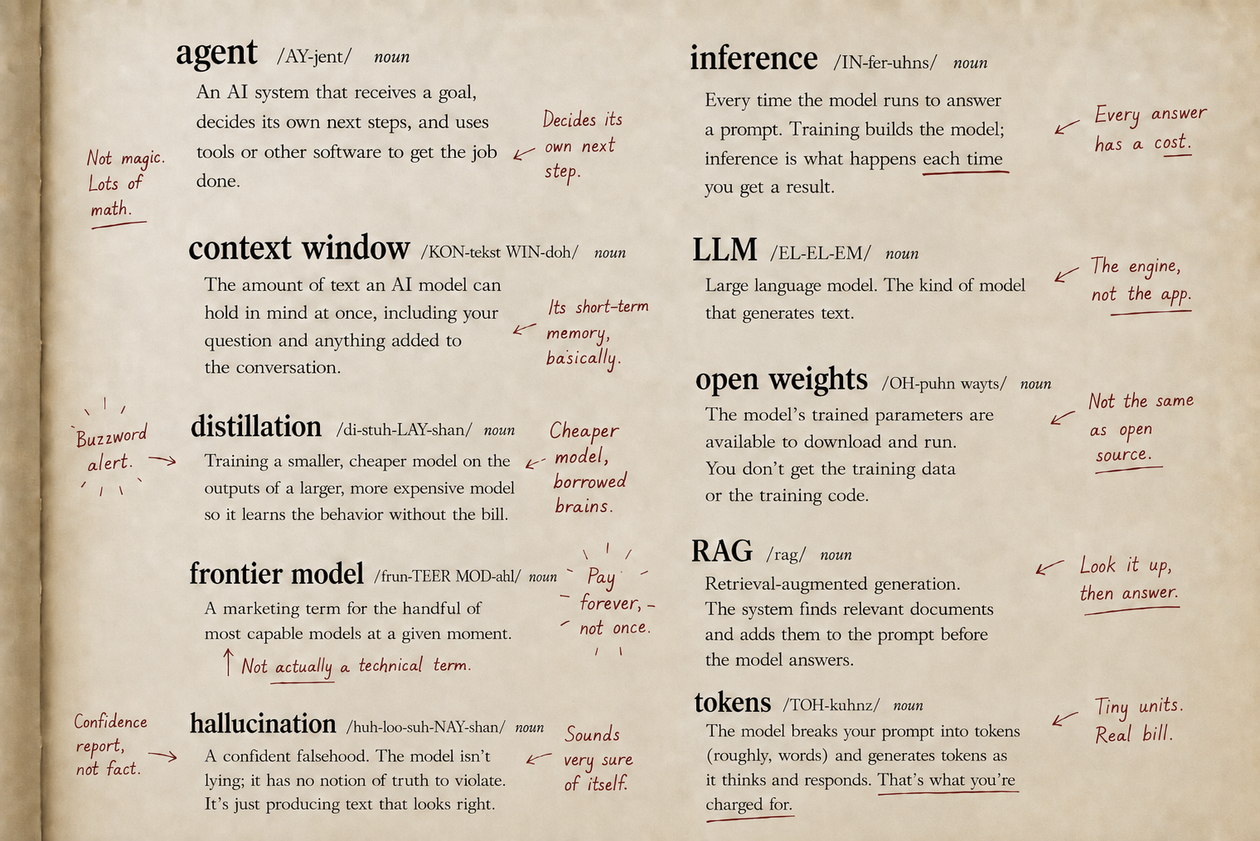
If you’ve tried to follow recent AI news, you have probably felt like you need a translator. Every headline glues together “frontier model,” “open weights,” “RAG,” “alignment,” and “agents,” as if these were not confusing enough on their own. But if you peel away the polish, the vocabulary is mostly about a few basic mechanics. AI is just the broad name for machines doing things that once required human thinking. Machine learning, despite the intimidating sounding name, simply means a system learns from examples instead of instructions someone had to type out. A neural network is the structure that does that learning; it is a pile of mathematical layers vaguely inspired by neurons. Deep learning is essentially “a neural network with too many layers to count,” which today is the default. Now, the phrase that everyone uses but almost no one can define on the spot: “LLM,” or large language model. The easiest way to understand it is to remember that ChatGPT is the app and a large language model is the engine humming inside it. The app gives you a chat box and a friendly design, but the model itself does all the work of generating the words. “Frontier model” is even more slippery. It is not a real technical category. It is just an industry phrase for the biggest and most capable models at any given moment. That label moves around as quickly as companies train their next and more expensive thing. You never need to memorize which model is “frontier,” because the meaning will change again next month. What matters is that an LLM is not a language entity that knows rules of English; it’s a very large prediction engine, trained to guess the next word, and from that simple trick, all the apparent “intelligence” grows.
That seemingly simple generator is full of internal machinery with strange names. A prompt is simply the question, instruction, or typed thought you send to the LLM. Sometimes apps quietly add extra instructions before your prompt, but the concept stays: it is what starts the machine. Tokens are the chunks the model actually reads. They are roughly the words going in and coming out, but sometimes weirdly split; the industry charges by the number of tokens. Parameters, meanwhile, are the numbers that have been tuned inside the model during training. A large model has hundreds of billions, sometimes trillions, of them, and no one on Earth can tell you what each one does. Marketers quote parameter counts like horsepower, but the number that actually matters for your wallet is the token count, which rarely appears on the promotional page and always shows up on the bill. How do the token parameters become the behavior? That’s what training means. Pre-training—the expensive, boring part—is feeding a model huge amounts of internet text so it can learn to predict the next word, not reproduce what it knows. Surprisingly, a model that has only been pre-trained is not good at answering questions; it knows patterns and facts but cannot follow your instruction. It needs post-training, which is called human preferences into words; people rank output, and the model learns to produce the higher-ranked answers. Fine-tuning is simply post-training done by someone else, on their own data, to make a model behave in their own way. For example, a legal firm could take a general model and fine-tune it with decisions and filings. The key concept is that pre-training is the expensive preliminary phase, while post-training is what turns a raw word predictor into a useful assistant.
Once a model is trained, you still have to decide how it gets used, and that decision is where a cloud begins. The training vs. inference distinction is simple but very important. Building a model costs hundreds of millions of dollars, happens once, and takes months. Inference is every time the completed model gives an answer; it is a smaller cost per request, but it happens billions of times every day. A model cannot answer even one question without inference. The expenses are structured differently: training costs get announced in flashy press releases, while inference costs you notice through a recurring monthly charge, or the massive energy usage at a data center. If you train from scratch, you buy or rent the computers and build the model from bare data. If you distill a model, you train a smaller one on the bigger model’s output, hoping the smaller one will behave like the big one but cost less to run. That sounds like borrowing notes from a benevolent smart friend, but most AI companies ban distillation in their terms of service. OpenAI has publicly accused other model makers of exactly this, which is a strange stance for a company that trained on everyone’s data without asking. The whole AI field has been built out of taking other people’s work; it only becomes “cheating” when the money wins flows into someone else’s pocket.
That same variable and money is the core about the “open” argument. When you use ChatGPT, Claude, or Gemini, you do not get the model itself; you are connecting to the company’s server over the internet. You get an app, and the company gets your input and answers. That is normally what an “API-only” model looks like, whether you know the term or not. The model stays locked in someone else’s data center. Open weights is different. With open weights, the actual model files are available to download, so a technical person can host or run that model on their own computer. It sounds generous, but it doesn’t give away the training code, the raw data, or the architecture, so you can still not tell why the model behaves the way it does. Many people call this “open distribution” rather than open source. Open source is a much stronger promise: you get all lines of code, the method, the training data, and the software right to modify it. Almost no major model offers that today. AI2’s Olmo is a rare exception. The snarky truth: open weights is a branding victory, a way to claim the luminous heritage of open source without giving the community much to scrutinize. Independent researchers can run the model, but they cannot dig into the clay or understand how it was trained. Don’t be confused. An API is just renting the AI over the internet; open weights is getting the model’s set of numbers; open source is the thing that should matter if you want to make real science.
All of this comes back to one specific issue: how can a word-prediction machine seem to “remember” you and know your documents? The answer is less magical than it sounds. The context window is the amount of text the model can see at the same moment. It includes your question, whatever you pasted into the chat, and any prior messages that still fit. Think of it as a small white table in the model’s office; if a conversation gets too long, the manager kicks off the older notes. “Memory” is not an internal lifetime of personal biography; it is a feature in the app that saves your name, preferences, and a few facts, then accidentally pastes them into the whiteboard before your next question. The model itself does not remember. The app keeps a file about you and just drops it into the context window. The difference a user can feel: if the AI reference something you told it last week, it is here-and-back. In the most clinical sense, the app is copying a file from its database into the conversation, then the generation still simpler. What about RAG? That stands for retrieval-augmented generation, and it is one of the most practical tricks AI today. Instead of sending your question directly to the LLM, the app first searches a separate database of documents and pulls the most relevant paragraphs into the context window; then the model generates an answer on the basis of those paragraphs. This is how an AI can answer questions about current events, your own company’s policies, or a recent report that wasn’v included in the training data. It is not looking up in the same way a search engine does; it does not “know” the facts. The document excerpts are part of the prompt, and the model does the writing. That distinction matters because it explains what is left out, reliable enough for reference, but not a magic memory that knows everything.
After the mechanics, the next step is to sort out what these models actually do on their own. A chatbot is the simplest: it produces a response and then stops, finishing its turn, waiting for the next prompt. A workflow is a little bit more active; the programmer defines the exact steps in advance, and the AI passes each step in the same order every time. If you ask about a delayed flight, a chatbot will reply with a refund; a workflow would upload a form and start the application, but it will not think of anything else. An agent is the most interesting category. It’s not given a sequence of steps; it’s given a goal, for example, “get me onto the next flight,” and then decides the next steps on own. It can bookmark if options, call up external apps, check results, try again, or decide to search for alternative routes. The difference is often not visible in the final teardown, but it is the critical one: if the system stops and asks you what to do next, you are taking or using a chatbot; if you are the one responsible for textbook, then it’s a workflow; if it decides what to do next by checking with the environment and continuously updating, then it’s an agent. This distinction matters because the word “agent” gets spread at every startup pitch. Every chatbot is called an agent; every AI feature is called an agent. But a truly autonomous agent is neither simple not a fixed routine; it is a way for an algorithm to explore. You’ll know one when you see one, because it can surprise you; sometimes good, sometimes the wrong if it has the right.
Finally, there is the language about what can go wrong, which is the most fun in the AI glossary. A hallucination is a confident falsehood, usually a made-up fact, an invented disease, or a citation that doesn’t exist. It is an important term not because the model is lying—lying requires intention and a belief in truth — but because the model is simply producing words that sound like a true answer. It is not impossible to fill in. It writes text that “looks like correct.” A diverse mistake, but sometimes a better one: AI slop is content that is exactly fluent, grammatically perfect, and worth nothing. It’s a LinkedIn post that gives 300 words to say “business has good and bad sides,” or a blog article generated by a computer. The term actually made it into the dictionary because the problem is volume as much as quality: the slop fills the internet, because it’s cheap and easy to make. At the other end is “AI cream,” the unusual case of writing that is genuinely excellent and insightful, where the AI helped a human do better. The uncomfortable truth is that no one sets out to make AI slop; the person who pasted that 300-word LinkedIn post probably thought it was great, and maybe it was when they approved copy. But the difference between slop and cream is passion and editing? It’s that the human behind it turns an ordinary generated paragraph into something that actually says something. As for getting the model to be “safe,” the terms get even more loaded. Alignment is the research problem, always trying to get AI to follow human intent. Guardrails are the explicit set of rules reflected in model refusals, meaning the model tells you no in certain places. Censorship is exactly the same guardian wall when it blocks you. That same system is called “safety” by the free email, “guardrails” by the documentation, and “censorship” on social media. The only honest term depends on who is speaking and is blocked and cleared. All the conflicting vocabulary is not completely a language problem, it is a way of framing the same feature. When you know, these are just definitions with agendas. Explanations won’t get rid of AI hype or anxiety, but at least you can tell the difference between the model, the app, the agent, the slop, and the public corpora—enough to question whatever the next news headline says as if it were the latest. Perhaps that is the most human thing to be confused, not by the words, but by the world they are building.