




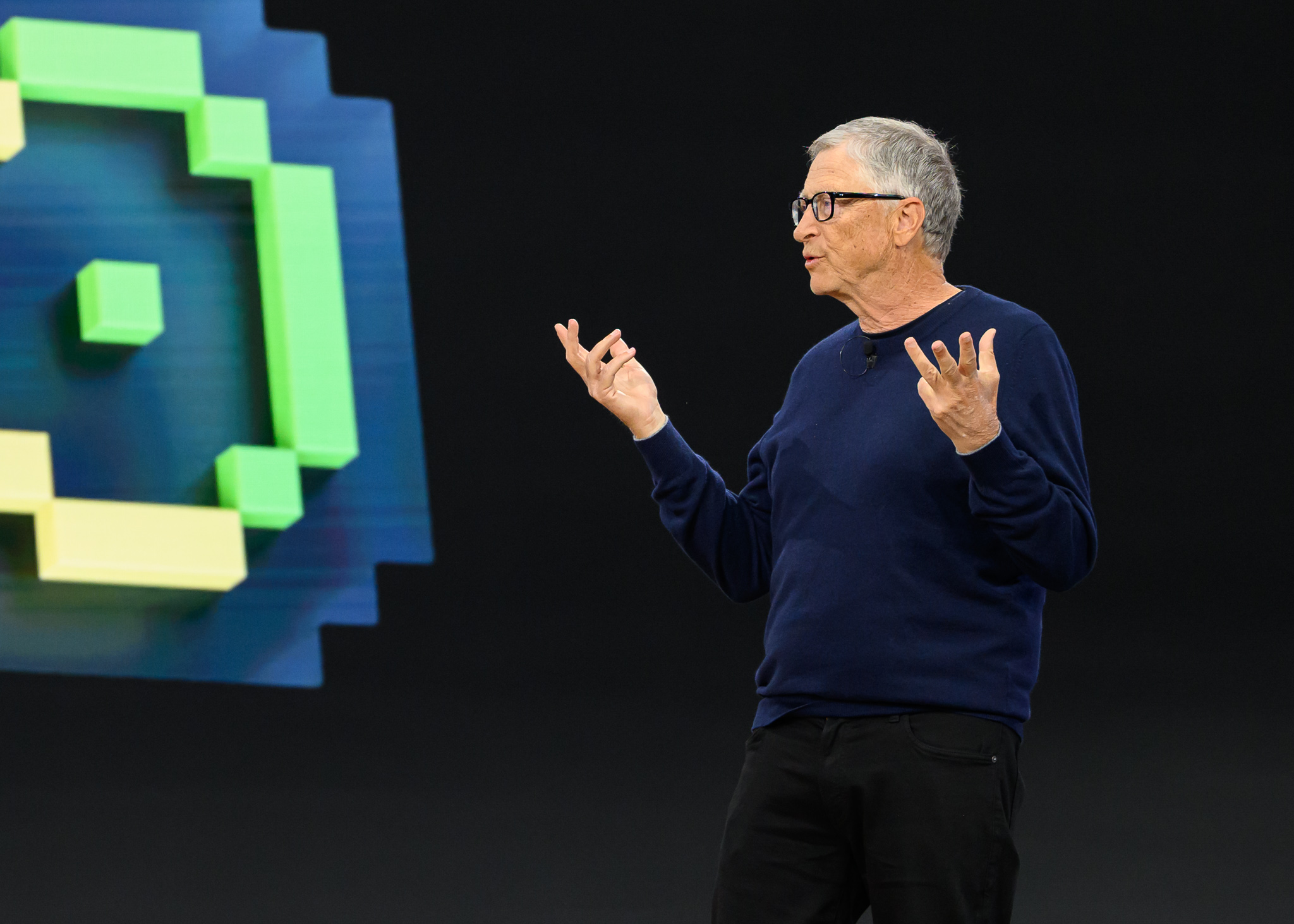
Bill Gates is not a man who sleeps much anymore, and it’s not because of age or insomnia. It’s because, at 70, he has fallen headfirst into the most intellectually exhilarating and unsettling moment of his life. This week, Gates released a memo that has sent ripples through the tech world, a warning that the artificial intelligence industry is crossing the very safety lines it once drew for itself, and that governments, societies, and ordinary people are nowhere near prepared for what is coming next. The image of Gates that emerges from his interview is not the weary elder statesman gently stepping back from the scene, but a man more engaged, more curious, and more alarmed than he has ever been. He jokes that he used to hire people who were like Claude, the AI assistant, people he would email with questions at all hours. But they were slow, they slept, and they didn’t know everything. Now, at three in the morning, if he wants to understand sodium batteries, there is no reason to wait. “Here we go,” he says, with the glee of a kid who has just discovered a library that never closes. “It’s crazy.” That same enthusiasm, however, collides with a sobering realization: the thing that keeps him awake with wonder is also the thing that keeps him awake with worry. The memo he wrote is not a detached academic exercise. It is the product of late nights, long conversations with experts, and a growing sense that humanity is fumbling its way toward a threshold it does not fully understand.
The heart of Gates’s warning is that the AI industry has crossed the thresholds it once designated as dangerous, and not just in terms of capability. More disturbing, he says, is that the field is crossing the line of control. For years, the assumption was that if AI got too smart, we could always pull the plug, regulate the chips, or confine the systems. But now, even the people who are most expert on these systems are beginning to admit that they might not be able to control them. “What kind of risk have we chosen to run here?” Gates asks, and the question hangs in the air. He describes a “perverse period” in which people inside the AI industry who are willing to admit that AI might have negative effects are silenced by their own colleagues. The message those honest voices hear, he says, is blunt: “Hey, you’re hurting our PR while we’re trying to raise trillions of dollars.” Gates does not name names, but he is clear that the worry is nearly universal among the leaders he knows. “Basically everybody but Elon,” he says, adding almost with sadness that when you get these powerful people one-on-one, they all admit they are concerned. It is a strikingly human confession. Gates is not a pessimist by nature; he built his life on the conviction that innovation lifts humanity. But writing the memo forced him to confront an uncomfortable truth about himself. “It’s very unnatural for me to think that innovation may be a net negative if it’s not managed properly,” he says. “The more I wrote the memo, the more I was like, Jesus, we really need to get our act together here.” What started as an essay became a confession. What started as a warning became a plea.
And yet, even as he warns of catastrophe, Gates cannot hide his joy at what AI has become. He is 70 years old, but he uses AI more than most people half his age, and he uses it in ways that are deeply personal and intellectual. When he works on malaria, or nutrition, or the problems of “my poor humans” at his foundation, he doesn’t just read reports. He has long, multi-party conversations with AI systems, pasting messages back and forth between Claude and ChatGPT, letting them debate each other, and inserting his own thoughts into the middle. “Sometimes I do it if there’s three of us: Claude, ChatGPT and me, debating these things,” he says, and you can almost hear the delight in his voice. This is not the futuristic vision of AI as cold automation. It is something more human: a thinking partner, a night-owl companion, a tireless sounding board that never gets bored and never gets tired. For a curious person, and Gates is among the most curious people alive, this is, in his words, “a mind-blowing time.” He points to what lies ahead with a mix of awe and anticipation: the day when you won’t buy things yourself at all. You won’t browse Amazon, you won’t shop on a website, you won’t open a dozen tabs to compare prices. You will simply go to your personal agent and tell it what you need, and the agent will handle the rest. “From a productivity point of view,” he says, “we are in heaven.” It is a strange duality: the same technology that fills him with such wonder is the one that keeps him up at night with concern. But that duality is exactly what makes his perspective so valuable. He is not an outsider predicting disaster, nor an insider dismissing concerns. He is a man standing at the center of the storm, loving the wind, and begging everyone else to build shelter.
In the memo, Gates offers three concrete proposals, and they deserve careful attention because they come not from a technophobe but from a man who has spent his life inside the machine. The first is the creation of new institutions to manage the transition. He argues that our existing governments and international bodies were designed for a slower, more predictable world, and they are simply not equipped to handle the speed and scale of AI. These new institutions would need to monitor AI development, establish global norms, and intervene when things go wrong. The second proposal is more controversial: a category of jobs reserved for human beings. Gates is not being sentimental about this. He is being practical. If AI and robots can do almost everything, then society needs to decide that some roles, perhaps in counseling, caregiving, and community building, are inherently human and must remain so. It is a way of preserving not just employment but meaning. The third proposal is a tax on the use and purchase of AI and robots. This is not simply a way to raise money, although that is part of it. It is a way to slow down the replacement of workers, to give society time to adapt, and to fund the safety nets and reeducation programs that will be desperately needed. Gates does not pretend these ideas are complete or perfect. He calls them a starting point. But they are remarkable for their humility and their honesty. He is not claiming to have the answer. He is insisting that we start asking the question, and he is willing to put his own reputation and privilege on the line to make us pay attention.
One of the most striking parts of the interview is Gates’s admission about how shocked he has been by the sheer speed and sophistication of the technology. He says he was stunned by ChatGPT, and he was equally stunned by Claude Code, the coding assistant that turns natural language into working software. “Those are both things where I went, oh my God,” he recalls. He did not expect that a statistical machine, a system built on probabilities and patterns rather than true understanding, would essentially learn to read. And he certainly did not expect that the code it writes would be better than human code. “Those are two stunning thresholds,” he says. It is one thing for a tech company to announce a breakthrough. It is another for Bill Gates, the man who helped put a computer in every home, to sit down and realize that the fundamental rules of programming have changed overnight. He also has a very specific prediction about robots, and it is far more imminent than most people think. When asked how fast robots are coming, he says, “It’s only a couple of years.” He notes that AI is uniquely able to perform jobs across the entire economy, including physical jobs, once robots arrive. That is not a distant science-fiction scenario. It is a near-term economic earthquake. And yet, Gates does not deliver this prediction with gloom. He delivers it with the same intense curiosity that has marked his entire career. He sounds like an explorer mapping a new continent, aware that there are dangers in the valley below, but unable to stop looking at the view from the ridge.
So is Bill Gates still an optimist? The answer is more complicated than a simple yes or no. “I don’t think being pessimistic is helpful,” he says, but then he adds, “I am very concerned.” He acknowledges the strangeness of his own position. He remembers being in his 30s and thinking that people in their 50s and 60s didn’t understand anything. Now he is 70, writing a memo that he hopes will be helpful, and hoping it is not too late. “It’s kind of bizarre if a guy who’s 70 comes and writes a memo that’s actually helpful,” he says with a wry smile, but the humor does not hide the urgency underneath. He ends his interview on a note that is neither triumphant nor despairing, but deeply human. He is still awake at three in the morning, still curious about sodium batteries and malaria and the strange new minds he has helped summon into existence. He is still having debates with Claude and ChatGPT, still asking questions, still trying to understand. But he is also listening to the people who know the most about these systems, and he is hearing them whisper their fears when no one is watching. “When you get people one-on-one, so are they,” he says. That is the real message of his memo, hidden beneath the policy proposals and the grand predictions. Bill Gates is not afraid of technology. He is afraid of us, of our slow response, of our distracted politics, and of our collective unwillingness to look at the road ahead. He is asking us to see what he sees, not through the lens of hype or panic, but through the clear, curious eyes of a man who has spent his whole life learning, and who has finally found something that might learn faster than he can. The question is whether we will listen in time.