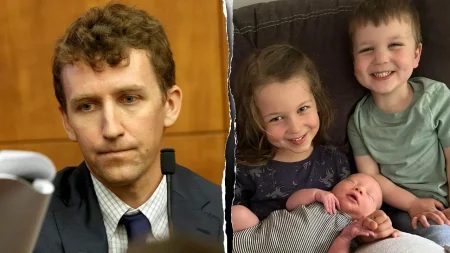





There are some losses so vast that they rewrite the very architecture of a person’s life, and Patrick Clancy’s is one of them. In a rare and deeply intimate interview on “60 Minutes,” he opened the door to a grief that most of us can only imagine from a safe distance, a grief that lives in the spaces between waking and sleeping. He said that he dreams “all the time” about his three children—Cora, Dawson, and Callan—all of whom were strangled to death in 2023 by his then-wife, Lindsay Clancy. The simple, devastating admission carries the weight of a father who has lost not just his children, but the entire future he had imagined with them. In those dreams, they are not gone; they are still here, still laughing, still small and full of wonder, and for a few moments, his mind grants him the mercy of forgetting the horror that ended their brief lives. Then the waking comes, and with it the terrible, unavoidable knowledge that they are gone. That contrast—between the vivid warmth of dreams and the cold permanence of reality—became the quiet center of his interview. He spoke not with the polished language of someone performing grief for a camera, but with the raw, unadorned honesty of a man still trying to understand how he is supposed to keep breathing in a world that no longer holds his children. It is a grief that has no roadmap, no timeline, and no forgiveness in the ordinary sense of the word. What he shared was not a story of closure, but of survival—one day, one night, one dream at a time.
To truly humanize this loss, it helps to remember who these children were, not just how they died. Cora, five years old, was old enough to have a personality, to love rituals and stories, to ask questions and test boundaries. Dawson, three, was still in that magical age of pretend play, curiosity, and impossible questions. Callan, just eight months old, was a baby—all softness, dependency, and the promise of a life that had barely begun. The Clancy family lived in Duxbury, Massachusetts, in what looked from the outside like a picture of ordinary American life: a working father, a mother at home with the children, a solid house with toys in the yard. But behind that façade, there were cracks invisible to neighbors and friends. Lindsay Clancy was reportedly struggling with her mental health in the months after Callan’s birth. She was hospitalized briefly, and there were signs that she was grappling with something far darker than the usual exhaustion of new parenthood. Postpartum depression and postpartum psychosis are not just statistics; they are lived realities that can consume a person’s mind and distort their sense of reality. On that terrible day in January 2023, Patrick left for a brief errand, and the world he knew was shattered. He came home to find his children unresponsive, and his wife injured from a suicide attempt. The details of that afternoon are almost unbearable to sit with, and yet there are no two ways around them: the children died, Patrick’s life exploded, and Lindsay survived, later to face criminal charges. In the aftermath, the nation watched a familiar pattern play out—the shock, the vigils, the headlines, the flood of commentary. But for Patrick, those headlines were not about strangers; they were about the three small people he tucked into bed, the names he said every night, the future he had already started building around them.
The dreams he described to “60 Minutes” are perhaps the most honest and human part of his story, because they capture the way the brain refuses to accept the impossible. In the weeks and months after profound loss, grieving people often report that their loved ones appear to them in sleep, alive and well, as if death were a mistake. For Patrick, these dreams are not hallucinations or figments; they are encounters. He hears Cora’s voice, sees Dawson’s grin, feels the weight of Callan’s tiny body in his arms. In those dream spaces, time has not yet split into before and after. The children do not know what is coming, and for the fleeting, helpless duration of sleep, neither does he. It is a kind of escape, yes, but also a kind of wound—because waking up means losing them all over again. Each morning, he is forced to grieve not once, but twice: once for the day they died, and again for every night his unconscious mind resurrects them. He said he dreams about them “all the time,” which means that the tragedy is not something that happened once in the past; it is a recurring event, a nightly reopening of the deepest cut a human being can experience. There is something unbearably tender about this detail. It suggests that his love for his children is so strong that it overrides even the logic of survival. His brain, in desperate love, keeps choosing to create them again, even though it knows that the morning will bring sorrow. That is what parental love looks like, stripped down to its rawest form: not grand gestures, not perfect memories, but an inability to stop reaching for those who are no longer there.
At the same time, the human heart does not exist in one single feeling, and Patrick’s story is no exception. Alongside the love and grief, there are other emotions that any person in his position would feel—anger, confusion, betrayal, perhaps even hatred toward the woman who was once his partner and the mother of his children. It would be easy for him to whittle his life down to that anger, to let it harden into a shell around him. What made his interview so striking was the way he acknowledged that complexity without pretending to have resolved it. There is a kind of moral courage in standing in front of a national audience and admitting that you are still wrestling with the wreckage, that you do not have neat answers, that some days you are fine and some days you are not. He did not offer easy platitudes about forgiveness, and he did not demand them from himself. Instead, he allowed the contradiction to exist: he could grieve his children and also grieve the woman his wife used to be; he could mourn the life they had built and still be unable to look at its shattered pieces without rage. In the years since the tragedy, there has been public debate about Lindsay’s mental state, legal proceedings, and questions of accountability. Patrick has remained, at times, an unpredictable figure in that narrative—sometimes speaking with compassion, other times with a raw edge of justifiable fury. That unpredictability is not inconsistency; it is honesty. Grief is not a straight line. It does not progress from shock to acceptance like a checklist. It spirals, doubles back, and sits motionless in your chest while the rest of the world moves forward. His willingness to let the world see that messy, unsanitized version of grief is a gift, though it is not one he likely ever wanted to give.
If there is a larger lesson to be drawn from this tragedy, it is not about demonizing one person or sanctifying another. It is about the quiet, systemic failure to care for mothers and families at the brink. Lindsay Clancy’s struggles were not invisible to everyone; she had sought help, been hospitalized, and expressed fear about her own state of mind. Yet the support she received was not enough to stop the unthinkable. Postpartum mental health crises are still treated, in many places, as an afterthought—something to be managed with brief prescriptions, short hospital stays, and plenty of “hang in there” messaging, rather than the emergency it can become. The Clancy family’s story is a brutal reminder that the stakes of ignoring these crises are not just a sad headline; they are the lives of children and the permanent destruction of a family. It is also a reminder that fathers, too, are caught in the blast radius. Patrick was not only dealing with the death of his children; he was dealing with the collapse of his marriage, the criminal justice system, the media, and the relentless inner question of what he could have done differently. He told “60 Minutes” that he dreams about his children, but he did not say whether the dreams are comfort or torment. Perhaps they are both. Perhaps they are the only place left where he still has an unbroken relationship with his little ones—where he can still be their father without the shadow of what happened pressing down on him. That kind of grief changes a person permanently, and it is not fair to expect anyone to move through it on a timeline or to perform it in a way that comforts the public. The best the rest of us can do is listen, hold the complexity, and let people like Patrick show us what love looks like after the worst possible thing has already occurred.
In the end, there is no neat moral to this story, no uplifting conclusion that can make it easier to hear. Patrick Clancy remains a father in mourning, a man whose children will never grow older than three and eight months and five years. He will spend the rest of his life calculating what they would be doing now—what kindergarten would have looked like, what Little League games he would have coached, what teenage arguments and adult graduations he would never get to witness. The dreams will likely continue, because love does not stop when a heartbeat does. He told “60 Minutes” that he dreams about them all the time, and there is something sacred in that admission. It means they are still with him, not just as memories but as presences—living, breathing figures in the landscape of his sleep. It would be reductive to say that he has found peace; peace may not be possible. But there is endurance. There is the stubborn, brutal refusal to let them fade. There is the fact that he wakes up every day and chooses to go forward, even when every part of him wants to stay in the dream. Some readers will look at his story and feel overwhelming pity; others may feel fury on his behalf; still others may see their own grief reflected in his words. That is the power of humanizing tragedy. It turns abstract horror into a father’s face, a child’s name, a dream that ends too soon. Mr. Clancy’s story is not a lesson; it is a witness. In sharing his dreams, he has given the world a way to understand what it means to love someone so deeply that even the boundary of death cannot stop your brain from trying to hand them back to you. That is not a weakness. It is the deepest testament to the love he still carries for Cora, Dawson, and Callan—a love that will go on, one dream and one waking hour at a time, until Patrick himself is no longer here to remember them.