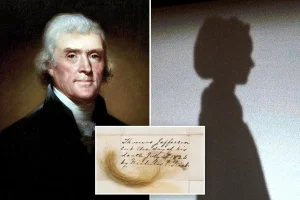






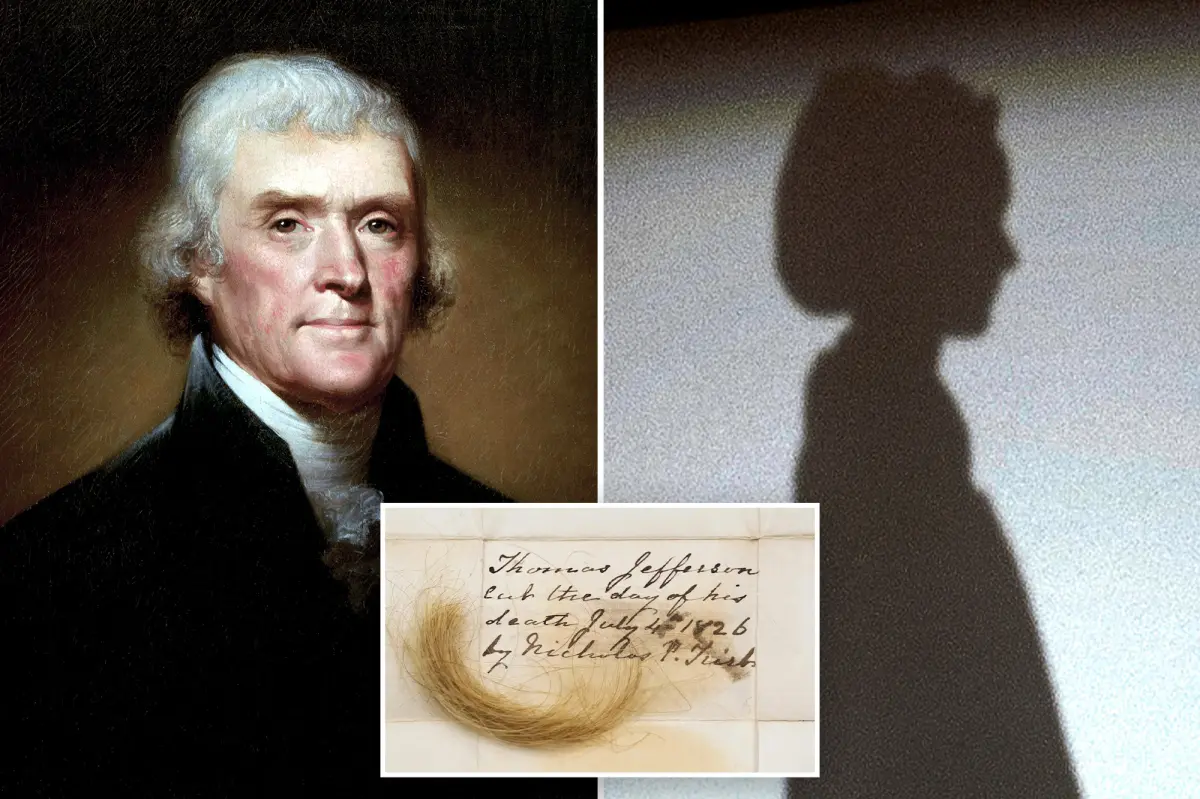
For more than two centuries, an intimate and painful question has hovered around the memory of Thomas Jefferson. How could the man who wrote the magnificent words “all men are created equal” have kept human beings in slavery, and could he truly have fathered children with Sally Hemings, an enslaved woman he owned? The rumor was not new; it had been whispered in political circles since the early 1800s, long before the American Revolution had faded from living memory. Jefferson’s legal family denied it, historians argued over it, and generations of Hemings descendants carried the story in their mouths like a fragile inheritance, dismissed by many as fantasy or slander. Now, after fifteen years of patient labor, a team of archaeologists, genealogists, molecular geneticists, and historians working with the Smithsonian Institution has presented what Richard Kurin, the project’s leader, describes as compelling and very clear evidence. Using a few strands of Jefferson’s hair, they sequenced his genome and compared it with DNA donated by thirteen people believed to be living descendants of both Jefferson and Hemings. The results point to one conclusion: Jefferson almost certainly fathered Hemings’ sons, Madison and Eston. Kurin, who has just published a book about the project, says no one had to invent this question. It belongs to the American people, and it goes back to the earliest days of the republic, to Alexander Hamilton and John Adams, who were alive when the rumors first began to circulate. For him, the duty to pursue evidence that can illuminate the American past is clear. What makes the finding so powerful is not simply the genetic tie. It is the way it transforms an abstract debate about paternity into a story about real people, whose lives were shaped by power, desire, and the brutal institution of American slavery. Sally Hemings was not a distant figure; she was an enslaved teenager when she arrived in Jefferson’s household, and she spent decades there, bearing children whose legal status was determined by her condition. For her descendants, official acknowledgment that their family stories were true is more than a scientific result. It is a form of long-delayed recognition, a confirmation that memory and oral history can carry truth across the centuries, even when the written record has been shaped by denial and silence.
The project began almost by accident in 2011, with a book rather than a strand of hair. Kurin was preparing a Smithsonian documentary about Jefferson’s Bible, a remarkable volume that Jefferson created by cutting out verses about Jesus’ moral teachings from the New Testament and pasting them into a blank book, creating his own distilled guide to ethics. While examining the pages for traces of blood, perhaps a leftover from the paper, the cutter’s knife, or some unknown hand, Kurin found three hairs tucked inside the binding. At first, the researchers compared those hairs with a DNA sample from a female-line descendant of Jefferson’s mother and found no match. The hairs could have come from someone else entirely, perhaps an enslaved laborer, a family member, or a later collector. But the search eventually led to another treasure: a lock of hair believed to have been clipped from Jefferson’s own head as he lay dying at Monticello on July 4, 1826. In the nineteenth century, it was common for families to cut hair from the dead and keep it in brooches, lockets, or envelopes; such locks were treated as intimate relics, treasured as physical reminders of a lost loved one. This particular lock contained Jefferson’s DNA. With extraordinary new techniques, researchers were able to sequence his entire genome from those fragile strands, opening a door that had seemed permanently closed. Older DNA tests, including a widely discussed study in the late 1990s, had mostly compared small segments of the Y chromosome from male-line descendants, which could rule out some potential fathers but could not paint a full genetic portrait. The new capability allowed the team to examine far more of Jefferson’s own genetic code. It transformed those hairs from sentimental keepsakes into biological archives, witnesses to a private life that Jefferson himself never publicly explained. The contrast is striking: Jefferson was a man of the Enlightenment, devoted to reason, evidence, and progress. It is somehow fitting that his own body, preserved through a mourning ritual familiar to generations of families, would be the evidence that finally settled a controversy he never resolved in life.
Once the genome was in hand, the challenge was interpretation. The genetic evidence alone was not enough; it had to be weighed with care. The researchers knew that a positive match to a Hemings descendant might not automatically identify Thomas Jefferson as the father. His younger brother Randolph, who also lived at Monticello and helped manage the plantation, had long been a favored alternative in the writings of historians who wanted to protect Jefferson’s reputation. If Randolph or one of his sons had fathered Hemings’ children, the DNA signatures could easily be confused with Jefferson’s, because the men were closely related. To untangle this problem, the team built a series of statistical models. They ran twenty thousand simulations of every plausible paternity scenario, involving Jefferson, his brother Randolph, and Randolph’s sons. The simulations weighed the genetic data, the family relationships, the known history of who was at Monticello when Hemings would have conceived, and the chance that different Jefferson men might have contributed to the Hemings family line. The result was decisive. The odds that Thomas Jefferson was not the father of both Madison and Eston Hemings were less than one in a thousand. In other words, the old alternative story—that some other Jefferson man was involved—was not absolutely impossible, but it was overwhelmingly unlikely. This kind of statistical rigor matters because the claim is so consequential. It touches not just the reputation of a Founding Father but the identities of living families. For the Hemings descendants, the finding is not an abstract probability; it is a confirmation of stories handed down through generations, often in the face of ridicule and denial. For historians, it reopens the question of how Jefferson could have held his children in slavery, and what he owed them, what he refused them, and how he lived with that private contradiction. The science does not offer a simple moral verdict, but it forces an honest reckoning with the reality of Jefferson’s life, and it places the Hemings family squarely inside the story of American democracy.
The same scientific revolution that made this possible has also changed the world of crime fighting in ways no one could have predicted. The techniques developed to extract, amplify, and analyze DNA from old hair and other difficult samples did not stay inside the Smithsonian. They began to move through forensic science, and eventually they helped catch some of the most notorious criminals in modern America. On Long Island, the so-called Gilgo Beach serial killer, Rex Heuermann, was linked to the murders of multiple women after investigators recovered DNA from a discarded pizza crust outside his Manhattan architecture office. The advances in analyzing tiny, degraded, or contaminated DNA samples—exactly the kind used to decode Jefferson’s hair—made that match possible. In California, the Golden State Killer, Joseph DeAngelo, was identified through a different but related tool: genetic genealogy, which uses public DNA databases and family trees to find relatives of the person who left a sample at a crime scene. Scientists had essentially learned how to read the faint biological traces that people leave behind, whether in a strand of hair two centuries old or in the crust of a slice of pizza. Beth Shapiro, an expert in ancient DNA at the University of California, Santa Cruz, put it plainly: “It’s hard to say we ever would have gotten to this place, where all these tools were used to convict the Gilgo Beach serial killer, if it hadn’t been for starting this project.” It is a remarkable chain of influence. A research team trying to understand a Founding Father’s private life developed a tool kit that now helps bring closure to cold cases, comfort to grieving families, and justice to communities that had almost given up hope. The same science that can awaken old ghosts can also put old demons to rest.
Yet the project has not been a smooth or universally celebrated triumph. The involvement of living descendants is intimate and sometimes painful, and science can reopen wounds as easily as it closes them. This month, a Hemings descendant who had provided a DNA sample in 2015 asked to withdraw her participation. Her frustration centered on timing and procedure: Kurin’s book, written for the general public, was appearing before a related article had undergone peer review and been published in a scientific journal. For her, that felt like a violation of the careful, respectful process that should govern research on human remains and family histories. The Smithsonian confirmed that her sample and related data were destroyed, and the analysis was rerun without her. The decision is a reminder that every DNA sample comes from a person with their own concerns, memories, and sense of agency. Even descendants who want the truth may disagree about how it should be revealed, who should tell it, and what obligations researchers have to the living before they use genetic material for a public story. Consent is not a single signature; it is an ongoing relationship. And when a project lasts fifteen years, the people who agreed to participate at the beginning may feel very differently by the end. The controversy does not necessarily undermine the scientific conclusion, but it complicates the story. It shows that the search for historical truth is never just about facts. It is also about trust, power, and the right of families to control their own narratives, especially when those narratives involve enslavement, intimacy, and generations of silence.
For the living descendants, the new confirmation carries a weight that no statistic can fully capture. David Miller, a sixth-generation descendant of Thomas Jefferson whose mother, Sarah Coachman Miller, provided a DNA sample before she died, said the results simply confirmed what his family had always believed. Through the project, he was able to meet and connect with his “cousins” in the Hemings family. He called the recognition long overdue: “It’s positive the family now hopefully gets the recognition and acknowledgement and acceptance they deserve.” Those words echo across two centuries. For most of American history, the relationship between Jefferson and Hemings was treated as a rumor, a political weapon, or a shameful secret. Enslaved families were denied the right to legally marry, to inherit, to pass down property, or to control the fate of their children. Yet they preserved their stories, and in the end, those stories found support in the most objective language we have: DNA. The Jefferson case is not merely a genealogical curiosity. It is a reckoning with the contradictions at the core of the American founding—the idea of universal liberty proclaimed by a man who was also an enslaver. It forces no simple moral conclusion. Jefferson was a brilliant, deeply flawed figure; Hemings was an enslaved woman who would have had little power over the choices that governed her body and her children; and the world they lived in was one in which such relationships were both common and unspeakable. What the science offers is a chance to look at that world without flinching. It gives the Hemings family a place in the national story that was always theirs, and it reminds all Americans that history is written in ink, in blood, in hair, and in the quiet truth that families tell one another across generations.