





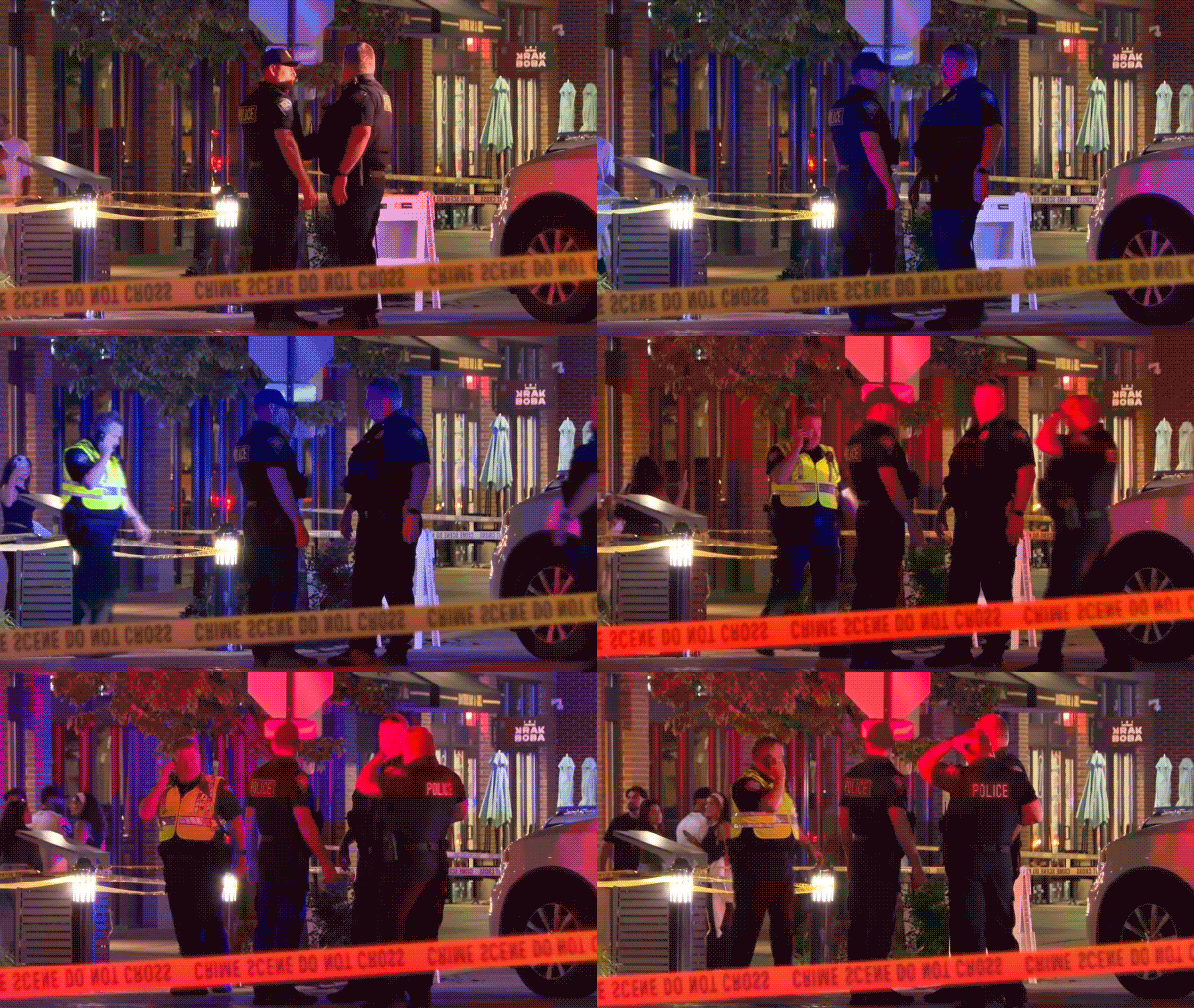
On a Saturday evening that should have been defined by the glow of stadium lights and the easy camaraderie of college football, the streets around Notre Dame’s campus in South Bend, Indiana, turned suddenly and violently chaotic. The game had ended, and thousands of people were streaming out of tailgating lots toward Eddy Street Commons, a lively district of restaurants, shops, and apartments that has become the beating heart of postgame life in the community. Friends laughed, children tugged at parents’ hands, and visitors soaked in the particular magic of autumn in Indiana. But the joy of the evening was shattered when a post-tailgate fight escalated into something far darker. Just after 7:30 p.m., police began receiving reports of a male suspect seen armed and reportedly pointing a gun at people in the area. The urgency of those reports was compounded by the fact that the crowd was dense and moving. People were not simply potential witnesses; they were potential targets. In the middle of a tense police response, a single gunshot was heard near the corner of Eddy Street and Angela Boulevard. That solitary sound would leave two people wounded and shake the sense of safety in a place built for togetherness. The victims were an unnamed woman, who had been hit in the leg, and a South Bend Police officer, struck by a ricochet or shrapnel. For a brief, terrifying moment, no one knew whether the injuries were survivable, whether the gunman would strike again, or whether the night would end in tragedy rather than the usual postgame satisfaction.
To understand the danger, one has to appreciate the setting. Eddy Street Commons is not a deserted alley; it is a carefully designed urban space where students, alumni, families, and locals converge after Notre Dame games. On a normal night, the biggest threat might be slow service at a restaurant or the difficulty of finding a parking spot. But on this night, the crowds were leaving their tailgates at the same moment a fight broke out, and the combination of alcohol, group dynamics, and high emotion may have provided the spark. Notre Dame Police were the first to notice and pass along the report that someone with a gun was either brandishing or pointing it at people. They contacted South Bend Police, who had deployed roughly 20 officers to the Eddy Street Commons area specifically for postgame security—a standard presence intended to reassure the public and keep the peace. Those officers began scanning the crowd, trying to match descriptions and zero in on the danger. When a suspect matching the general description was located, he was unarmed, an encounter that must have created a moment of tense uncertainty. And then, almost as if the universe were testing their resolve, the sharp crack of a gunshot echoed through the district. Officers ran toward the sound, not away from it. Bystanders dove for cover, froze, or screamed. Police immediately began searching for the source of the bullet—and for the person who had fired it.
In the immediate aftermath, the police response was both professional and deeply human. Officers found the woman first, bleeding from a leg wound that, while not life-threatening, had to have been terrifying. She was an innocent onlooker, and nothing in her evening had prepared her to become a victim of gunfire. As emergency medical personnel arrived, the officers continued their sweep of the area, ensuring there were no other victims and that the active threat was gone. It was then that they discovered one of their own had been hurt. A South Bend Police officer had been struck by a ricochet or shrapnel—a harsh reminder that the same bullet that injures a civilian can just as easily find a person in uniform. The officer was transported to a local hospital alongside the woman, and the wait for updates must have been agonizing for their families and colleagues. South Bend Police later issued a Facebook post that sought to calm the community: the officer was “doing fine,” and the woman was “okay.” Those words carried a mixture of relief and gravity. Full recoveries were expected, but the psychological wounds would take longer to heal. The officer had been doing his job, protecting a crowd on a football Saturday, and still the violence found him. The woman had simply been in the wrong place at the wrong time. Their survival is a small miracle, but it does not erase the fact that they were casualties of a choice someone made to bring a gun into a crowded public space.
With the victims on their way to the hospital, the search for the shooter began in earnest. Notre Dame officials, coordinating with South Bend authorities, indicated that the suspect had fled west from the scene. The picture that emerged from witness descriptions was disorienting in its specificity: a heavyset Black male with dreadlocks, wearing blue shorts, a black shirt with a red and blue design on the front, and perhaps most strikingly, missing one shoe. That last detail humanizes the chaos in an almost haunting way. It suggests someone running for his life, or running from his choices, without the luxury of stopping to retrieve a lost sneaker. The suspect remained at large as of late Saturday night, and the uncertainty that came with that fact pushed the tension to another level. Police evacuated nearby businesses and parking garages, turning the popular commercial district into a controlled perimeter. The hush of just hours earlier—the sound of fans laughing—was replaced by the whop of helicopter blades and the crackle of police radios. South Bend Police locked down the area and asked the public to steer clear while investigators collected evidence and reviewed surveillance footage. Fox News Digital reached out for additional comment, but a spokeswoman had nothing beyond the department’s official Facebook post. It was a reminder that during active investigations, silence is often the loudest signal that authorities are focused on catching a fugitive, not feeding a 24-hour news cycle. For residents and visitors in the surrounding neighborhoods, the heavy police presence was both reassuring and unsettling: reassurance that officers were taking the threat seriously, but also a clear sign that the safest description of the night was gone.
The night, however, was not done testing South Bend’s resilience. About one mile away, a second shooting unfolded that was far more violent. At least two people were killed, and another person was critically injured. The horrors of the two incidents would inevitably be linked in the public imagination, but police explicitly stated that there was no indication they were related. Even so, for a community already reeling, the news of a second shooting landed like a second punch. It is impossible not to wonder whether the first incident—the gunfire that wounded a woman and a police officer—was the opening act of a larger wave of violence, or whether it was simply a tragic coincidence on a single calendar date. The fact that the two events occurred about a mile apart, within hours of each other, turned the broader city into a landscape of anxiety where every siren carried new meaning. This is the uncomfortable context of American life in recent years: no one assumes a shooting is an isolated event anymore. Families in South Bend began checking phones, messaging friends who had attended the game, and retracing the routes their loved ones might have taken to get home. The second shooting also forced a stark reckoning with what could have happened at Eddy Street Commons. The woman’s leg injury, the officer’s ricochet wound—they could so easily have been another headline, another statistic. Instead, with luck and quick medical care, they were the story of survival, while the families of the two people killed a mile away began their long journey through grief.
Looking forward, South Bend will need time to heal, and that healing will require more than just apprehending the suspect in the Eddy Street shooting. It will require the community to talk openly about the fear that descended on a beloved gathering place, and to support the woman and the officer who now carry the physical and emotional marks of that night. It will require questions to be asked—about how the gunman obtained his weapon, why he chose that particular moment to fire, whether there were missed warnings, and what more can be done to prevent the next eruption of violence. But in the immediate aftermath, there is a quieter, more human work that matters just as much: neighbors checking on neighbors, university counselors making themselves available to students who witnessed the terror, restaurant workers who were evacuated recounting the sound of the shot, and parents holding their children a little more tightly. The resilience of a community is not measured in press conferences, but in the small acts of kindness that happen after the cameras leave. Notre Dame and South Bend have a deep connection, one that has weathered many storms before, and that connection will be the foundation of their recovery. The return of game-day joy will not happen overnight, but it will happen. People will gather again at tailgates, fill Eddy Street Commons, cheer for the Fighting Irish, and maybe—just maybe—be a little more alert, a little more grateful, and a little more determined to look out for one another. In the face of senseless violence, that stubborn commitment to community is the only true answer.