




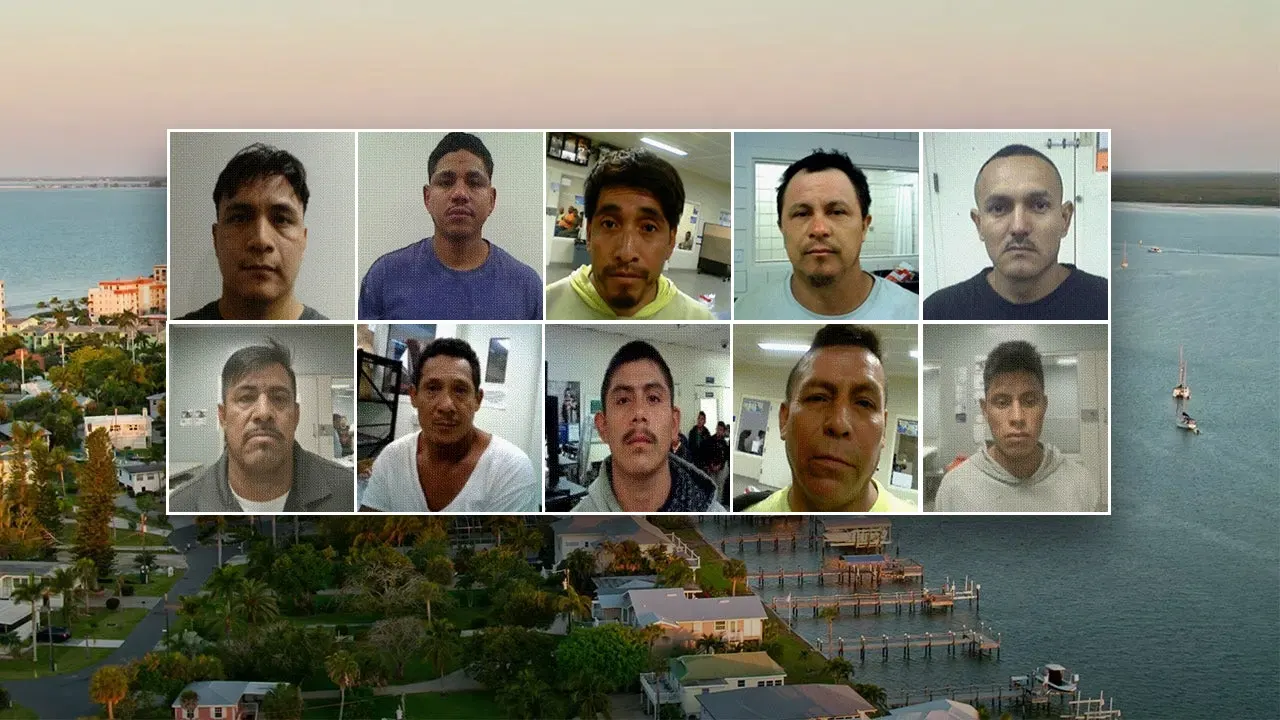
During the final week of August, U.S. Immigration and Customs Enforcement carried out a large, coordinated immigration enforcement operation across Southwest Florida, working alongside more than five other federal, state, and local agencies. The operation, which ran from August 24 through August 27, resulted in approximately 500 arrests. According to ICE, the people taken into custody included a Haitian national charged with murder, a Honduran man accused of molesting children, a suspected Mexican cartel member, a Guatemalan man who allegedly tried to use a Taser against a police officer, and many others who had been accused or convicted of crimes ranging from battery, DUI, hit-and-run, domestic violence, and drug possession to driving without a license, resisting arrest, and returning to the United States multiple times after being deported. The agencies involved included the Florida Highway Patrol, the Lee County Sheriff’s Office, the Florida National Guard, the Florida Fish and Wildlife Conservation Commission, and U.S. Customs and Border Protection. But behind the stark statistics of this weeklong sweep are real human stories—stories of alleged victims, some of whom were killed or terrorized, and stories of immigrants whose lives now hang in the balance of the immigration enforcement system. For the men and women arrested, the operation means possible deportation, separation from families, and an uncertain future. For Florida communities, it represents a forceful attempt to remove people who were already in the country without legal status and who had, according to law enforcement, committed serious crimes or repeatedly violated immigration laws. The sheer scale of the operation makes clear that this was not a routine effort; it was a deliberate, multi-agency push to make a statement about public safety and the enforcement of immigration law.
Perhaps the most tragic case to emerge from the operation involved Whycliff Longin, a 28-year-old man from Haiti who was in the process of seeking asylum in the United States. The Lee County Sheriff’s Office arrested him on a murder charge during the operation. According to officials, just before 3 a.m. on August 27, deputies responded to a 911 call from a woman who said she had escaped a terrifying attack. She had been strangled, had fought desperately for her life, and then managed to barricade herself inside a bedroom. When deputies arrived, they saw Longin fleeing from a neighboring residence and took him into custody. When they searched that neighboring home, they made a devastating discovery: a second woman was found deceased inside a bedroom, showing obvious signs of blunt force trauma. The medical examiner later ruled her death a homicide. Longin was charged with second-degree murder, attempted murder, sexual battery, and burglary with battery. He was being held without bond in the Lee County Jail, and an ICE detainer was lodged against him. Lee County Sheriff Carmine Marceno spoke publicly about the case, saying, “My prayers are with the family of the woman who tragically lost her life, and with the survivor who showed incredible strength in fighting to live.” The case is a chilling reminder that immigration enforcement is not simply about paperwork or policies—it is about protecting people from violence that can shatter lives and destroy families. The woman who died had a name and a story; the survivor carried deep trauma. And the man accused now faces a criminal justice process that could end in a long prison sentence, while his immigration status remains a secondary question.
Beyond that heartbreaking case, the operation also captured other individuals with serious alleged offenses. ICE agents and troopers with the Florida Highway Patrol worked together to arrest a suspected Mexican cartel member, as well as a Honduran man accused of molesting two children. Those cases alone highlight the wide range of danger that law enforcement says it was trying to remove from Florida streets. Another arrest involved Noe Lux Castro, a 24-year-old man from Guatemala who had entered the United States illegally, according to ICE. During his arrest, Castro became involved in a physical struggle with a trooper. He took the trooper’s Taser and tried to use it against the officer. He was eventually subdued and taken into custody. ICE characterized him as a criminal illegal alien, and he was charged with obstructing a law enforcement officer, resisting an officer with violence, and resisting an officer without violence. These encounters are not clean, quiet procedures; they are often dangerous, tense, and unpredictable moments where officers are trying to do their jobs while someone else is fighting to avoid capture. For the person being arrested, the moment can feel like a catastrophe; for the officer, it can be a matter of life and death. The fact that such incidents took place during a single week of enforcement shows how volatile immigration enforcement can become, and it explains why agencies from across federal, state, and local levels felt the need to join forces. They knew they were dealing with people who might resist, who might have weapons, or who might be wanted for violent crimes in other contexts.
The rest of the arrests painted a portrait of how complicated undocumented immigration and criminal history can be. ICE listed numerous individuals who were taken into custody during the operation. Olmen Noel Vargas-Mendoza, 40, from Honduras, was described as a criminal illegal alien who illegally reentered the United States without inspection three times and had a history of domestic violence. Marlon Rolando Calderon-Castellon, 43, also from Honduras, had reentered the country without inspection and had a criminal history that included battery and illegal drug possession. Carlos Humberto Monzon-Cabrera, 53, from Guatemala, had a criminal history that included battery and multiple convictions for driving without a valid license, and he had entered the country illegally. Hermenegildo Andres-Juan, 52, also from Guatemala, had reentered after a previous deportation and had a criminal history that included DUI, resisting arrest, hit-and-run, and public order crimes; he had entered the country on January 10, 2025. Armando Coc-Yat, 39, from Guatemala, entered the United States without inspection on December 4, 2018, and had a criminal history that included DUI and hit-and-run; an immigration judge had issued a final order of removal on November 16, 2021. Rigoberto Vargas-Resendiz, 52, from Mexico, had reentered without inspection three times, including on December 9, 2018, and had an old removal order from May 26, 2011. Daren Ruiz-Mejia, 37, from Venezuela, reentered without inspection on April 5, 2016, and had a criminal history including DUI. Melchor Perez-Garcia, 31, from Guatemala, reentered without inspection and had a criminal history including DUI, resisting an officer, and obstruction without violence. Samuel Mateo-Francisco, 33, also from Guatemala, reentered without inspection on three separate occasions, including on October 31, 2023. Each of these names represents a person who, according to ICE, was not in the country lawfully and had engaged in behavior that brought them to the attention of law enforcement. Some had old convictions; some had recent entries. Some seemed to be repeat offenders, while others may have simply had a single DUI. But under the current system, any criminal history combined with a lack of legal status made them a priority for removal.
ICE officials framed the operation as a powerful example of what can happen when agencies cooperate and share a common mission. Matthew Elliston, the interim field office director for ICE’s Enforcement and Removals Operations in Miami, praised the outcome. “The continued success of these weeklong operations is a testament to the power of unity and our shared commitment to community safety,” he said. “Working hand-in-hand with our state and local partners, we have successfully removed more than 500 illegal aliens from our streets, ensuring a safer environment for all.” He added a direct warning: “Those who choose to knowingly flaunt this nation’s immigration laws will face the consequences, and they will be provided a one-way ticket home.” The political context is also important. Florida has more law enforcement deputizations to assist in federal immigration enforcement than any other state. All 67 county sheriffs and their agencies partner with ICE, along with multiple state law enforcement agencies. Florida Governor Ron DeSantis, who has made immigration enforcement a central priority, responded to the operation with strong support. “Florida continues to demonstrate how to turn important policy into meaningful action,” he said. He called the state the “most proactive and effective state in identifying, apprehending and deporting illegal immigrants who have intentionally avoided lawful immigration processes and committed horrific crimes within the United States.” His statement went further: “We will not sit idly by and allow Floridians to be victimized. Rather, we are executing on a whole-of-government approach that engages federal, state, and local law enforcement to get the job done and keep Florida safe and free.”
In the end, this weeklong operation is a reminder that immigration enforcement is never just a set of statistics. The 500 arrests are a number, but each number is a human being with a background, a family, and a reason for being in the United States—some seeking refuge, some seeking work, some fleeing violence or poverty. Yet the operation also stands for the victims whose voices are easy to overlook in the policy debate: the woman who was strangled and fought for her life, the second woman who was brutally killed in her own home, the children who may have been molested, and the communities that feel unsafe when people with violent histories are living among them without legal status. The officers, deputies, and agents involved in the operation had to make difficult split-second decisions, confront resistant individuals, and process a massive number of arrests in a very short time. The people arrested will now face criminal courts, immigration courts, and the possibility of removal to countries they left years ago. Some may be wrongfully accused; others may be exactly what the government says they are. But the broader challenge remains: how does a country balance compassion for people who want a better life with the obligation to keep its communities safe? That is not an abstract question. It is a question that plays out every time an ICE agent knocks on a door, every time a sheriff makes an arrest, and every time a judge decides whether someone stays or goes. Southwest Florida’s week of enforcement did not answer that question, but it made clear that the choices are being made with urgency, with force, and with real human consequences on every side.