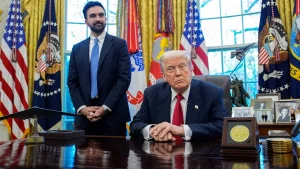






It begins quietly, in laboratories and university corridors that rarely make headlines. A postdoctoral researcher in a plant genetics lab stares at a funding notice pinned to her office wall, wondering whether the grant that pays her salary, buys the seeds, and keeps the fluorescent lights humming will still exist in six months. Across the country, a professor in a public health department checks his email for the tenth time before breakfast, waiting for word on a project that could reduce opioid overdoses in rural communities. These are not abstract policy questions. They are the daily realities of people whose work depends on federal research dollars. And now, according to federal officials, those dollars may be subject to a new and unprecedented layer of scrutiny. An executive order is being drafted that would place federal research grants under review by an outside panel, marking the latest and most ambitious effort yet to redirect billions of dollars in government-funded science. For the scientists whose careers are built on these grants, the news lands like a tremor—unseen at first, but with the potential to reshape the landscape around them in ways they cannot fully predict.
To understand why this matters so deeply, one has to appreciate how federal research funding actually works. Unlike corporate spending, where a CEO can decide overnight to pivot a company’s strategy, government research dollars flow through a carefully structured system of agencies, peer review, and scientific committees. The National Institutes of Health, the National Science Foundation, the Department of Energy, and dozens of other agencies distribute more than a hundred billion dollars each year to universities, hospitals, and research institutes. These grants fund basic research that often has no immediate commercial payoff—the kind of curiosity-driven science that eventually leads to the internet, CRISPR gene editing, mRNA vaccines, and countless other breakthroughs that seem obvious only in hindsight. The current system is not perfect. It is slow, sometimes bureaucratic, and occasionally frustrating. But it is built on a simple principle: scientists review the work of other scientists. Experts in a given field evaluate proposals based on scientific merit, feasibility, and potential impact. This peer-review process is deliberately insulated from politics because the founders of the modern research system understood that breakthroughs do not always come from predictable places. A discovery about how fungi share soil nutrients might seem irrelevant to today’s economic crisis, but it could one day help us grow food in degraded land. Advances in quantum physics may not create jobs next quarter, but they could lead to new materials that transform industry in a generation. This is why federal grants are not just checks written to clever people. They are an investment in national capacity, a way of betting on the future when the returns are uncertain and far off.
The proposed executive order would insert an outside panel into this delicate machinery. The details are still being shaped, but the broad outline is clear: before federal grants are approved—or perhaps after they have already been funded—a panel of individuals from outside the traditional scientific establishment would review them to assess alignment with national priorities. Supporters of the idea argue that too much government money goes into projects that are academically interesting but impractical, or that duplicate work already being done abroad, or that reflect the biases of an insulated scientific elite rather than the needs of ordinary citizens. In this view, the outside panel would serve as a kind of intellectual auditor, making sure that taxpayer dollars are spent on problems that matter: energy security, public safety, health emergencies, infrastructure, and American competitiveness. There is a certain populist logic to this. When people hear stories of large grants going to study the mating habits of fruit flies or the history of table manners, it is easy to feel that the system is out of touch. The word “waste” becomes powerful, especially when families are struggling to pay rent and inflation is pinching every corner of the budget. The executive order is being framed, perhaps, as a way to bring accountability to a system that seems self-referential and removed from everyday life. For many taxpayers, the idea that a panel of outsiders could veto scientific projects and force agencies to spend on more pressing concerns sounds less like government overreach and more like common sense.
But among researchers, the reaction is far more complicated and anxious. They worry about one essential fact of modern science: it is exactly the unpredictable, seemingly useless research that often yields the most transformative results. Penicillin was discovered because a scientist noticed something strange on a petri dish. X-rays were found by accident. The structure of DNA emerged from work on the genetics of bacteria, not from a project with a direct goal of curing cancer. None of these breakthroughs would have survived a review panel asking, “What is the immediate practical return?” Scientists also fear the composition of the outside panel itself. If it is filled with people who have no scientific training, how will they judge technical complexity? If it is appointed by politicians, will it become a mechanism for rewarding friends and punishing critics? If it reviews grants after they have already been approved and funded, it could create an environment of permanent uncertainty, where scientists cannot plan multiyear studies because a midstream review might pull the plug. This is not a hypothetical concern. Human beings are working inside this system. A graduate student in marine biology may have spent four years of evenings and weekends mastering a laboratory technique, only to discover that her research into coral reproduction no longer fits the list of national priorities. An engineer developing low-cost water filtration systems for tribal communities might see his project stalled because the outside panel believes that semiconductor research is more strategically important. When grants are redirected, real human careers are rerouted, and so are the quiet, cumulative efforts that make discoveries possible.
There is also a deeper human question hidden in this policy debate: what kind of relationship do we want between government and science? The current system, for all its flaws, is built on the idea that knowledge is a public good. Scientific progress is not a zero-sum competition where every dollar spent on astrophysics is a dollar stolen from cancer research. Rather, the entire ecosystem supports itself. Medical research depends on advances in imaging, materials science, and computer software, which in turn depend on basic physics and mathematics. A grant to study the atmospheres of distant planets may seem irrelevant to a patient in a hospital, but it trains the engineers who later build better MRI machines. The outside panel proposal, however, treats scientific research more like a portfolio of stocks that must be actively managed and rebalanced. It suggests that with enough oversight, government can identify precisely which research will yield the best returns. This is a comforting idea, but it runs against the history of discovery, which is full of surprises. No one can predict which seed will grow into the tallest tree. The most effective way to support the future is to allow many seeds to be planted, even the ones that look strange. This is not an argument for chaos or irresponsibility. All federally funded research should be rigorous, transparent, and responsive to broad public needs. But it should also be allowed to follow curiosity, to take risks, to fail, and to ask questions that do not have immediate answers.
In the end, the executive order represents a referendum on trust. Do we trust scientists to make decisions about science, or do we believe that outside political appointees will do better? Do we trust that the research enterprise is already looking for ways to address major national challenges, or do we believe that a radical new oversight structure is necessary? There are no easy answers. Some federal grants are undoubtedly wasteful. Some science programs have grown stale, comfortable in their routines, disconnected from the public. There is a legitimate argument to be made for ensuring that research dollars align with urgent problems like pandemics, climate change, infrastructure decay, and economic inequality. The researchers who would be affected by these changes are not enemies. They are people who have dedicated their lives to understanding the world and making it better. They raise families, volunteer at schools, coach little league teams, and read bedtime stories. They also happen to be extraordinarily good at solving difficult problems, and they need resources to do so. Perhaps the outside panel, if it is designed wisely, could bring a fresh perspective that breaks some unhelpful inertia. But if it is designed poorly, it could chill the very creativity that has made American science the envy of the world. The next few months will be a time of waiting for that postdoc and that public health professor, for the grant administrators and the university vice presidents, for everyone whose work lives at the intersection of curiosity and funding. They will keep doing their research, writing their papers, mentoring their students, and hoping that the government remembers what science is actually for. The executive order is still just a draft, a set of words being shaped in offices far away from the bench where experiments are actually conducted. But in those offices, in those labs, in the quiet spaces where the future is being built, everyone is paying attention. The outcome will be more than a policy change. It will be a message about who we are as a nation and what we believe progress requires.