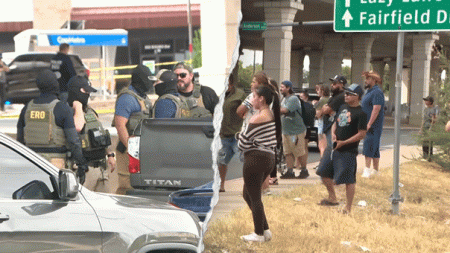






In the late hours of an Austin afternoon, a city that has long prided itself on being a place of refuge and reinvention, the quiet rhythm of daily life was broken by a sound that has become far too familiar in America—the crack of gunfire, followed by sirens, shouting, and the kind of sudden chaos that leaves a neighborhood breathless. The shooting in the Texas capital, carried out by federal immigration agents, was not just another incident in a long list of violent encounters; it was a stark symbol of a much larger and more deliberate shift in how the country approaches the people who live within its borders. The Trump administration has made clear that deportation is not merely a policy but a priority, and the presence of armed agents on the streets, in parking lots, and near schools is now part of the everyday texture of life for millions. For those who have followed the slow building of this pressure, the shooting was less a surprise than an inevitability—the logical result of an environment where enforcement is measured in speed and volume, and where every encounter can escalate from a knock on the door to a tragedy. But for the people who live in that neighborhood, for the families who heard the gunfire while making dinner or comforting a crying child, the moment was not abstract. It was terrifying. It was the sudden collapse of safety, the reminder that in this political climate, the presence of an agent can turn an ordinary errand into a life-threatening event.
The human cost of these intensified deportation efforts cannot be measured in statistics or press releases. Behind every raid, every detention, every handcuff, there is a person with a name, a history, a family that will be forever altered. Consider the mother who had just dropped her children at school, the grandfather who had worked the same construction site for twenty years, the teenager who was born in Texas but whose parents were not—each of them now lives with a new kind of fear, one that settles in the chest and never fully leaves. When federal agents arrive, they bring with them the weight of a policy that treats people as problems to be removed, not as neighbors to be understood. The shooting in Austin has left a community reeling, not only because of the violence itself, but because it confirms what many had feared: that in the rush to deport, the lives of individuals have become secondary. The tears shed in the aftermath are not just for the victim or the officer, but for all the families who now understand that no one is truly safe, that a simple mistake, a misunderstood order, or a moment of panic can end in a way that nothing can repair. This is the true face of a deportation effort—not clean, not efficient, but fractured, painful, and full of the messy, unbearable reality of human beings colliding with a system that has little time for their stories.
And what of the agents themselves? It is easy to paint them as faceless enforcers, but they too are part of this human story. They are men and women who took an oath to uphold the law, who put on uniforms every morning, who often come from the same communities they now patrol. Some are driven by a genuine belief in order and security; others are simply trying to earn a paycheck, support their families, and survive in a job that has become increasingly dangerous and politically charged. The intensification of deportation efforts has placed an enormous burden on these agents, demanding that they act quickly, assert authority, and make split-second decisions in environments where fear is high and trust is low. They are trained to protect themselves, but that training often cannot account for the complexity of human interaction—the mother who does not speak English, the man who reaches into his pocket for his wallet, the child who runs toward a parent. When a shooting occurs, it is not always the result of cruelty; it is often the result of pressure, exhaustion, and the volatile mixture of authority and anxiety. Yet the same system that pushes agents to act faster also fails to provide them with the tools to de-escalate, to communicate, to understand the people they are confronting. The humanization of this story requires us to hold two truths at once: that the shooting was a tragedy for all involved, and that it was made possible by a policy environment that prioritizes enforcement over empathy, speed over understanding, and removal over relationship.
In the neighborhoods most affected, the aftermath of the shooting has taken on a tone of grief and resistance. Community organizers, local leaders, and ordinary residents have gathered not to riot but to mourn, not to rage but to demand answers. They have lit candles, held signs, and shared stories of other encounters with immigration agents—the time an officer stopped a father at a bus station for no apparent reason, the late-night knock at a door that nearly caused a child to have an asthma attack, the countless moments when a patrol car’s presence made an entire block go silent. These are not isolated anecdotes; they are the collective memory of a community that has learned to live in a state of watchful anxiety. The shooting in Austin has become a rallying point, a new symbol of what happens when a nation forgets that immigrants are not abstractions but people with dreams, traditions, and deep roots in the places they call home. But even as the community grieves, there is an underlying awareness that this moment is part of a larger pattern. Across the country, federal agents are being dispatched with more authority, more weapons, and more pressure to produce results. The language of public officials, with its talk of “mass deportation” and “cleaning up” neighborhoods, has created an atmosphere in which any encounter can feel like a battle, and any immigrant can be viewed as a threat. The residents of Austin, like millions of others, are not just reacting to one shooting; they are responding to the slow erosion of everything that made them feel like they belonged.
This is not the first time, nor will it be the last, that a policy of enforcement has collided with the messiness of real life. History tells us that immigration crackdowns, however well intentioned, tend to produce harm beyond their intended targets—separating families, destabilizing communities, and creating a climate of fear that drives people into the shadows. The Trump administration’s intensification of deportation efforts is not a break from tradition but an acceleration of a pattern that has been building for years. Each raid, each detention, each shooting is a chapter in a story that is far from over. And while supporters of the policy argue that it is necessary to uphold the rule of law, opponents point out that the law itself is being applied in ways that ignore due process, compassion, and basic decency. The shooting in the Texas capital is a moment for reflection, an opportunity to ask not only how we enforce our laws but why we enforce them the way we do. It is an invitation to consider whether the safety we seek is worth the violence we create, whether the order we demand is worth the chaos we leave behind, and whether the nation we imagine is one in which families are torn apart in the name of protection. These are not easy questions, and they cannot be answered with slogans or statistics. They require a willingness to look into the eyes of the people affected—the frightened parents, the grieving children, the exhausted agents—and to acknowledge that there is no policy that can erase the fundamental dignity of a human life.
What emerges from this tragedy is a call for a different way forward, one that begins not with deportation quotas but with human connection. There is a difference between enforcement and cruelty, between security and fear, and that difference lies in how we treat people on the ground, in the neighborhoods where life actually happens. A humane immigration system would not begin with armed raids and mass removals; it would begin with listening—to the employer who needs workers, to the teacher who sees a child’s potential, to the miner, the nurse, the farmer, the dreamer who wants nothing more than to contribute to the country they love. It would recognize that the vast majority of immigrants are not criminals but human beings seeking the same safety and opportunity that all Americans want. The shooting in Austin is a warning, a painful and urgent reminder that policies made in distant capitals have consequences in living rooms and playgrounds, in the hearts of people who just want to live in peace. As the next debate over immigration begins, let us remember that behind every policy is a person, behind every raid is a family, and behind every shooting there is a story that cannot be summarized by a political talking point. The humanization of this moment is not about choosing sides; it is about acknowledging that the cost of this effort is being paid in real blood, real tears, and real loss, and that we can choose to find a better way—one that honors the rule of law without abandoning the rule of love, one that keeps our communities safe without making them afraid, and one that recognizes that every person, no matter where they come from, deserves to be treated as a neighbor, not an enemy.