




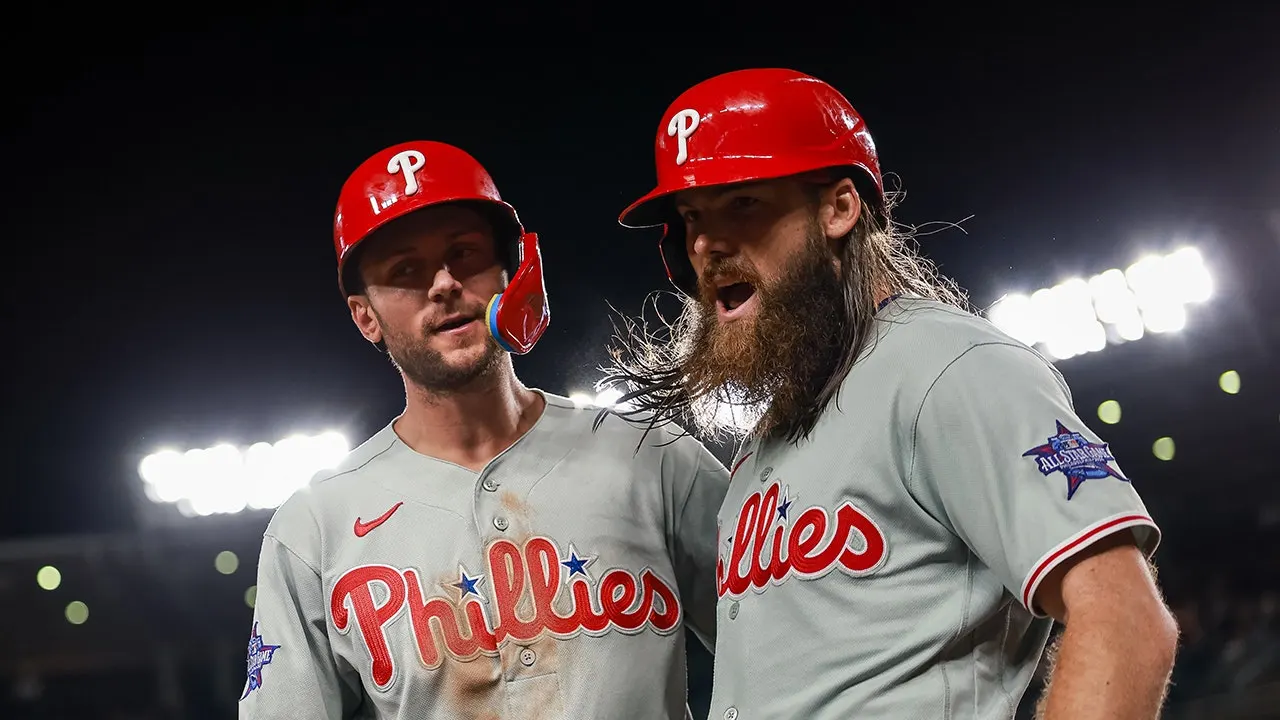
There is a unique brand of quiet that only settles over a baseball dugout when a hard-fought lead evaporates in the twilight of a late-summer evening. In the bottom of the eighth inning at Nationals Park, the Philadelphia Phillies found themselves enveloped in that exact chill. Young reliever Orion Kerkering had just surrendered a crushing, three-run home run to the Washington Nationals, erasing Philadelphia’s hard-earned advantage and plunging them into an 8-6 deficit. For a team locked in the grueling, day-by-day marathon of the National League East race, the moment felt like a physical blow to the solar plexus. The momentum, which had swung back and forth like a pendulum all night, seemed to have permanently departed, leaving the Phillies to contemplate a demoralizing defeat against their division rivals as they prepared for their final turn at the plate.
When the top of the ninth inning began, the mountain ahead of the Phillies looked entirely too steep to climb, and the first two plate appearances did little to inspire hope. Two quick strikeouts left Philadelphia down to their final out with nobody on base, a scenario that usually prompts fans to beat the traffic and players to begin packing their gear. Stepping into the batter’s box was Trea Turner, the team’s seasoned shortstop, carrying the weight of the entire roster on his shoulders. With two strikes against him, Turner was a single heartbeat away from sealing the defeat. Yet, in the high-stakes theater of professional baseball, the line between despair and destiny is razor-thin; Turner kept his composure, stayed back on a pitch, and laced a clean single into center field to keep the game breathing. It was a seemingly modest play that would ultimately serve as the catalyst for one of the most astonishing turnarounds of the Major League Baseball season.
What followed Turner’s single was not merely a gritty comeback, but an absolute offensive deluge that defying the mathematical odds of the sport. Brandon Marsh stepped up next, carrying the hopes of a dugout that had suddenly found its pulse, and unleashed a ferocious swing that sent a two-run home run soaring into the night sky to tie the game at 8-8. The blast did more than just reset the scoreboard; it completely shattered the confidence of the Nationals’ bullpen and sent a shockwave of disbelief through the home crowd. What made this sudden eruption historic was the sheer impossibility of its context: every single run scored in this frame came with two outs. To find a parallel in franchise history, one had to look back to September 2015, when the Phillies also managed an eight-run ninth inning against these very same Nationals, proving that baseball history has a strange, poetic way of repeating itself when the pressure is at its highest.
The tying run was only the beginning of Washington’s nightmare, as the Phillies’ lineup transformed into a relentless carousel of contributors who refused to let the inning end. Bryce Harper, ever the theatrical focal point, kept the chain moving with a sharp single, followed immediately by another base hit from Derek Hill. This setup brought Bryson Stott to the plate with runners on and the potential to turn a tie game into a definitive statement. Stott delivered in spectacular fashion, launching a deep drive down the left-field line that had everyone in the stadium holding their breath. In a moments-long display of human instinct, Stott visibly leaned his entire body to the left as he ran, desperate to guide the ball fair through sheer force of will. The ball stayed true, clanging off the fair pole for a dramatic three-run home run that put the Phillies up 11-8 and effectively sucked the remaining air out of Nationals Park.
Even with the lead secured, the Philadelphia onslaught refused to slow down, mutating into a masterclass of collective plate discipline and aggressive hitting. Ten consecutive batters managed to reach base safely, a staggering feat achieved through a mixture of eight hits—including three extra-base knocks—and patient walks drawn by veteran catcher J.T. Realmuto and prospect Justin Crawford. Edmundo Sosa drove in two more runs with a clutch hit to extend the lead to 13-8, before Turner returned to the plate to drive Sosa home with his second hit of the inning. By the time Brandon Marsh finally struck out to bring the grueling top of the ninth to a close, the Phillies had put up an astonishing eight runs. The bottom of the ninth felt like a mere formality; though Washington’s Luis Garcia Jr. managed a solo home run to slightly soften the blow on the scoreboard, the game was already decided, culminating in a surreal 14-9 victory for Philadelphia.
Beyond the immediate theater of a miraculous comeback, this victory provided a massive injection of adrenaline into the Phillies’ campaign as they navigate the fierce competitive waters of the NL East. Moving to a 43-36 record, the Phillies kept themselves within striking distance of the first-place Atlanta Braves, while simultaneously putting valuable distance between themselves and both the Nationals and Miami Marlins. More than the standings, however, this game served as a profound human reminder of why baseball remains so deeply woven into the American sporting fabric. It is a sport where clock-watching is useless, where the game cannot simply be run out by taking a knee, and where a team down to its absolute last strike can still rewrite the ending of their story. The Phillies showed that as long as there is still one out left to play, destiny is always up for grabs.