





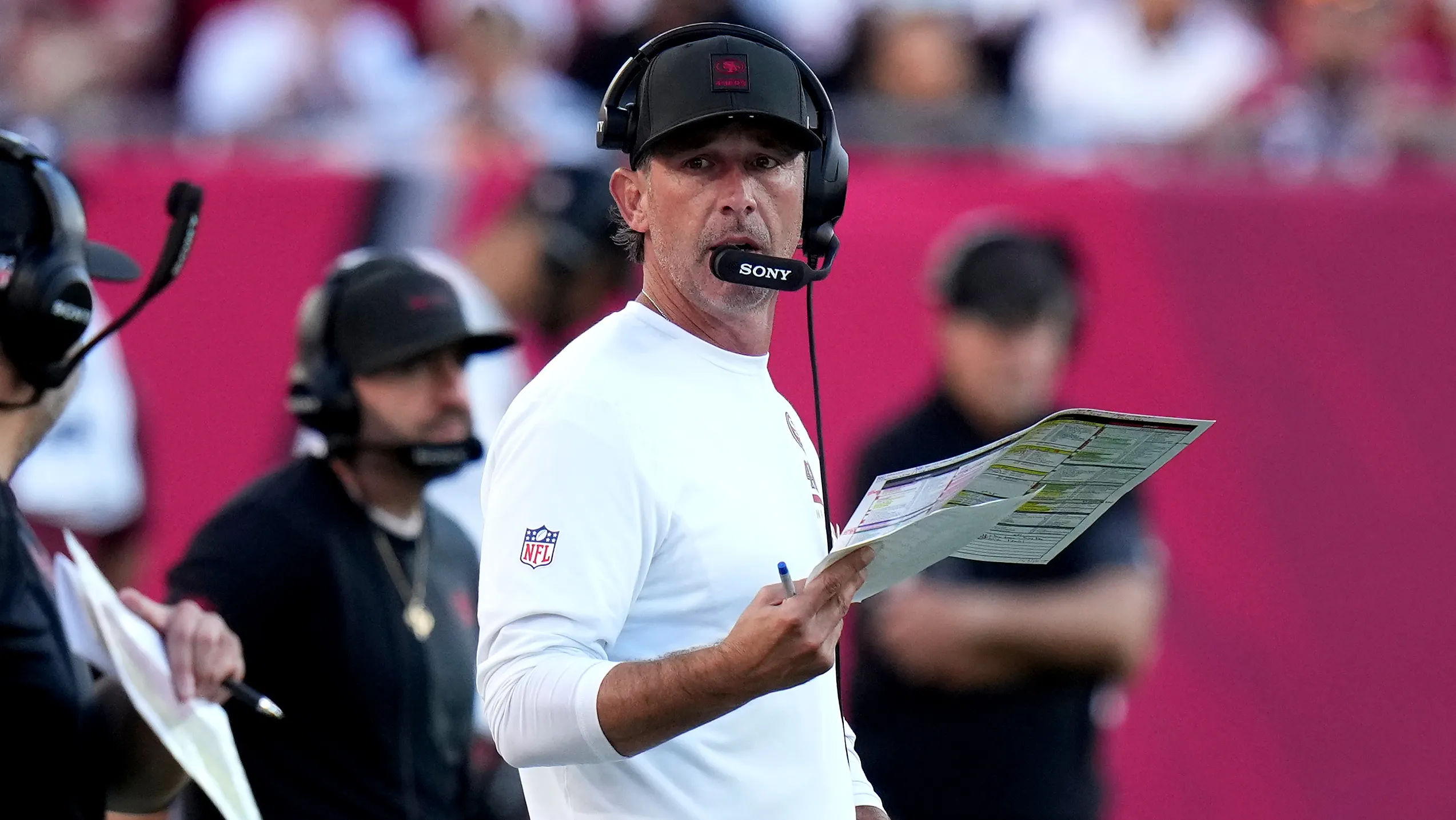
Kyle Shanahan is a man whose professional life is defined by meticulous planning, razor-sharp focus, and an almost obsessive attention to every conceivable variable on the football field. As the head coach of the San Francisco 49ers, he is tasked with anticipating the unpredictable, scripting every play, and executing complex strategies under immense public pressure. Yet, on a quiet, seemingly ordinary summer afternoon on July 14, the carefully constructed illusion of complete control evaporated in a single, devastating fraction of a second. Driving down a local road at a relatively modest speed of twenty miles per hour—a pace that feels deceptively safe compared to the high-velocity collisions he witnesses every Sunday on the gridiron—Shanahan made a simple, painfully human mistake that nearly cost him his life. His cell phone, a modern anchor of constant connectivity and professional demands, slipped from its console and fell into the narrow gap between the front seats of his vehicle. It is a mundane, everyday annoyance that almost every modern driver has experienced, a fleeting moment of inconvenience where the impulse to quickly retrieve the device overrides our survival instincts and situational awareness. Looking down to locate the fallen phone, he took his eyes off the asphalt for only a brief moment, but in the unforgiving realm of vehicular kinetics, a moment is all it takes to shift the boundaries of safety. When his eyes snapped back up to the windshield, the margin for error had already vanished; his vehicle had drifted over the dividing line and directly into the path of an oncoming SUV. The ensuing impact was a sudden, violent symphony of crumpling metal, shattering glass, and deploying airbags, instantly transforming a routine errand into a life-altering crisis of survival. It serves as a stark, visceral reminder that no matter how organized, successful, or powerful an individual may be, a single moment of distraction can immediately level the playing field of human vulnerability, leaving us entirely exposed to the harsh and unpredictable realities of our own fallibility on the open road.
When the dust finally settled and the emergency responders cleared the wreckage of the two-car crash, a bureaucratic anomaly threatened to obscure the true narrative of the collision and shift the burden of blame away from the coach. A clerical error within the official California Highway Patrol database erroneously attributed the cause of the accident to the innocent female driver of the SUV, a mistake that could have easily remained uncorrected in the eyes of the public. In a professional sports culture often dominated by highly polished public relations machines designed to shield famous figures from scrutiny, legal fallout, and reputational damage, Shanahan chose a path of radical honesty and profound humility. Rather than allowing the administrative error to stand as a convenient shield for his public image, he proactively summoned the team’s beat reporters directly into his office on a Monday morning to set the record straight and publicly assume complete responsibility. He did not couch his explanation in evasive corporate speak, nor did he attempt to downplay his personal culpability; instead, he openly admitted that he was the sole cause of the crash and had violated the law by attempting to retrieve and operate his cell phone while driving. Although the local police had not issued a formal traffic citation in the immediate, chaotic wake of the accident, Shanahan refused to let an innocent bystander bear even a temporary stain on her driving record or peace of mind. By pulling back the curtain on his own negligence, he demonstrated a level of mature accountability that is increasingly rare in the glaring spotlight of professional sports. His public confession was not merely about correcting a mistake on a police report; it was a deeply human recognition of the moral duty we owe to our fellow citizens, proving that true leadership is defined not by flawless execution, but by the courage to stand up, look the world in the eye, and say, “I made a terrible mistake, and I am the one who must answer for it.”
The physical consequences of this split-second distraction were immediate, severe, and painfully visible across Shanahan’s entire body, utterly stripping away the aura of invincibility often associated with elite professional sports figures. Although initial media reports of the crash tended to downplay the wreckage by focusing primarily on the miraculous news that the female driver of the SUV had escaped without physical injury, the reality of Shanahan’s own trauma was a gruesome, visceral testament to the violent forces at play when vehicles collide. The head coach sustained a fractured hand, a broken nose, several cracked, agonizingly painful ribs, and a severe concussion that scrambled his cognitive equilibrium, leaving him profoundly physically limited at the start of the 49ers’ critical training camp. The most alarming and visually shocking aspect of his trauma lay deeply etched across his face, where a jagged laceration required forty delicate, painful stitches to close and preserve his features. The sheer gravity of what transpired behind closed doors was laid bare by Chris Simms, a close personal friend of Shanahan and former NFL quarterback, who recounted his sheer horror and disbelief upon viewing raw photographs sent to him by Shanahan’s wife, Mandy, shortly after the crash. These images revealed a jarring landscape of open facial wounds and severe swelling that looked more like the aftermath of a catastrophic combat zone than a low-speed automotive mishap. Simms, visibly shaken as he discussed the incident on national television, pointed directly to his own forehead to illustrate the massive, imposing scale of the scar, revealing the terrifying reality that his close friend had come within mere millimeters of permanently losing his right eye. This intense physical devastation serves as an undeniable reality check, stripping away the glamorous, untouchable veneer of an NFL mastermind and exposing a vulnerable human being who was nearly blinded, permanently disfigured, and deeply broken by a simple, everyday lapse of attention.
Beyond the visible wounds, the mending bones, and the structural damage to his skull, the most challenging battle Shanahan now faces is the silent, invisible struggle raging within his mind and spirit. Managing a severe concussion is an agonizingly slow, non-linear process, particularly for an individual whose entire career and daily identity depend on high-intensity cognitive processing, rapid decision-making, and relentless mental focus. General Manager John Lynch confirmed that the head coach has been placed in a recovery protocol akin to the strict systems designed to protect active players, forcing a man famous for his twenty-four-hour work ethic to slow down, limit his sensory exposure, and sit quietly in the dark with his thoughts. This forced stillness has brought with it an overwhelming wave of emotional processing that has left the normally stoic coach deeply shaken and vulnerable. In his personal conversations with loved ones and trusted confidants like Simms, Shanahan has been noticeably emotional, grappling with the agonizing realization of how close his family came to an absolute, irreversible tragedy. He has had to look his wife and children in the eye and process the haunting “what-ifs” of an accident that could have easily left them grieving or caring for a permanently disabled husband and father. Furthermore, this emotional weight is profoundly compounded by his ongoing empathy and concern for the other driver involved in the crash; despite his own physical suffering and the overwhelming pressure of his job, Shanahan’s thoughts have remained anchored to her well-being, demonstrating a compassionate concern for how she is coping with the psychological trauma of a sudden head-on collision. It is this internal reckoning—the quiet, difficult processing of guilt, survival, and profound gratitude—that truly humanizes his recovery, showing that the deepest, most difficult scars are often those that cannot be bound by forty stitches or captured in a photograph.
In the hyper-competitive, high-stakes ecosystem of the National Football League, where training camp is viewed as a sacred period of preparation and every minute of a coach’s absence is heavily scrutinized, Shanahan’s physical limitations have forced a radical shift in the 49ers’ daily operations and organizational dynamics. To allow their leader the necessary time and space required to heal his battered brain and body, the entire franchise has rallied around him, demonstrating the profound strength of their internal culture and support systems. Assistant head coach Chris Foerster has stepped forward to manage the active, day-to-day on-field coaching duties of training camp, serving as the steady, reliable hand at the helm while Shanahan operates on a highly restricted, supervised basis behind the scenes. For a coach who has built his entire reputation on hands-on control, obsessive attention to detail, and personally calling his own offensive plays, the act of stepping back and delegating authority is a profound exercise in vulnerability and trust. It requires admitting that he cannot do it all, that his body has hit a hard, biological limit, and that his personal recovery must take absolute precedence over the immediate demands of the playbook and game tape. The unwavering support of the front office, championed by General Manager John Lynch, highlights a progressive and empathetic approach to NFL leadership that values human well-being over raw athletic output, recognizing that a fully recovered, healthy human being is far more valuable to the organization’s long-term success than a coach trying to grind through a traumatic brain injury. This temporary transition of power is active proof that personal crises do not have to break a community, but can instead serve as a powerful catalyst for collective strength, trust-building, and mutual support in the face of unexpected adversity.
Looking forward, the immediate future brings both an extraordinary logistical challenge and a symbolic fresh start for the franchise, as the San Francisco 49ers prepare to kick off their regular season against the divisional rival Los Angeles Rams on September 10. This highly anticipated matchup carries historic weight, marking the first-ever NFL game to be played on the pristine shores of Australia, a massive milestone that reflects the league’s global expansion and the grand, international stage upon which these athletes and coaches operate. Yet, as the team prepares to cross the globe for this historic kickoff, the true journey for Kyle Shanahan will be measured not in the thousands of miles flown across the Pacific Ocean, but in the small, deliberate, and painful steps of daily physical and mental rehabilitation. The healing tissues on his face, the mending bones in his hand and chest, and the quiet, sobering lessons of his close brush with death will accompany him halfway across the world, serving as a permanent, intimate map of a summer he will never forget. Ultimately, his story transcends the boundaries of sports talk and sports journalism to become a universal cautionary tale about the perils of distracted driving and the breathtaking fragility of our everyday existence. It stands as an urgent, highly relatable reminder to all of us that the thin line between safety and disaster is easily severed by a single look at a cell phone screen, and that acknowledging our mistakes with honesty, transparency, and grace is the first step toward genuine healing. As Shanahan continues his journey back to full health and guides his team onto the field in Australia, his vulnerability offers others a profound lesson in accountability, reminding us all that we must actively protect the lives of those around us on the road, and that sometimes, merely surviving our worst mistakes is the greatest victory of all.