


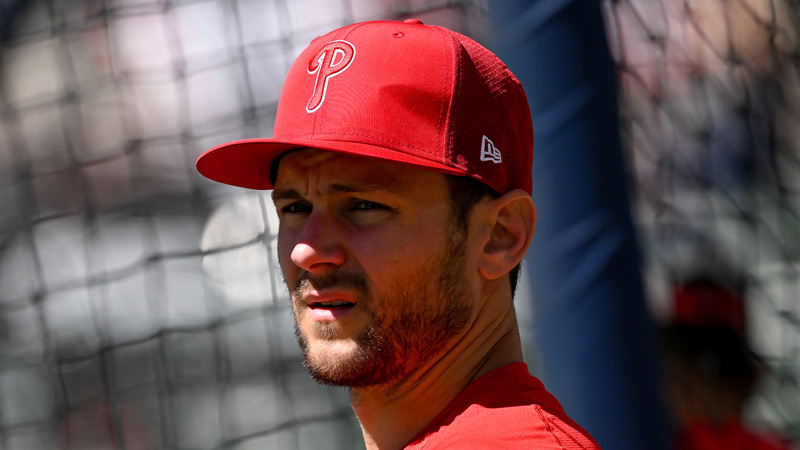
For Trea Turner, the 2026 season was supposed to be just another chapter in a career defined by elite speed, impeccable bat-to-ball skill, and the kind of athletic confidence that made him one of the most exciting players in baseball. Instead, it became the most unsettling year of his professional life, and the Philadelphia Phillies are no longer willing to soften the message. Phillies president of baseball operations Dave Dombrowski stood at a podium at Citizens Bank Park on Thursday morning and delivered a blunt assessment that made headlines: Turner knows he has to be better at shortstop, and if he wants to keep playing the position, it is not a suggestion but a mandate. “We were very clear. He knows he has to be better at shortstop. And I told him that it’s really mandatory that he’s like that,” Dombrowski said, per MLB.com. For a player of Turner’s caliber, hearing those words must sting, but they also capture the reality of a franchise with championship expectations and little patience for decline. There is no hiding from the numbers, no way to spin a season that, by Turner’s standards, was arguably the worst of his entire major league career. The Phillies did not sign him to be an average player. They signed him to be a difference-maker, and in 2026, he was not. The moment calls for both accountability and empathy, because Turner is not a lazy player or an unwilling one; he is a great athlete suddenly confronting the cruel math of age and performance.
Nowhere was that decline more alarming than in the field. Turner posted minus-17 defensive runs saved at shortstop this season, a number that is as ugly as it sounds, and it marked the third time in his four years with the Phillies that he has finished with a negative, double-digit defensive runs saved total. For a team built around pitching and up-the-middle defense, that kind of glovework is a liability, not just in isolated moments but in the aggregate pressure it places on the entire staff. Dombrowski did not dance around the issue. “He feels he can play, and if he plays shortstop like he did in ’25, he can play shortstop. But if he plays it like he did in ’26, he can’t. And he totally understands that.” The contrast between 2025 and 2026 is striking. Last season, Turner looked like the MVP-caliber force the Phillies thought they were getting, leading the National League with a .304 batting average and posting 5.4 wins above replacement. This season, he looked like a player fighting himself, often late on fastballs, hesitant in the field, and uncharacteristically unsure. Defensive metrics can be noisy, but when a player’s range shrinks and his errors multiply, the eye test agrees with the numbers. Shortstop is not just a position in Philadelphia; it is the anchor of a defense that has to support a rotation featuring some of the game’s most ground-ball-heavy arms. When the anchor slips, everything shifts. To hear Dombrowski say those words publicly is rare, especially for a front office executive who usually protects his players. But this is also a front office that just watched its team stumble to a 9-19 start, fire a beloved manager, and then scrape its way into the playoffs only to be eliminated in the Wild Card Series. The patience in Philadelphia is wearing thin, and Dombrowski is not going to pretend otherwise.
Turner’s offensive numbers told the same sad story. He finished the 2026 season with 19 home runs, 58 RBIs, and 21 stolen bases, but those surface stats hide a deeper collapse. His batting average was .242, his on-base percentage was .297, and his slugging percentage was .378. His OPS+ was 81, meaning he was 19 percent below league average, and he finished at minus-0.1 wins above replacement, which essentially means a replacement-level player could have provided the same overall value. For a two-time batting champion and three-time All-Star, those are career worsts across the board, not just in one isolated category but in nearly every meaningful offensive metric. The most human part of this story is that Dombrowski admitted he did not see it coming. “The reason we signed him at the beginning compared to some others, not only was he a good player, but we thought that he had the ability to continue to be a good player for a longer time period because of his quick-twitch muscles, the type of athlete he is, what he possesses,” Dombrowski said. “I mean, he led the league in hitting last year, so I was surprised myself on the offensive year that he had and that we weren’t able to get out of it, as he was, so it’s up to us to try to fix all those types of things.” There is something vulnerable in Dombrowski’s honesty, a recognition that even the best evaluations can fail and that baseball is a game of unpredictability. For Turner, the struggle is likely as much mental as physical. When a player has spent his entire career relying on athleticism, losing just a half-step can change everything: timing swings, beating out infield hits, covering ground in the hole. The confidence that made him a star quietly erodes with every ground ball that gets past him and every fastball he fouls off. The front office says they have already given Turner some information they think could be helpful, which suggests a plan is in place. But plans only work if the player can still execute them.
The elephant in the room, of course, is the contract. Turner is four years into an 11-year, $300 million deal, and at 33 years old, he is no longer in the prime of his career. There are still seven years left on that commitment, which makes him not just a player but a massive financial investment. That is why Dombrowski’s comments carry so much weight: he is not threatening to release Turner or bench him indefinitely, but he is drawing a line. If Turner cannot play shortstop at an acceptable level, he must be willing to move. “We’ve already given him some information ourselves that we think could be helpful. … We need to leave it that he is very willing to do, if he doesn’t play shortstop, what is best for the Philadelphia Phillies organization. So, that’s how we left it with him, and he’s determined to show us that he can play it. And I said, ‘You have to show it. You cannot play shortstop like you did defensively in ’26, going into ’27.'” The history suggests Turner could adapt. He primarily played second base for the Los Angeles Dodgers down the stretch of the 2021 season and has made 79 career starts at the keystone. He even started 44 games in center field for the Washington Nationals back in 2016. But aside from serving as the designated hitter, he has not played a position other than shortstop since 2021. Asking a player to change positions at this stage of his career is not easy, especially for someone who clearly still sees himself as a shortstop. There is a certain pride in being the guy who anchors the infield, the one who makes the spectacular play look routine. Dombrowski’s message, though, is clear: pride cannot get in the way of winning. Turner may be determined to prove he can still play shortstop, and perhaps he will. But he also seems mature enough to understand that the organization comes first, and that if his body no longer allows him to play the position the way it demands, he will have to accept a new role.
Turner’s personal battle is happening against the backdrop of a larger organizational shakeup in Philadelphia. The Phillies named interim manager Don Mattingly their full-time skipper on a two-year deal Wednesday, a move that was hardly surprising after the team’s late-season surge. Mattingly, who had been the bench coach, was promoted after manager Rob Thomson was fired in the wake of the team’s disastrous 9-19 start. Philadelphia went 79-55 under Mattingly, which was enough to right the ship and reach the postseason, but not enough to make a deep run. The Phillies lost in three games to the Atlanta Braves in the MLB Wild Card Series, and for a franchise that has not advanced past the National League Division Series since 2023, that is simply not good enough. Mattingly’s promotion signals stability, but it also signals urgency. He is a respected baseball lifer with a calm demeanor, but he is not a miracle worker. He needs his best players to perform like best players, and Turner is near the top of that list. The front office has made it clear that this team is in win-now mode, and every decision, from the manager hire to the message to Turner, reflects that urgency. There is a sense in Philadelphia that the window is still open but not forever. The starting pitching remains formidable, the lineup has dangerous hitters, and the fan base is ravenous for a championship. But a team cannot claim to be a serious contender if its shortstop is costing runs on defense and providing below-average offense. Mattingly will have to manage this delicate situation, balancing support for Turner with the accountability demanded by Dombrowski. That is a tough spot for any manager, but Mattingly has been around long enough to know that honesty and trust are the only currencies that matter in the clubhouse.
So now the ball is in Turner’s court, as it should be. The next several months will be about more than just offseason workouts and spring training at-bats. They will be about proving that 2026 was an aberration, not a decline. Dombrowski’s words were harsh, but they were also a challenge rooted in belief: the Phillies still think Turner has something left, or they would not be bothering to lay out the requirements so explicitly. Turner is determined to show them he can still play shortstop, and that determination is exactly what a team wants to see. But if he cannot, the organization has already signaled that he is willing to do what is best for the Phillies, even if that means moving to second base, center field, or a more flexible role. That kind of acceptance does not come easily for a player of his stature. It requires humility, self-awareness, and a love of the game that goes beyond individual glory. At 33, with seven years left on a historic contract, Turner is at a crossroads that will define the final act of his career. He can either reclaim his place as one of the game’s premier shortstops, or he can evolve into a different kind of valuable player. Either way, the Phillies need him, and he needs them. The story is not over; it is just entering its most honest and perhaps most human chapter. Baseball has never been kind to aging stars, but the ones who find a way to adapt, to listen when the front office is blunt, and to fight for every remaining ounce of their talent, are the ones who leave the most lasting legacy. For Trea Turner, 2027 is not just another season. It is a chance to answer the doubters, including the man standing in front of the microphone at Citizens Bank Park, and to prove that he still has greatness left in him.