


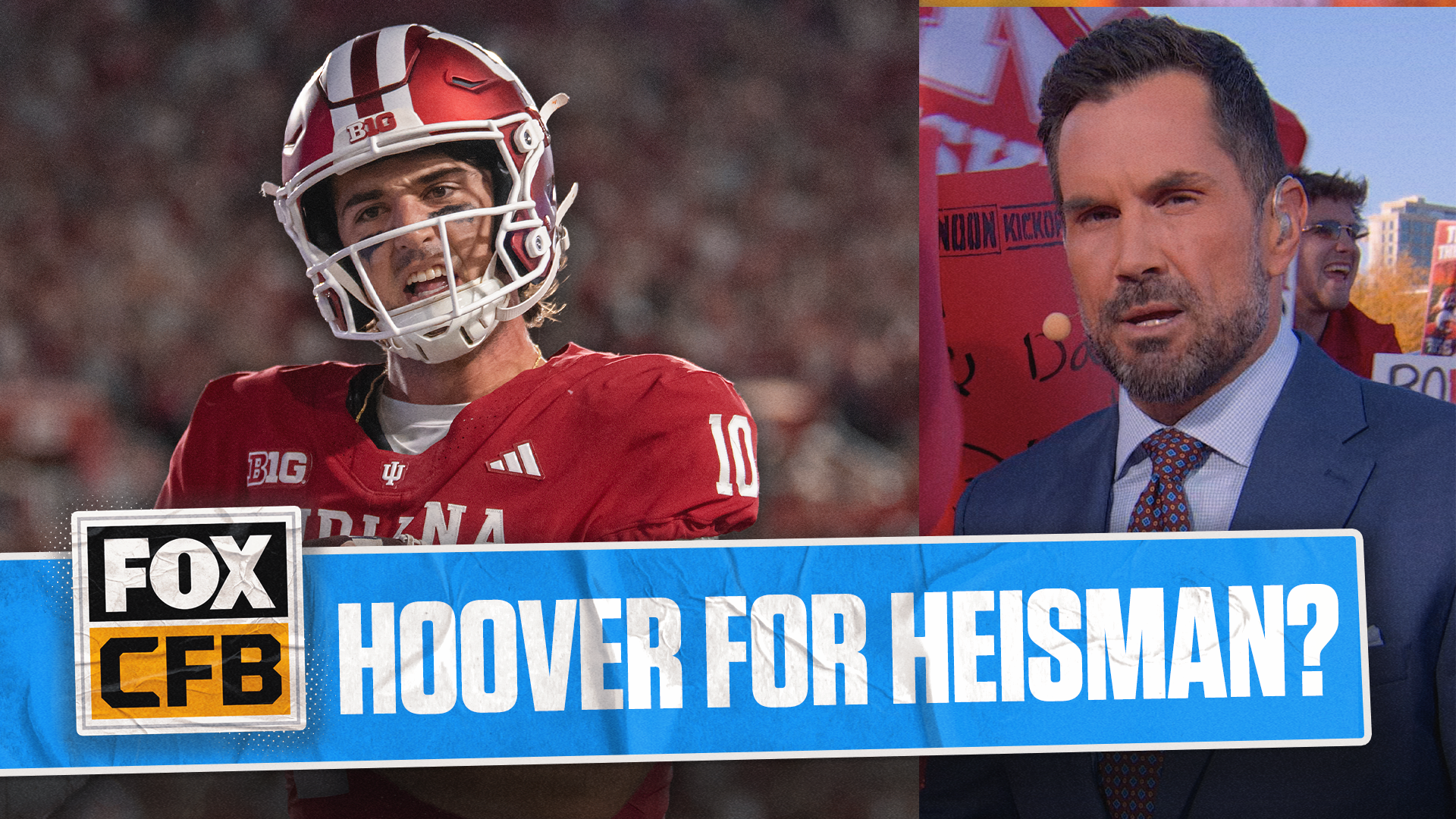
College football has a strange way of allowing brilliance to hide in plain sight. For five weeks, Indiana quarterback Josh Hoover has been precisely that: brilliant, efficient, unflappable, and yet somehow not a major topic in Heisman Trophy conversations. The Hoosiers have won 21 consecutive games, and Hoover has been the steady hand guiding an offense that rarely stumbles. But because Indiana isn’t a traditional blue-blood program, and because Hoover didn’t arrive in Bloomington with a five-star recruiting profile or a massive preseason hype machine behind him, his name has been absent from the headlines he deserves. The numbers scream. The wins scream. The poise screams. Yet the buzz has been whisper-quiet. Matt Leinart, a former Heisman-winning quarterback, decided that needed to change. On Saturday’s edition of “Big Noon Kickoff,” Leinart called out the situation with the kind of directness that often comes from someone who has been in the quarterback spotlight and knows exactly how hard it is to play the position at an elite level. “No one’s talked about Josh Hoover,” Leinart said. “Fernando Mendoza came out of nowhere last year toward the second half of the season [for Indiana]. Hoover’s got better stats than Mendoza, hasn’t turned the football over and is a really talented player.” He continued: “He’s got a chance with this schedule, starting today [against Nebraska] and then Ohio State next week in the Big Ten to make a run at this thing [the Heisman Trophy].” For Hoover, that public affirmation from a respected quarterback voice is significant. It might be the exact moment the broader college football world starts paying attention to a player who has been quietly doing everything right.
Through Indiana’s first five games, Hoover has established himself not just as a game manager but as one of the most productive passers in the country. His line is almost comically clean: 1,101 passing yards, 15 touchdown passes, zero interceptions. He has completed 71 percent of his throws and posted a passer rating of 203.7, a figure that would make most video game quarterbacks blush. Both his touchdown total and passer rating lead the Big Ten, and he has done it while protecting the football with near-perfect discipline. That kind of efficiency is not an accident. It is the product of preparation, good decision-making, and a deep understanding of the offense. The Hoosiers as a team have been equally formidable. Indiana ranks second in the Big Ten in rushing yards per game at 252.6, third in total yards per game at 489.6, third in scoring at 44.2 points per game, and eleventh in passing yards at 237.0 per contest. Those numbers tell a larger story: this is a balanced and dangerous offense, one that can run the ball down a defense’s throat but also strike over the top when the moment calls for it. Hoover is not being asked to do everything by himself; the running game is powerful. But at every critical juncture, he has delivered. The zero-interception statistic is especially remarkable given the thin margin for error in Big Ten football. Quarterbacks who throw the ball frequently are going to test defenses, and yet Hoover has shown the kind of patience and accuracy that keeps possessions alive and puts the defense under constant pressure. There is something almost unassuming about how he operates. He doesn’t force throws into double coverage. He takes what the defense gives him, and then he takes a little more. He moves within the pocket with a calmness that inspires confidence in his teammates, and when a play breaks down, he finds a way to extend it rather than give away the football. His 15 touchdowns to zero interceptions is not just a statistical snapshot; it is a statement about his maturity, his vision, and his understanding of the moment.
To understand how Hoover arrived at this point, you have to trace his journey. He spent four seasons at TCU, including three as the starting quarterback. From 2023 through 2025, he averaged 3,209 passing yards, 23.7 touchdowns, and 11 interceptions per season, with a 147.8 passer rating and a 65.1 percent completion rate. Those are solid numbers, but they don’t immediately scream “Heisman front-runner.” They do, however, show a quarterback who has been battle-tested, who has seen every coverage imaginable, and who has learned from both success and failure. The 11 interceptions per season, in particular, may have been the greatest catalyst for growth. At TCU, Hoover took risks. Sometimes they paid off. Sometimes they didn’t. Now, at Indiana, he seems to have finally found the perfect balance between aggression and control. That is where the Fernando Mendoza comparison becomes so important. Mendoza came to Indiana before last season and, as Leinart put it, emerged as the season progressed. He led the Hoosiers to a perfect 16-0 record, their first national championship in program history, and put up enormous numbers along the way: 3,535 passing yards, 41 touchdown passes, only six interceptions, a 182.9 passer rating, and a 72 percent completion rate. He also rushed for 276 yards and seven scores. That performance won Mendoza the 2025 Heisman Trophy and made him the No. 1 overall pick in the 2026 NFL Draft, selected by the Las Vegas Raiders. Hoover is stepping into the exact same system, with the exact same expectations, and through five games, he has actually been more efficient from a scoring standpoint: 15 touchdowns in five games, with fewer mistakes. The torch has been passed, but the standard has not dropped. That alone is no small featable, especially for a fifth-year senior who chose to leave the comfort of a familiar system and take on the challenge of following a Heisman winner.
Now, the real test begins. The college football world loves legitimacy, and nothing grants it like a tough schedule. Indiana’s first five games may have built a foundation, but the next two weeks could define Hoover’s Heisman candidacy. First comes Nebraska, an undefeated opponent with a defense that will try to force the kind of mistakes Hoover has avoided all season. Then comes Ohio State, a matchup that, in college football terms, carries national weight and captures the attention of voters and casual fans alike. For Hoover, these games represent both an opportunity and a risk. If he crumbles against elite competition, the beautiful stats will be dismissed as a product of easy early scheduling. If he thrives, if he throws for multiple touchdowns without turning the ball over against the Buckeyes, there will be no way to deny his legitimacy. Leinart sees that possibility clearly. “I think he’s exceeded expectations so far,” Leinart said. “Obviously, the schedule picks up starting today and next week, and then in the second half of the season. But I just want to say this: I think it’s time to start putting some respect on Josh Hoover’s name. He’s one of the best players in the country.” The quote captures the central tension of Heisman season. Statistical dominance needs a stage to become iconic. Hoover has been dominant. Now he has a stage. If he responds the way he has responded to everything else this year, the conversation will shift from “why isn’t he in the mix?” to “why wasn’t he the obvious choice from the start?” The second half of Indiana’s season also includes enough tests to keep him in the conversation, but the point is that the chance is right in front of him. He doesn’t need to be perfect in every moment; he just needs to be Josh Hoover, the same version of himself he has been all season: careful with the ball, aggressive when necessary, and completely unbothered by the pressure.
Beyond the stats and the schedule, there is a human story here that makes Hoover’s success compelling. He is a fifth-year senior, a quarterback who has seen the highs and lows of college football. He could have stayed at TCU, where he had a comfortable job and a familiar system, but he chose to transfer to Indiana, a program that was coming off a national championship but had lost its Heisman-winning quarterback to the NFL Draft. Stepping into the shadow of Fernando Mendoza could have been overwhelming. It would have been easy for Hoover to try to channel Mendoza’s heroics, to press for every big play and turn the ball over in the process. Instead, he has played with a kind of freedom that only comes from experience. There is a difference between a young quarterback who is merely talented and an older quarterback who understands how to manage a game. Hoover belongs to the second category. He has been sacked, he has been chased, he has thrown interceptions in his career, and he has learned from all of it. Now he is playing with a calm confidence that permeates the entire offense. His teammates can see it; when the pocket gets muddy, he doesn’t panic. When the first read isn’t there, he doesn’t heave the ball into traffic. He simply finds the next answer, progresses to the next read, and more often than not, that leads to a positive play. This is the kind of quarterbacking that wins championships and makes people believe in something bigger than raw statistics. Yet because Hoover doesn’t have the name recognition of some of the sport’s biggest stars, he has had to earn his respect piece by piece. That is exactly what Leinart is trying to speed up. He sees a player with an arm strong enough to make any throw, a mind sharp enough to avoid mistakes, and a schedule with enough marquee matchups to finally force the nation to pay attention.
Nothing about what Hoover has done so far is a guarantee of future success. Nebraska and Ohio State present real challenges, and every big stage brings the possibility of failure. But the way sports culture works, a player is often only one great performance away from becoming a household name. Hoover is standing at that threshold. The 21-game winning streak, the 15-to-zero touchdown-to-interception ratio, the passer rating that leads the Big Ten—all of it has set the table. What remains is the proof against the best opponents on the schedule, and if Hoover delivers, the Heisman narrative will take care of itself. The award has always favored players who combine statistics with memorable moments, and Hoover now has a chance to create plenty of them. He doesn’t have to put the offense entirely on his shoulders; Indiana’s running game gives him support whenever he needs it. But at the moments when the game is on the line, he has shown he can be the difference. That is what the Heisman Trophy ultimately asks for: a player whose impact on the sport cannot be ignored. Josh Hoover has been ignored for too long. Matt Leinart put it bluntly: it’s time to start putting some respect on his name. If Hoover keeps doing what he has been doing, that respect will come. It will come after Nebraska and Ohio State, after the trophy ceremonies and the highlight reels, after the nation finally stops looking past Bloomington and realizes that the quiet, efficient quarterback wearing Indiana’s uniform is one of the best players in the entire country. The stage is set. The spotlight is about to find him. The only question is whether Josh Hoover will be ready—and so far, he has been ready for everything.