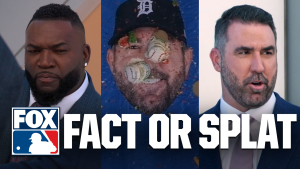






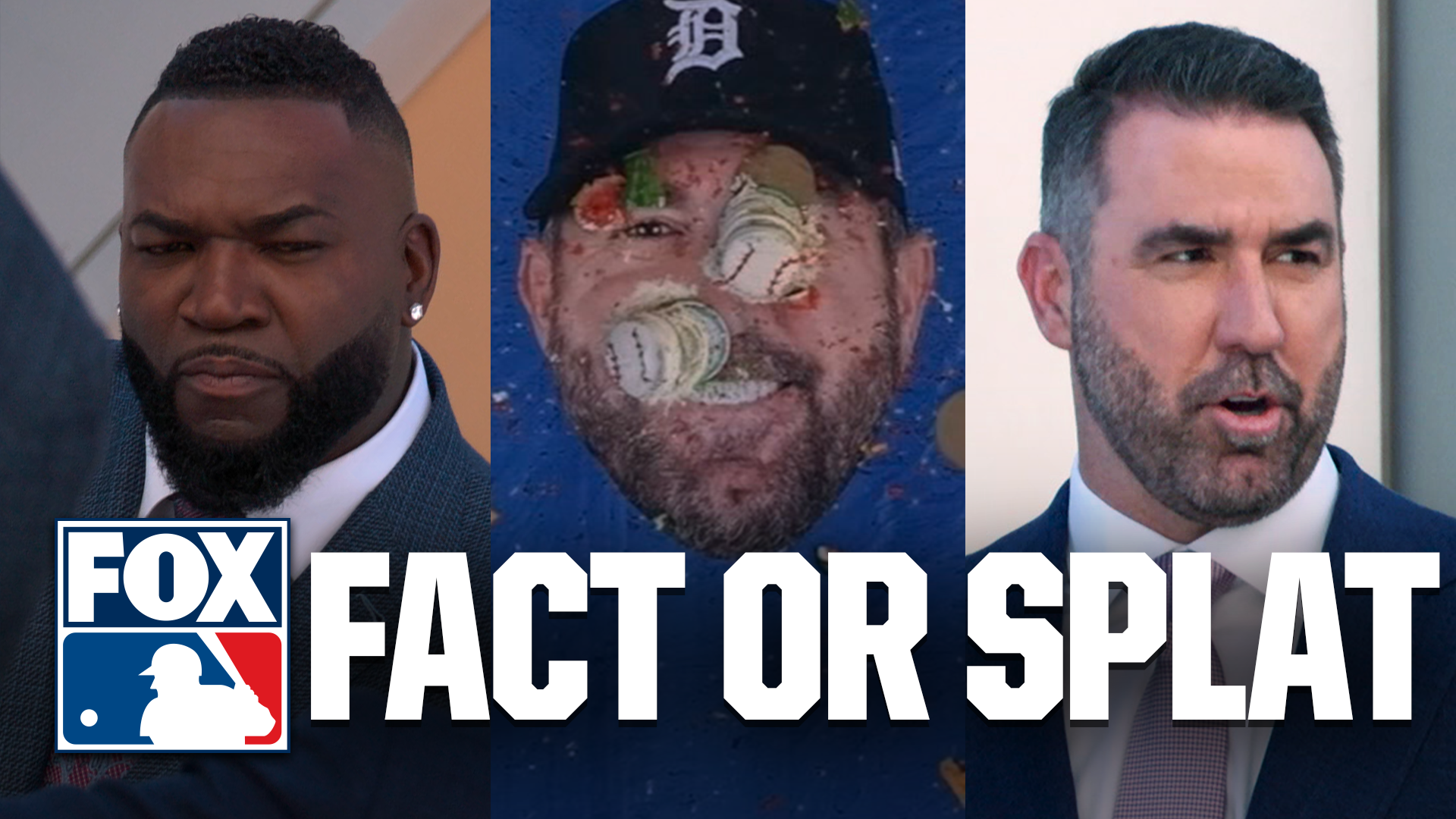
Some numbers are too big to fit in a scorebook. David Ortiz and Justin Verlander have spent a combined 3,088 games in the major leagues, appeared in 20 All-Star Games, and collected five World Series rings between them. They have lived through no-hitters, walk-off home runs, wild clubhouse celebrations, and the quiet, grinding days of a 162-game season. They have seen baseball from every angle, and they have the scars, stories, and smiles to prove it. So when Derek Jeter and Alex Rodriguez invited them to play a silly little game called Fact or Splat, the setup was simple: answer a question about your own career correctly, and you get to drop a piece of fruit onto a giant cutout of the other guy’s face. Answer wrong, and the other guy gets to do the dropping. The whole thing sounded like a party game, and maybe it was. But for four men who have spent their lives being measured by batting averages, ERAs, and October legends, it was also a chance to be human. The cutouts were big, the fruit was messy, and the memories were the real prize. There was no pressure, no cameras catching a bad at-bat, no scoreboard telling them they had failed. Just laughter, old friends, and the kind of playful competition that reminds you why baseball people are so easy to love.
The first question belonged to Ortiz, and Jeter was kind enough to offer a hint. Big Papi’s first home run at Fenway Park came off a pitcher who was “in the family.” For a moment, the hint hung in the air, but Ortiz’s face lit up almost instantly. He knew the answer was Ramon Martinez, the former Dominican right-hander, and he said it with the same confidence he used to carry into the batter’s box with the game on the line. The cake came crashing down onto Verlander’s face, and the game was officially underway. Then it was Verlander’s turn. Jeter asked him to name the first strikeout victim of his entire career. The recently retired right-hander did not hesitate. “Travis Hafner,” he said, quick as a fastball. It was a great answer, even if his aim was not. His fruit toss barely grazed Ortiz’s face, drawing groans and laughter from the room. But the moment was about more than accuracy. Every great career starts somewhere, and these firsts are tiny time capsules. For Ortiz, that first Fenway home run was an early sign that he would become a legend in that ballpark. For Verlander, that first strikeout was the smallest beginning of a career that would produce thousands of them, along with Cy Young Awards, no-hitters, and World Series moments. It was the kind of trivia that sounds small but actually means everything.
The second round was less kind to Ortiz. He played 20 years in the big leagues, 14 of them in Boston, so naming his longest-tenured teammate should have been a layup. The correct answer was Dustin Pedroia, the scrappy second baseman with the huge heart and the dirt-stained uniform. Ortiz, however, guessed Tim Wakefield, the beloved knuckleballer who kept hitters guessing for years. It was not a terrible guess. Wakefield was a constant presence in Boston, a pitcher who threw a pitch nobody could really explain and a teammate everyone adored. But it was wrong, and Verlander made him pay. His second toss was a direct hit, sending fruit splattering across Big Papi’s face. Verlander was on a roll. The next question asked which of Jeter, A-Rod, and Ortiz had the best batting average against Verlander. He looked around the room, weighed his options, and said, “I’m going to go with Derek.” He was right, and a pumpkin came crashing down on Ortiz’s face. Jeter, ever the captain, accepted the compliment with a modest smile. The moment was pure baseball theater. There was no animosity, no sore feelings, only the easy banter of men who have been through the same battles and come out the other side. Even Ortiz, covered in fruit and laughing, seemed to enjoy it. That is the thing about legends: they know that the game is serious, but they also know that the best moments are often the ones where everyone can laugh at themselves.
Then came the question that gave Ortiz his sweetest revenge. Jeter and A-Rod asked him to name the three World Series MVPs from his title teams. Ortiz did not need time. “Manny Ramirez, Mikey Lowell, and myself,” he said, and with that, cake fell onto Verlander’s face. There was a little extra joy in that answer. Ortiz had been the heart of Boston’s championship revival, the man who helped break the curse and turn the Red Sox into a team that believed in impossible comebacks. Ramirez was the brilliant, volatile slugger who could carry a franchise on his back. Lowell was the steady third baseman who did a little bit of everything and became a fan favorite in Boston. And Ortiz was the October monster, the hitter every pitcher feared in the biggest moments. Naming those three was not just a trivia exercise. It was a reminder of a golden era in Red Sox history and of the bond between teammates who went through something extraordinary together. Verlander, to his credit, took the splat with good humor. He had been on the other side of those October moments, watching Ortiz do damage against the best pitchers in the world. Losing that round was almost an honor. It meant he had been part of baseball history too, even when history was happening to him.
The toughest test of the day belonged to Verlander, and it showed just how ridiculously decorated his career has been. He was asked to name eight teammates who had won the Cy Young Award. He started confidently, rattling off Max Scherzer, Rick Porcello, Tarik Skubal, and Gerrit Cole. But Skubal came with a generous hint from A-Rod, and the final four names would not come. The ones he missed were Dallas Keuchel, Zack Greinke, David Price, and Robbie Ray. Each of those pitchers won a Cy Young, and each at some point shared a clubhouse with Verlander. On one hand, it was a surprising miss for a man known for his memory and preparation. On the other hand, it was a testament to the sheer number of elite arms that have passed through his teams. Very few pitchers can say they played alongside eight Cy Young winners. Verlander can, even if he could not recall all of them in the moment. The segment was a perfect illustration of how baseball careers are so long and full that even the greatest players lose track of their own history. It also gave Jeter and A-Rod the chance to tease him, and Verlander, ever competitive, took the ribbing with a grin. These are the moments that make fans feel connected to the game, because they show that the heroes we admire are not infallible machines. They are people who forget things, laugh at themselves, and keep going.
When the game finally ended, the cutouts were covered in cake and pumpkin, and the four legends were laughing like they had just come off the field after a spring training game. Nobody kept track of the final score, because the score was never the point. Fact or Splat was a silly game with a simple purpose: to get two great players to remember the moments that made them great, and to let the rest of us watch. Ortiz and Verlander have given baseball fans so much, from Ortiz’s walk-off heroics to Verlander’s electric no-hitters and World Series performances. Seeing them stumble over a few trivia questions made them more human, not less. It was a reminder that even the greatest players are just people who have lived full lives, with names and moments that blur together after a while. Jeter and A-Rod were perfect hosts, playful and knowing, the kind of former stars who understand exactly how to draw the best out of their friends. In the end, the real winner was anyone watching. The fruit flew, the cake splattered, and the stories came alive. That is the best kind of baseball content, not because it is polished, but because it is real. The game may have been silly, but the bond it revealed was absolutely genuine.