





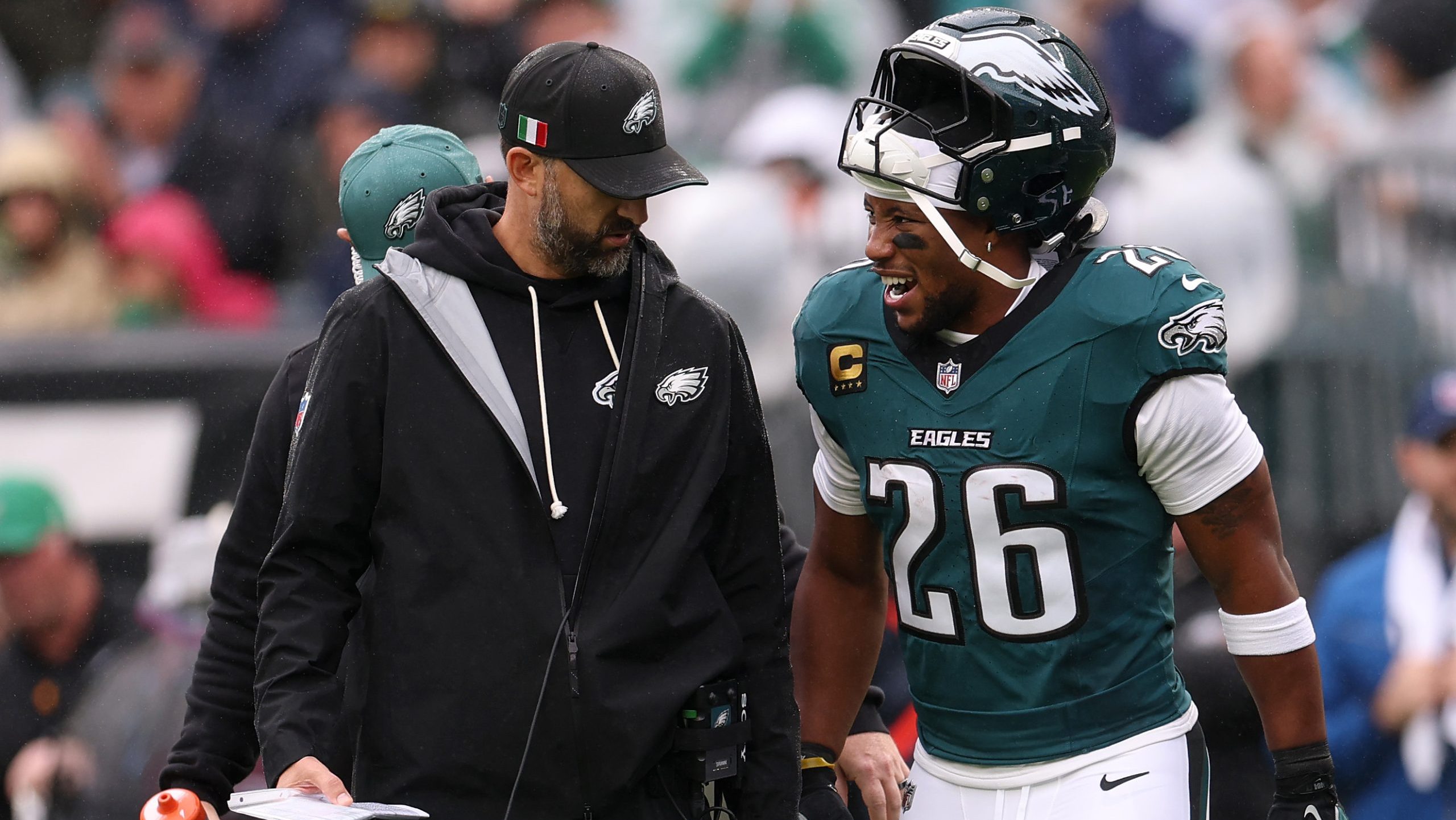
The Philadelphia Eagles have entered a defining stretch of their season, one that will test not just their talent but their resilience and depth in ways no one expected so early. After a heartbreaking 24-20 loss to the Los Angeles Rams on Sunday, the team’s biggest concern has shifted from X’s and O’s to the status of their star running back, Saquon Barkley. According to NFL Network, Barkley is considered week-to-week with a hamstring injury, a label that sounds reassuring and unsettling at the same time. It means the injury is not considered long-term, but it also means no one can say with certainty when he will be back. The hamstring is a cruel muscle for a running back, because it is the engine of everything he does—his explosive acceleration, his ability to make tacklers miss, his sudden sharp cuts that turn a short gain into a long touchdown. For Barkley, who has spent the early part of this season reminding the league how powerful and dynamic he can be, this injury is both a physical obstacle and an emotional gut punch. He was just beginning to feel fully like himself again, carrying the offense with 174 yards on 34 carries over the first three games, an average of over five yards per carry. Then, in the blink of an eye, it all stopped. Barkley left the Rams game after just two carries for eight yards, watching the rest of the contest from the sideline as his team fought valiantly but ultimately came up short. There is a loneliness in being injured on a football field, especially when you know your team needed you, and the days that follow are often a blur of treatment, ice baths, and quiet frustration.
Head coach Nick Sirianni addressed the situation on Monday with a tone of cautious optimism, but he would not commit to whether Barkley could play in London against the Jacksonville Jaguars. “I know he’ll do everything he can do to get himself back,” Sirianni said, a statement that speaks to the unwavering work ethic Barkley has shown throughout his career. The coach’s words are a comfort to fans who want to believe their star will somehow find a way onto the field, but they also reveal the reality of the situation: this decision is out of anyone’s control but the body’s. Barkley will spend the coming days in a relentless cycle of stretching, treatment, rehab, and testing. There will be moments where he feels close to ready, followed by moments of hesitation that remind him how fragile these things can be. The last thing anyone wants is for him to rush back and make the injury worse; a hamstring strain that doesn’t heal properly can linger for months and rob a player of his burst. But there is also the quieter battle of being sidelined while your teammates board a plane for a pivotal international game. For a competitor like Barkley, that might be the hardest part. He has rebuilt his career on perseverance, from his early days as a college phenom to the ups and downs of professional football, and this is just another challenge in that long and complicated journey. The Eagles are scheduled to face the Jaguars in a London showdown, a game with all the added weirdness of travel, time zones, and unfamiliar surroundings. If Barkley is unable to go, the team will need someone else to carry the load, and everyone knows that the offense simply looks different without him in the backfield.
The running back room has been hit even harder by the news that Tank Bigsby is reportedly heading to injured reserve. Bigsby, who has been the primary backup to Barkley, suffered an injury late in the Rams game that turned out to be more serious than initially thought. It now appears he will need core muscle surgery, a procedure expected to take place at the famed Vincera Institute in Philadelphia, a facility recognized across the sports world for its expertise in treating complex core injuries and sports hernias. The hope is that Bigsby can return in six weeks or less, but in the fast-moving world of an NFL season, six weeks can feel like an eternity. This leaves Will Shipley as the lone healthy running back on the active roster, a situation that no one anticipated when the season began. Shipley, a rookie with a reputation for hard work and high football intelligence, is suddenly being thrust into the spotlight in a way that can be daunting for a young player. But it is also the kind of opportunity that defines careers. Behind him, the Eagles have a handful of options on the practice squad: Dameon Pierce, who has starting experience in the NFL and a physical running style; Carson Steele, a bruising back who can grind out tough yards; and Jaydon Blue, a younger player with speed and potential. The front office will have to make difficult decisions about who to elevate, who to keep in reserve, and how to construct a game plan without the two top backs who were expected to lead the ground game. For Bigsby, this setback is especially painful because he had been carving out a meaningful role for himself, earning the trust of coaches and showing flashes of the powerful running style that made him a promising draft pick. Watching another season get interrupted by injury is never easy, and the road back will require patience, discipline, and the kind of support system that every player needs during difficult times.
As if the running back situation were not challenging enough, the offensive line is dealing with its own wave of adversity. Cam Jurgens, who had recently moved from center to left guard to compensate for the loss of Landon Dickerson, is now in the concussion protocol. It was reported that Jurgens self-reported symptoms on Monday morning, a decision that speaks to the culture of awareness and responsibility that the league has worked hard to build around head injuries. His status is unclear, and his absence leaves what was already a patchwork offensive line with even more uncertainty. Dickerson, of course, is already on injured reserve with a knee injury, meaning the team has now lost two key interior linemen in the span of a few weeks. For an offense that prides itself on physicality and balance, this is an enormous challenge. Offensive line play is built on continuity, trust, and the ability to communicate in the split-second before the ball is snapped. When new players are inserted, especially ones who are learning new positions on the fly, the entire rhythm of the offense can be disrupted. This is not just about protecting the quarterback; it is about creating running lanes, picking up blitzes, and winning the battle in the trenches that decides most NFL games. The Eagles’ coaching staff, led by offensive line coach Jeff Stoutland, has a well-earned reputation for getting the most out of his players, but even the best coaching cannot fully replicate the instinctive chemistry that comes from a group of five linemen playing together for years. Yet there is a sense of pride in stepping up when your team needs you, and the next man up mentality has long been a hallmark of successful organizations. Players who have spent months working quietly behind the scenes, waiting for their chance, will now be called upon to perform under the bright lights of an international game. For them, this is the opportunity of a lifetime, and the Eagles will need every ounce of their effort.
Saquon Barkley’s numbers so far this season tell the story of a player who is still capable of being one of the most dangerous running backs in the NFL. Through the first three games, he had carried the ball 34 times for 174 yards, a statistical output that placed him among the league leaders and gave the Eagles a reliable foundation for their offense. His performance against the Rams, though brief, was a reminder that he is more than just a stat sheet; he is the kind of player whose presence alone changes how opposing defenses prepare. The two carries he managed before exiting the game were only a taste of what might have been, and one cannot help but wonder how the outcome might have changed if he had been able to stay healthy. But the NFL offers no such luxury of dwelling on what-ifs. The focus now is on recovery and the long-term picture. A week-to-week designation gives the Eagles flexibility; it allows them to keep Barkley on the roster and avoid the mandatory four-week absence that comes with injured reserve, but it also creates a temptation to push him back too quickly. The smart play is always caution. Barkley has been through this before; he knows how easily a hamstring injury can turn from a minor annoyance into a recurring nightmare. He will likely spend his days in the training room, doing everything from gentle stretching to strength exercises designed to test the integrity of the muscle. He will watch film, stay engaged with his teammates, and prepare mentally as if he is going to play, because that is how competitors approach their craft. But even he cannot speed up the biological process of healing. The Eagles will need to make a decision based on what is best for the team and for the player, and that decision will not be easy. There is a reason why so many teams choose to rest players with hamstring injuries even when they say they feel close to 100 percent; the risk of re-injury is just too high.
As the Eagles prepare to travel to London for their game against the Jacksonville Jaguars, there is an undeniable sense that the season has reached a crossroads. This is not the time for panic, but it is a time for introspection and resolve. Football, at its core, is a game of adversity, and the teams that survive the grind are often the ones that have learned how to adapt. The Eagles have a roster filled with players who have been counted out before, men who have fought their way onto the team against long odds and are ready to answer the call when their number is announced. Will Shipley will get his chance to prove what he can do, and perhaps the practice squad will provide an unexpected hero. The offensive line will find a way to block, even if the names on the jerseys are not the ones fans expected. The coaching staff will adjust the game plan, emphasizing short passes, quick decisions, and a more conservative running attack. There will be mistakes and frustrations, but there will also be moments of inspiration—the kind that remind you why this sport is so beloved. Saquon Barkley’s presence will still be felt, whether he is on the field or standing on the sideline in the cool London night, cheering for the teammates who are carrying the torch in his absence. And when he is finally healthy, he will return to a team that is stronger for having survived these tests. The road ahead is difficult, but the Eagles are not alone in facing it. They have the support of a city that knows something about resilience, a coach who believes in his players, and a locker room full of men who understand that football is never about one person. It is about all of them, together, pushing through the pain and uncertainty until the light at the end of the tunnel becomes visible. That is the essence of the sport, and it is exactly what this team will need in the weeks to come.