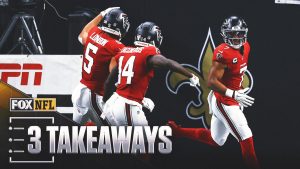






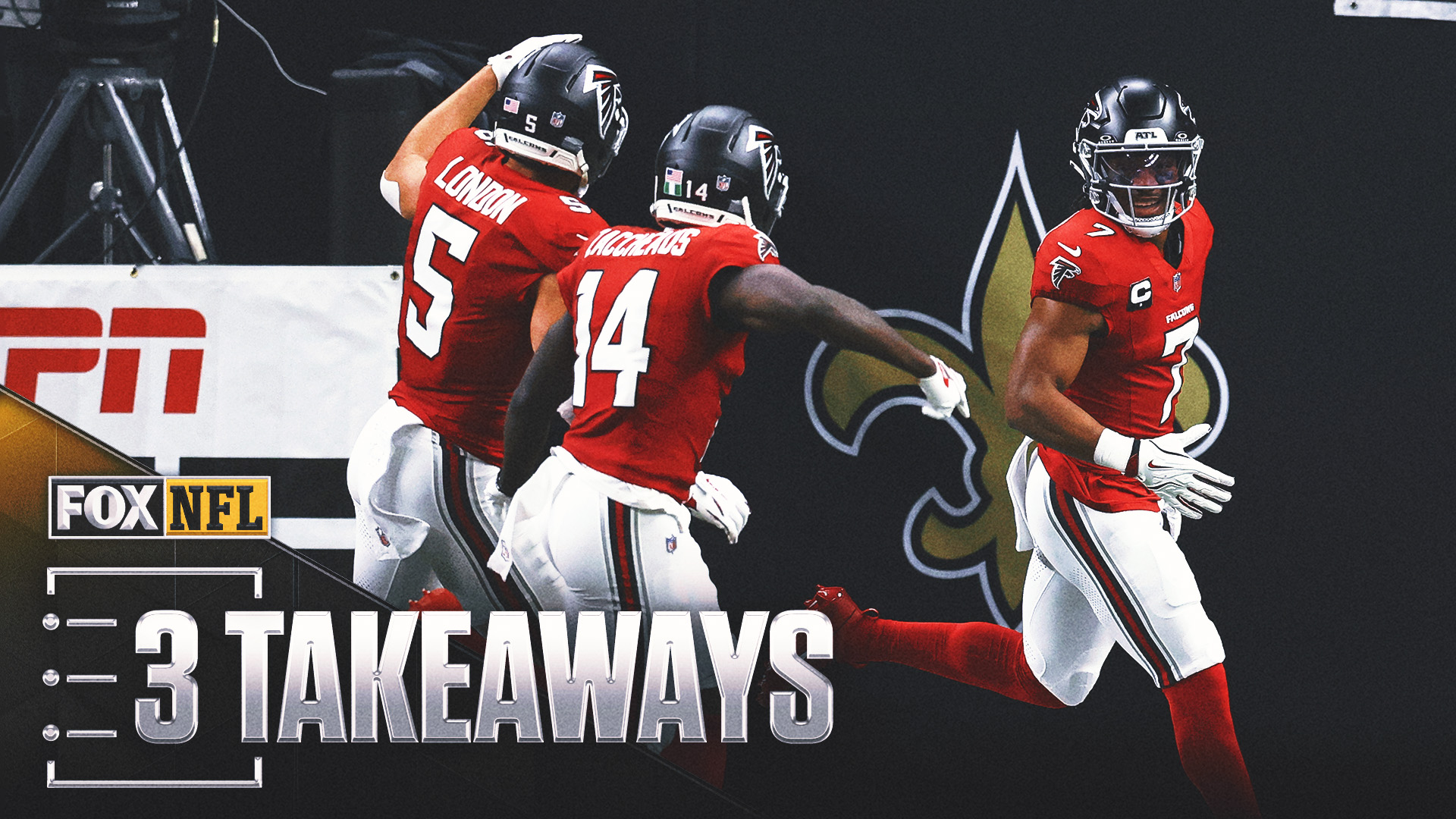
On a Monday night inside the loud, sweaty Superdome, the Atlanta Falcons did something they haven’t done in years: they made a statement without ever letting their foot off the gas. The 45-24 win over the New Orleans Saints was more than just a victory—it was a declaration of identity. After opening the season with two ugly losses while backup Cooper Rush tried to hold down the quarterback position, the Falcons have suddenly, spectacularly, righted the ship. They’re now 2-2, but more importantly, they’re 2-0 with Michael Penix Jr. as their starting quarterback. For the second straight week, Penix looked like a seasoned veteran under the primetime lights, and the entire team played with the kind of confidence that had been missing for what felt like forever. The old Falcons would have found a way to make this game close, would have let the Saints hang around and then invented some heartbreaking way to lose. These Falcons, with Penix at the wheel, didn’t just win; they buried a division rival on their own turf. There’s something different about the way they carry themselves now. Penix isn’t just putting up numbers—he’s bringing a calm, competitive energy to the huddle, and his teammates are feeding off it. It’s the kind of performance that makes you think the franchise might have finally found its quarterback, its offensive rhythm, and its collective nerve all at the same time. And while the season is still young, the feeling around this team is unmistakable: they no longer look like a team waiting for something bad to happen. They look like a team that believes it can dictate how the game unfolds.
The most striking part of this turnaround isn’t just the two straight wins, though those are obviously huge. It’s the way the Falcons have been winning, especially on the road. For the previous six seasons, Atlanta couldn’t buy a road victory by twenty or more points. Not one. And then, in the span of eleven days, they did it twice: first with a 34-10 demolition of the Packers at Lambeau Field, and then Monday night with an equally impressive rout of the Saints in New Orleans. That’s not a coincidence. That’s a pattern, and it’s the kind of pattern that can change the identity of an entire organization. The offense has been humming with Penix at the controls. He was remarkably efficient against Green Bay, completing 18 of 25 passes for 256 yards, and he followed that up against the Saints with 15 of 20 for 223 yards and a touchdown. His passer rating over those two games is a career-best 127.7, and he’s doing all of this while every defense he faces is doing everything possible to stop Bijan Robinson. That’s the beauty of this offense right now: Robinson is the focal point, the star, the guy opponents build their game plan around, but Penix is making them pay for it. He’s reading defenses, taking the easy completions, and occasionally pushing the ball downfield to keep defenses honest. Credit also has to go to offensive coordinator Tommy Rees, who came to Atlanta alongside Kevin Stefanski and has been entrusted with the play-calling. Rees is using both Robinson backs in creative ways—Bijan Robinson and Brian Robinson, who scored three touchdowns of his own on Monday—and the rotation is keeping the running game fresh late into games. The result is an offense that can separate from opponents, something the Falcons simply couldn’t do in recent years. Now the schedule gets tougher, with home games against Baltimore, Chicago, and San Francisco, three teams that entered Week 4 with a combined 10-2 record. The NFC South is still up for grabs, but the Falcons have shown that they’re not just hoping to compete. They’re showing up ready to take control.
Now let’s talk about the team on the other side of that blowout, because the Saints are in a genuinely confusing and painful place. If you just looked at their offensive numbers, you’d think they should be a playoff team. Despite missing first-round wide receiver Jordyn Tyson to injury, New Orleans ranks in the top ten in both scoring and total yardage. And yet they are 1-3, stuck in a hole that they keep digging for themselves with terrible starts. In four games, the Saints have trailed by double digits three times. They fell behind 21-0 to the Lions and lost by one point. They were down 14-3 to the Ravens in their only win. They trailed 13-6 to the Raiders in a close loss. And then Monday night, they gave the Falcons a 24-7 head start and never recovered. That’s not a team that’s getting unlucky; that’s a team with a serious execution problem in the opening quarter. The offense eventually puts up numbers, but by the time it gets going, the game is already slipping away. The defense is also struggling to give the offense a chance, and the injuries aren’t helping. New Orleans missed Travis Etienne against Atlanta, and he’s expected to miss at least three more games with a hamstring injury. Without him, the Saints lose balance and explosiveness in the running game. The Falcons, meanwhile, have Bijan Robinson, and that difference was glaring in the first half, when Atlanta outrushed New Orleans 138-15. When you’re behind by multiple scores that early, you become predictable, you abandon the run completely, and you end up looking like a much less dangerous offense than you really are. The Saints have talent, but they’re wasting it with slow starts, and the clock is ticking on a season that’s already dangerously close to slipping away.
If there’s any silver lining for the Saints, it’s that their offensive production suggests the pieces are there to make a run. But the defense is a different story, and that’s where the problems become impossible to ignore. Through the first three games, New Orleans was allowing 27 points per game, and Monday night didn’t do anything to lower that average. The Falcons put up 45, and honestly, the game felt even more one-sided than the score indicates. The Saints are a bottom-ten defense against the run and on third downs, which is a brutal combination in today’s NFL. If you can’t stop teams from running the ball, and you can’t get off the field on third down, you’re going to spend your entire afternoon watching the other team control the tempo and the clock. It’s demoralizing, and it puts enormous pressure on the offense to play perfect football just to stay competitive. The defense was supposed to be a strength for New Orleans, but right now, it looks tired, disorganized, and vulnerable. When the offense does manage to score, the defense gives that momentum right back. When the defense forces a stop, it’s on a third down that happened after ten plays of sustained pressure. The Saints can’t keep living like this, especially with Travis Etienne out. Without a reliable running back to help control the game, the offense has to throw the ball on nearly every second-half possession, which inflates the stats but doesn’t change the outcome. The reality is that New Orleans has to find a way to start faster on both sides of the ball, or their season will be over before Thanksgiving. The talent is there, but talent doesn’t mean much if you’re always playing from behind and your defense can’t make a defining stop when you need it.
For Atlanta, the concerns are different, but they are just as real, and they might ultimately decide whether this promising start turns into something lasting or fades away. The biggest issue is the pass rush. Going into the season, there were real fears that losing Jalon Walker for the year and having James Pearce suspended for eight games would wreck the defense’s ability to pressure the quarterback. After finishing second in the NFL with 57 sacks last season, the Falcons needed someone to step up and fill that void. So far, that just hasn’t happened. Through four games, Atlanta has only seven sacks, which puts them on pace for roughly half of last season’s total. Za’Darius Smith, who came out of retirement to help, has been a bright spot with 2.5 sacks, but he left Monday’s game with a concussion, and his immediate future is uncertain. If he misses time, the pass rush becomes an even bigger problem. The consequence of all this is a defense that has forced only two takeaways in four games, tied for the lowest mark in the NFL. You can’t go from a 57-sack team to a seven-sack team and expect the same kind of chaos and short fields. Opposing quarterbacks have too much time to sit in the pocket, and that means every drive feels like a potential scoring drive. That is a scary thought with the next three opponents on the schedule—Baltimore, Chicago, and San Francisco are all capable of exploiting a defense that can’t rush the passer. James Pearce might eventually provide a boost in the second half of the season, but right now, the Falcons need immediate answers. Without a real pass rush, they are just a good offensive team, and in the NFL, being just a good offensive team is rarely enough to make a deep run.
So where do things stand now? Both teams are at a crossroads, but they’re staring at very different versions of the same problem. The Falcons have shown that they can be explosive, balanced, and composed, particularly with Michael Penix Jr. leading the way. They’ve also shown that their defense can be exposed when the pass rush isn’t getting home, and the next few weeks will test whether they can find a way to manufacture pressure without sacrificing coverage. The Saints, meanwhile, have shown that they can score, but only after they’ve already put themselves in a hole, and their defense is currently too porous to keep them in games. The NFC South is wide open, and nobody is running away with it. The Panthers, who beat the Falcons in Week 2 before Penix became the starter, are also at 2-2, and the whole division feels like it’s waiting for someone to grab it by the throat. For Falcons fans, this is a season of hope, a chance to believe that the painful years of near-misses and late collapses are finally behind them. For Saints fans, it’s a season of frustration, watching a team with real offensive talent waste opportunity after opportunity because it can’t get out of its own way. Football is unpredictable, and October has a way of revealing what teams are truly made of. But after Monday night, one thing is certain: the Falcons no longer look like a team that’s just happy to be competitive. They look like a team that expects to win, and in this league, that expectation often becomes the difference between staying ordinary and becoming something more.