


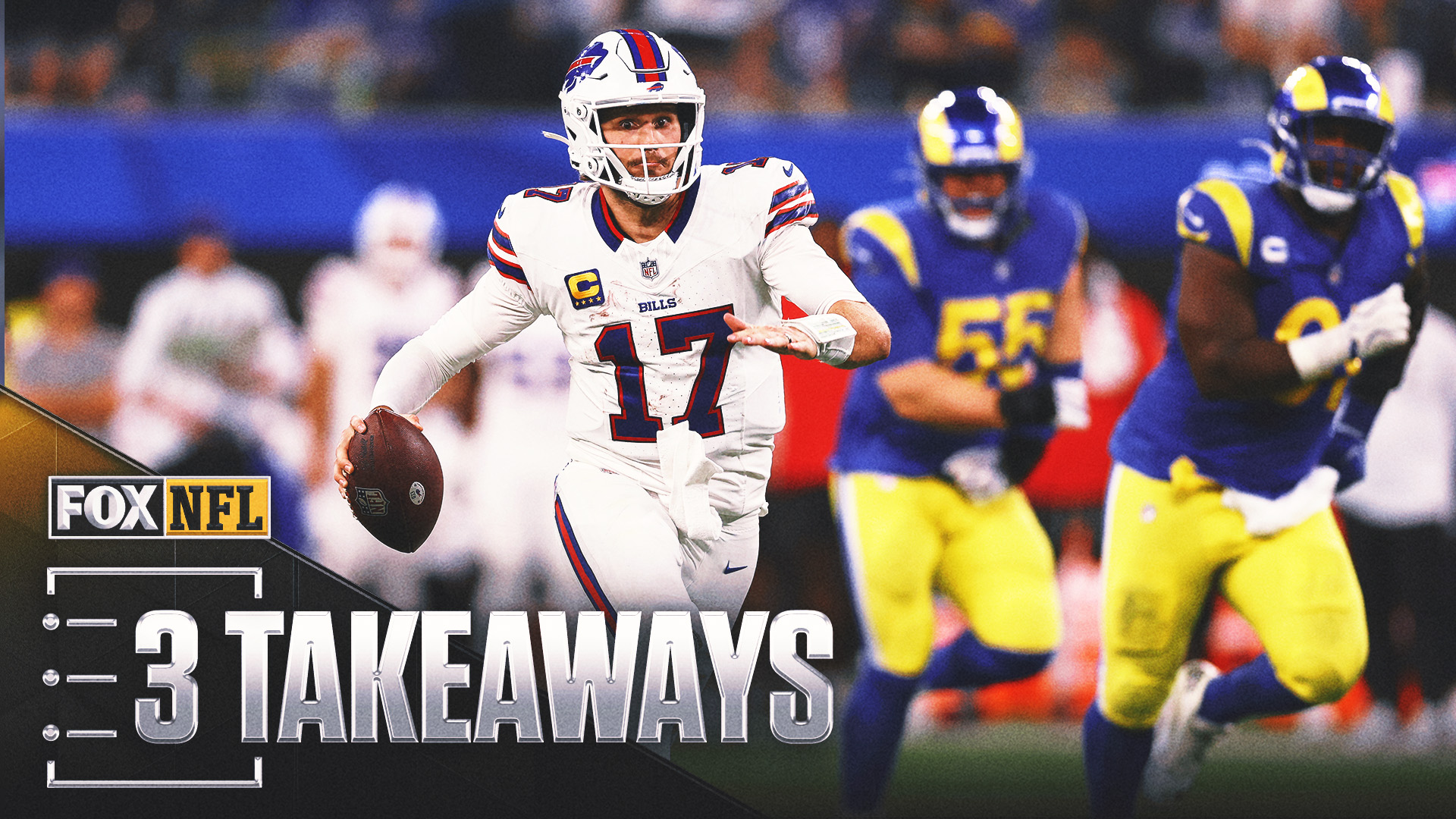
The night air above Inglewood crackled with something beyond the usual Monday Night Football electricity. Two MVPs stood under the bright lights of SoFi Stadium, each leading a franchise with legitimate Super Bowl dreams, and the football world settled in for what was being called a preview of February’s biggest game. But previews rarely capture the chaos of the actual performance, and this one spun out into a five-quarter, penalty-ridden, heart-stopping marathon that ended with Josh Allen finally exorcising a personal demon. The Buffalo Bills walked off the field with a 37-34 overtime victory, a win that pushed them to a stellar 4-1 record, but more importantly, it gave Allen his very first overtime win as a professional. Zero and seven had been his overtime record heading into the night, a statistic that had become a nagging, unfair asterisk on an otherwise brilliant career. There would be no such footnote this time, only the image of a quarterback on his knees at midfield, absorbing the weight of a monkey that had finally been lifted from his back, while Matthew Stafford and the Los Angeles Rams walked into the tunnel with the crushing reality of a 2-3 record and a season that is rapidly slipping through their fingers.
The Bills walked into SoFi without their security blanket at receiver. DJ Moore was ruled out with a shoulder injury, and Joshua Palmer was unavailable for the same reason, leaving Allen to look toward Khalil Shakir and rookie Keon Coleman to stretch the field. For most of the night, neither produced the kind of separation that would allow the offense to function conventionally. But when the game hung in the balance, Allen simply decided that the passing game was a suggestion rather than a requirement. He became the offense. With a game-high 121 rushing yards and a touchdown on the ground, to go along with 210 yards through the air, Allen transformed himself into a one-man wrecking crew, a human highlight reel of broken tackles and desperate gain after desperate gain. On the critical final drive in overtime, he ripped off back-to-back runs totaling 32 yards, dragging defenders with him and demonstrating a will that simply refused to be denied. This was not the elegant, air-it-out offense Buffalo has sometimes showcased; it was a gritty, visceral display of determination. He had help, though. James Cook was the workhorse the Bills needed, grinding out 111 yards and two touchdowns on 25 punishing carries, giving Buffalo just enough balance to keep the Rams’ defense honest while Allen did his damage on the edges and through the creases of a tired front seven.
But to call this game beautiful would be a stretch. What transpired at SoFi was about as sloppy as it was thrilling, an ugly, thrilling, combustible mess of football that featured 24 combined penalties and a kicking game in absolute shambles. The Rams’ special teams unit, a group that has been a recurring nightmare all season, found new and creative ways to sabotage their own efforts. Harrison Mevis, the Rams’ kicker, had a 50-yard attempt clank off the upright earlier in the contest, and then, in the most agonizing moment of the evening, watched as his 48-yard game-winning attempt in overtime was swallowed up by the Bills’ defensive line, blocked and returned, ending the game in sudden, brutal fashion. Mevis, now a shaky 5-for-9 on the season, wasn’t the only culprit on his team. A 70-yard return on the opening kickoff immediately gifted the Bills points and set a tone of special teams dread that Los Angeles never fully escaped. The Bills were guilty of their own mistakes, committing 13 penalties and seeing kicker Tyler Bass miss a crucial extra point that could have been the difference in regulation. Allen also continued an unwanted streak, throwing an interception for a third consecutive game—this one to Jaylen Watson, a player the Rams had just acquired—proving that even in victory, Buffalo left a trail of self-inflicted wounds that will surely be focus points at practice this week.
Amidst the chaos, no player on the field shined brighter for the Rams than Puka Nacua, who delivered the kind of performance that makes you wonder if he is secretly a video game creation. Nacua hauled in a career-high 17 catches on 21 targets, racking up 138 receiving yards and a touchdown, serving as Stafford’s oxygen, his escape hatch, and his security blanket all at once. Sean McVay made it a point to get his star involved in every conceivable way—jet sweeps, bubble screens, downfield slants—anything to put the ball in the hands of his most dangerous weapon. And yet, with the game on the line in overtime, with a third-and-five from the Buffalo 30 and the season hanging by a thread, McVay inexplicably chose to hand the ball to Kyren Williams up the middle, who was stuffed for no gain. The decision forced the kicking team onto the field and set up the block that sealed the Rams’ fate. Stafford, for his part, was magnificent in defeat, completing 40 of 54 passes for 383 yards and three touchdowns without an interception, finishing with a passer rating of 111.9. But his efforts were undercut by the Rams’ inability to run the football—they managed just 77 rushing yards total, with Williams averaging barely three yards per carry—forcing the offense to become entirely one-dimensional and predictable in the final moments.
Look beyond the box score and the game takes on a more profound meaning for both franchises. For Buffalo, this win is the kind of character-building victory that championship campaigns are forged from. They were on the road, against a tough opponent, missing key weapons, playing poorly in spurts, and facing a quarterback in Stafford who seemed determined to steal the game. Yet they found a way to win, powered by their transcendent leader and a running game that showed the team’s offensive identity is far more versatile than most gave them credit for. Allen’s ability to win ugly, to rely on his legs, and to carry the offense while his receivers struggled, sends a chilling message to the rest of the AFC. For the Rams, however, the loss is a bitter pill that exposes the fragility of their season. At 2-3, with a defense that has been consistently inconsistent all year and a special teams unit that has become an unmitigated disaster, the margins for error have evaporated entirely. The “Super Bowl preview” narrative that dominated the pre-game discussion now feels like a cruel joke, as Los Angeles looks less like a contender and more like a team fighting to stay afloat in a vastly improved NFC West.
Looking ahead, the immediate future offers no time to sulk. The Rams limp home to SoFi Stadium to face the Arizona Cardinals on a short week—a team they are fully expected to beat, making the matchup a trap game in the worst way. It’s a game that has “must-win” written all over it, as another loss would drop Los Angeles to 2-4 in a division where every game is a firefight. For the Bills, the West Coast swing continues with a trip to Las Vegas to take on the Raiders, a team that is mired in their own struggles, having lost two straight. Buffalo would do well to remember the lessons of this game, knowing that championships are often won not in the clean, highlight-reel moments, but in the messy, penalty-laden, overtime battles where pure will can overcome tactical errors. Monday night was not a masterpiece—it was a grind, a gut-check, a beautiful disaster. In the end, it was the Bills who walked away with the win, the confidence, and the belief that no matter how ugly it gets, they have the ultimate weapon on their side: Josh Allen, a man who refuses to lose, even when the football gods seem to be conspiring against him. For the fans in Buffalo, nights like this are why they believe. For the Rams, the questions are mounting, and the answers on the schedule ahead are growing rapidly more daunting. But that’s the NFL—a league where one night can define a season, and Monday night belonged to the Bills.