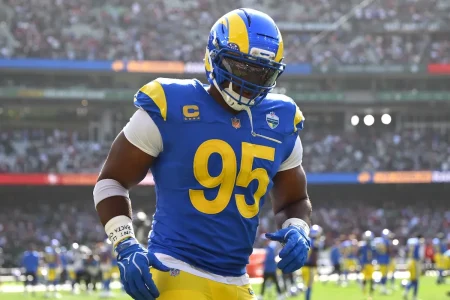


The memory still burns in Jared Verse’s mind, a crisp, unsettling replay that disrupts his focus even days after the final whistle. It wasn’t the scoreboard in Pittsburgh that stayed with him, nor the sting of a divisional loss that tightened the AFC North race—it was the flash of a single second during a routine extra-point attempt, a moment that felt less like football and more like an ambush. He had leaped, trying to get a hand on Chris Boswell’s kick, when Steelers guard Mason McCormick launched his body into Verse’s legs, cutting him down with a violent, unnecessary force that sent the young defensive end crashing toward the turf on his neck and shoulders. The yellow flag fluttered to the ground, but the physical impact was only the beginning of the wound. As he lay there, momentarily disoriented, the world tilted sideways, and a cold dread crept into his chest—the terrible realization that his body, his livelihood, and the very trajectory of his life had been inches away from catastrophic change. This wasn’t just a hard play; it was a deliberate demolition, and the fear that followed wasn’t about pride or bruised ego, but about pure survival. The thoughts raced through his mind like a frantic pulse: what if he had landed perfectly on the crown of his helmet? What about his family, his future, the millions of dollars invested in his athletic prime? The moment crystallized an anger that transcended the physical pain—it was the cruel awareness that in a split second, an opponent had tried to take everything from him without a trace of remorse, and that the game he loved could turn on him in a heartbeat.
Yet, the most agonizing part of that memory isn’t the hit itself; it’s the silence that followed. As Verse struggled to regain his footing, his eyes scanned the huddle, the sideline, and the swirling chaos of the play, desperately looking for a spark, a defender, someone—anyone—to charge into McCormick’s face and demand an answer for such a reckless act. That reaction never came. His teammates, perhaps conditioned by years of the “next play” mantra or simply stunned by the rapidity of the offense, kept their composure, their helmets pointed downfield, their focus already shifting to the next down. But for Verse, that composure felt like abandonment, a cold void where brotherhood should have been. “The lack of reaction by those around me upset me a lot,” he admitted later, his voice carrying a raw, unguarded frustration that is rare in the polished world of NFL press conferences. He wanted blood—not necessarily violence, but the visceral, unspoken promise of the game’s code that says, If they touch you, they answer to me. Instead, he got a disciplined retreat, a maddening display of professionalism that felt like cowardice in the moment. The silence festered, transforming his physical ache into a psychological gulf between him and his locker room. In that void, he began to question the very fabric of the team’s identity, wondering if the camaraderie he felt in Berea during practice was merely a superficial illusion that dissolved the moment the whistle blew and the stakes became genuinely physical.
The breaking point arrived, as he recalls, on the very next field goal attempt. Derek Barnett, his teammate, suffered a near-identical fate, a violent takedown that echoed Verse’s own near-miss in chilling symmetry. Watching Barnett’s body twist and crumple to the turf, Verse felt something snap inside him. The restrained professionalism he had been clinging to evaporated, replaced by a primal, roaring fury that nearly boiled over. “I lost it,” he confessed, because it was no longer just his own neck on the line—it was his brothers, his war brothers, being systematically targeted by an opponent he had already deemed dirty. This wasn’t a football play anymore; it was a pattern, a deliberate strategy of elimination. In that moment, the game dissolved into a raw conflict of survival, and Verse realized that the Steelers weren’t just trying to win—they were trying to physically remove their opponents from the field. The anger was righteous, but it was also laced with a chilling existential fear he couldn’t shake. The hit on him, the hit on Barnett, they were grim reminders of the razor-thin margin between an accomplished career and a wheelchair-bound future. He spoke with a solemnity that cut through the usual athlete bravado, admitting that the play could have “put me in a position to not be able to finish the season, put me in a position to change my life in a very bad aspect.” It was the cold, hard arithmetic of the sport—glory purchased with the constant currency of mortal risk, a coin flip that could land on devastation at any snap.
Yet, perhaps the most humanizing element of Verse’s confession is his startling willingness to turn the lens inward. Refusing to play the role of the blameless victim, he acknowledged his own culpability in setting the stage for the hostile confrontation. Before kickoff, he had engaged in a war of words, accusing the Steelers of playing “too dirty” and vowing to “make Pittsburgh ours,” a brash, trash-talking persona that surely amplified the tension in the stadium, painting a target on his own back and, by extension, on his teammates’. Now, sitting in Berea, grappling with the aftermath, he admitted the hard truth: he hadn’t properly communicated his plans or his emotions to the men who were supposed to stand beside him. “I got to be better than that. I didn’t do enough on my part. We all got to pick it up,” he said, echoing a maturity that often escapes veterans twice his age. It’s a delicate balance—a player must be fiery and aggressive to survive in the trenches, but he also must understand the ripple effects of his words, how they can invite retribution not just on himself but on the entire unit. By owning his failure to unite his team behind his pregame narrative, Verse demonstrates a profound self-awareness that elevates him beyond the caricature of an angry defensive end. He is a young man learning the intricate choreography of leadership, realizing that passion must be paired with preparation, and that having your brother’s back requires telling them exactly what kind of battle you’re about to start before the bullets start flying.
The aftermath of the game provided a sobering backdrop to Verse’s internal turmoil. The Steelers walked away with a commanding 27-6 victory, sending the Browns spiraling out of the AFC North lead—a lead they had held with such promise just weeks earlier. The physical loss was compounded by the emotional drain of the confrontation, leaving the locker room in a state of unsettled tension. Head Coach Todd Monken, a steadying presence, delivered a message that cut through the noise: “Speak with your play.” It was a directive aimed not just at Verse, but at the entire team, reminding them that words are cheap and that the scoreboard is the ultimate arbiter of truth. For Verse, this mantra serves as both a challenge and a balm. He arrived in Cleveland as the marquee piece in the historic Myles Garrett trade, carrying colossal expectations that weigh heavily on every single snap. He is trying to justify that astronomical price tag, to establish himself as a franchise cornerstone rather than a volatile hothead who gets baited into losing his composure. The sting of the Pittsburgh loss, the lingering anger over the hit, and the frustration with his teammates’ perceived passivity have all been filed away as fuel for the long season ahead. He understands now that the confrontation with the Steelers was a test—and that he and his team failed it collectively, both in execution and in emotional solidarity. The silence he felt on that field is now a stark reminder that unity isn’t just painted on the walls of the facility; it is forged in the fire of violent moments.
But the season is long, and the narrative is far from finished. Verse’s next opportunity to translate this simmering anger into productive force comes against the New Orleans Saints, a starkly different opponent with a different style of offense, yet the emotional residue of Pittsburgh looms large. He carries with him the dual-edged sword of vengeance and redemption: a burning desire to prove that the Browns are not soft, that he is not broken, and that the brotherhood he questioned is still worth building. He vows to be better—better at communicating, better at leading, better at protecting his teammates, and better at keeping his own feet planted firmly on the ground. The fear of that life-altering hit hasn’t dissipated; it has ingrained itself into his muscle memory, making him sharper, angrier, and more hyper-focused on the dangers lurking in every block. When he steps onto the field against the Saints, he won’t just be rushing the passer; he’ll be reclaiming his agency, proving to the Steelers, to his doubters, and most importantly, to himself, that he is the master of his own fate. The anger remains, hot and untempered, but it is now harnessed beneath a thin veneer of calculated discipline. The eyes of the league will be watching, waiting to see if the young edge rusher can turn his petty grievance into a season-defining performance, or if the echo of that silence in Pittsburgh will haunt him until the final whistle of the season. For Jared Verse, Sunday isn’t just another game; it’s the first chapter of his retribution, a chance to rewrite the ending of a story that nearly ended in catastrophe.